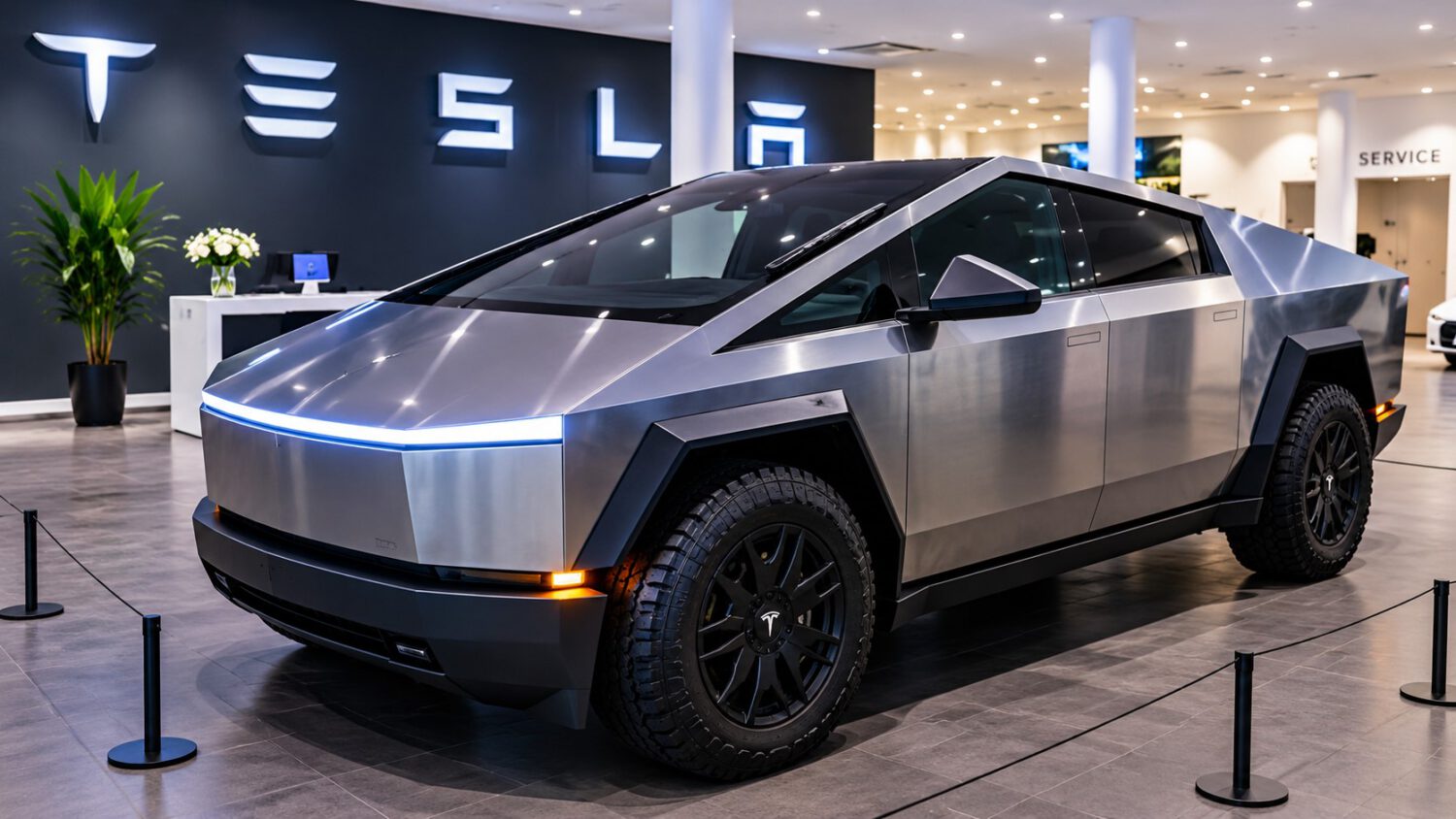
Elon Musk announced on X that Tesla will wind down Cybertruck production at Gigafactory Texas around the middle of 2027, freeing factory floor space for increased Cybercab output. This is a confirmed production wind-down at one site, not an official model cancellation, and Tesla has not stated whether manufacturing will move to another facility.
Tesla did not respond to Reuters’ request for comment sent outside regular business hours.
The Numbers Tell a Brutal Story
Sales fell to roughly 8 percent of Musk’s own forecast, placing the Cybertruck among the broader struggles of electric pickups.
Musk had previously forecast annual Cybertruck sales of 250,000 units. Kelley Blue Book data cited by Reuters shows 20,237 U.S. sales in 2025, down 48 percent from 38,965 in 2024, placing last year’s figure at roughly 8 percent of that target.
Automotive analyst Felipe Munoz noted that electric pickups from Ford and other manufacturers have also struggled to gain traction. That context places the Cybertruck’s performance within a broader segment weakness rather than as an isolated failure.
A Design That Boxed Itself In
The Cybertruck’s stainless-steel body generated attention at home while closing off major international markets.
The Cybertruck’s sharp-edged stainless-steel body was polarizing from its 2019 debut. A demonstration of its supposedly shatter-resistant windows left two panes visibly cracked, cementing early doubts about the vehicle.
Former Aston Martin CEO Andy Palmer said pedestrian-impact regulations made European approval impossible for the vehicle in its existing form, leaving Tesla heavily reliant on U.S. demand. Austin is the only known Tesla site equipped to produce the Cybertruck’s specialized components, leaving no obvious fallback factory if Tesla intends to continue the model elsewhere.
What Tesla Is Making Room For
The freed floor space is earmarked for the Cybercab, an autonomous vehicle Tesla envisions anchoring a global robotaxi network.
Musk framed the production shift in direct terms: “Tesla will be winding down production of the Cybertruck at Gigafactory Texas around the middle of next year to make room for increased Cybercab production.” The Cybercab is designed as an autonomous vehicle with butterfly doors and no steering wheel, pedals, or conventional mirrors.
Tesla began offering paid Cybercab rides in Austin in September 2026. The U.S. National Highway Traffic Safety Administration has since opened an Audit Query into whether the vehicle has properly self-certified compliance with federal motor-vehicle safety standards.
Cybertruck lead engineer Wes Morrill offered a note of continuity on X: “Cybertruck was an incredible technology development platform and lives on through Cybercab.”
What No One Has Answered Yet
Several key questions about the Cybertruck’s future and the Cybercab’s expansion remain publicly unresolved.
Tesla had not publicly clarified, as of publication, whether Cybertruck production will continue at a different facility or what spare-parts and service commitments will look like for existing owners. It has also not said when Cybercab will scale beyond Austin, and NHTSA’s Audit Query into Tesla’s self-certification remains an open regulatory question to monitor.