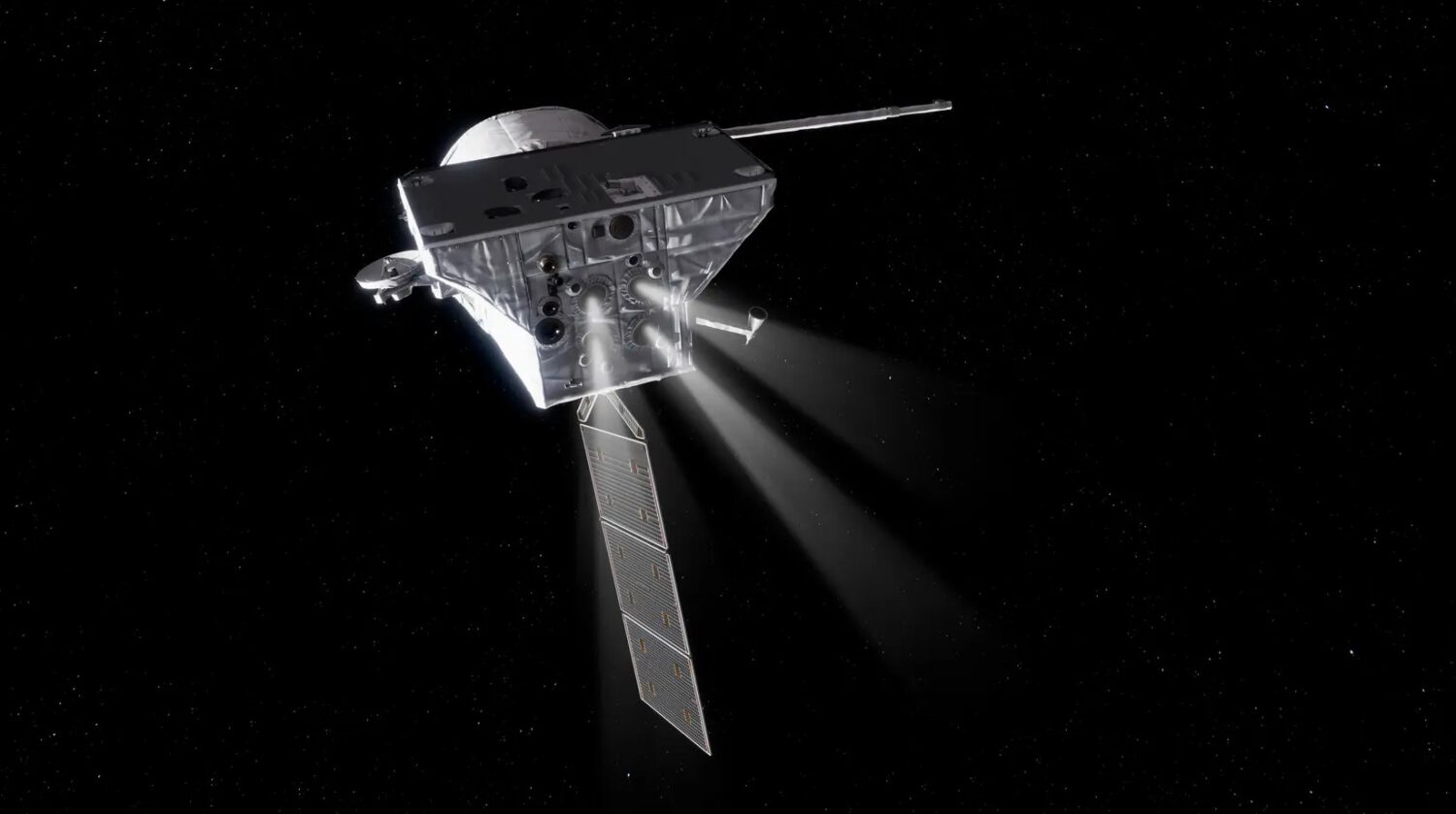
BepiColombo, the joint European Space Agency and Japan Aerospace Exploration Agency mission to Mercury, entered orbit around the planet on November 21, 2026, completing an eight-year cruise. It is only the second mission to orbit Mercury, following NASA’s MESSENGER, which operated there from 2011 to 2015. BepiColombo is the first mission to place two science orbiters around the planet simultaneously.
Slowing Down Was the Hard Part
A spacecraft traveling inward naturally gains speed, so reaching Mercury requires shedding energy rather than simply pointing toward the Sun.
BepiColombo used solar-electric propulsion, which converts sunlight into electricity to power ion thrusters, reducing the propellant needed for a long cruise. Gravity assists from Earth, the Moon, Venus, and Mercury across nine circuits around the Sun supplemented that propulsion, with six Mercury flybys progressively slowing the spacecraft before orbital insertion. Propulsion problems along the way pushed the original schedule back by 11 months.
A Hiccup at Arrival
A thruster burn ended earlier than planned, but the spacecraft arrived in a stable orbit with its science schedule intact.
ESA confirmed that the orbit-insertion burn cut short unexpectedly, attributing the cause to a software issue involving attitude guidance and thruster control. The spacecraft remained in a stable Mercury orbit, and the anomaly did not affect the planned separation timeline or MPO’s ability to reach its target science orbit, according to ESA. The current orbit is highly elliptical, stretching from approximately 590 to 11,640 kilometers above the surface.

Two Spacecraft, Two Jobs
The probes part ways in December, then settle into complementary orbits designed to study Mercury from two very different altitudes.
The two orbiters are scheduled to separate on December 9 or 10, 2026, depending on time zone. JAXA’s Mio will occupy a high elliptical orbit ranging from roughly 500 to 11,000 kilometers, positioned to sample Mercury’s magnetic environment and study how the planet’s magnetic field interacts with the solar wind. ESA’s Mercury Planetary Orbiter, known as MPO, will descend to a lower orbit between approximately 400 and 1,500 kilometers, with its target science orbit scheduled for March 2027.
Why Two Vantage Points Change the Science
Coordinated measurements from different altitudes could help scientists separate what Mercury generates from what the solar wind imposes.
Mio’s distant orbit will repeatedly cross Mercury’s magnetospheric regions, while MPO’s closer pass will observe the surface and probe signatures related to the planet’s interior. Measuring both simultaneously could help scientists distinguish changes driven by Mercury itself from those produced by the constantly shifting solar wind. MPO carries the Mercury Imaging X-ray Spectrometer, or MIXS, described as the first X-ray imaging instrument sent on an interplanetary mission. Mission scientists tested it during the cruise by observing the Crab Nebula, the remnant of a supernova recorded from Earth in 1054. Full science operations begin only after instruments complete commissioning, placing orbital insertion at the start of the mission’s central scientific phase rather than its conclusion.