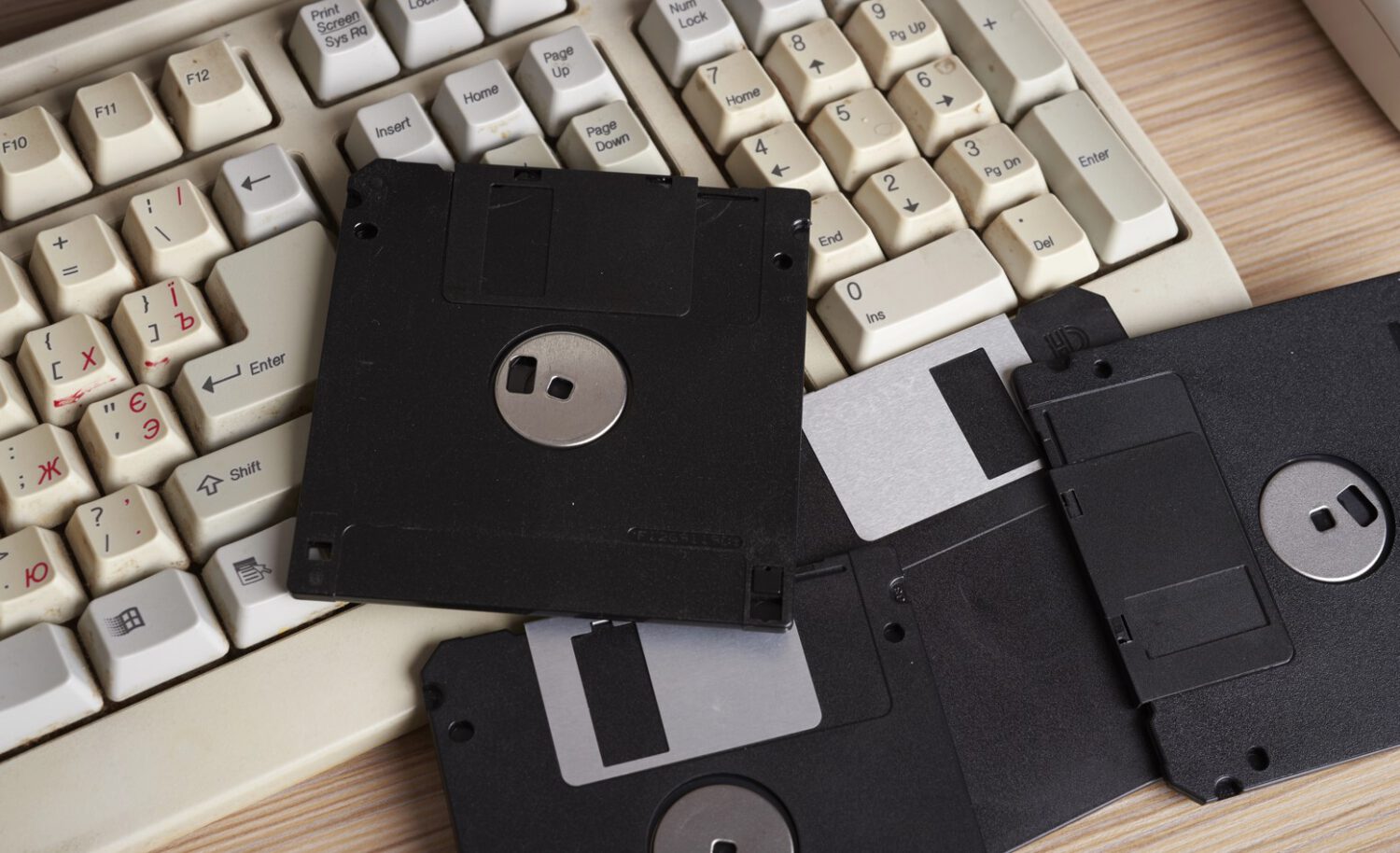
Developer WollyMonjac has released an open-source transformer-based question-answering model that fits on a standard 1.44 MB floppy disk. It executes under plain MS-DOS on Intel 486DX and Pentium hardware, with the complete program package sitting at approximately 435 KB according to the project’s GitHub repository.
Four Choices That Made the Footprint Possible
Narrow scope, a minimal architecture, and compressed weights each contribute to an unusually small footprint.
Tiny 2.1 is not modern AI squeezed into a smaller container. Four deliberate constraints make it fit on a floppy.
The first constraint is task scope: the model handles question-answering within a narrow training domain and nothing else. The second is character-level text processing. Rather than using the token-based approach common to contemporary language models, it reads and generates text one character at a time, reducing the need for a conventional large subword-token vocabulary.
The architecture itself is minimal: 367,000 parameters across four layers with a hidden width of 96. Finally, the model uses 8-bit quantized weights, meaning numerical values are stored at lower precision than standard floating-point representations. That compression cuts the trained model file to roughly 380 KB, with lower numerical precision than higher-bit alternatives.
The Runtime Catch
Fitting on a floppy and running on a machine are two different engineering problems.
Storage capacity and runtime memory are not the same thing. Executing Tiny 2.1 requires approximately 540 KB of free conventional DOS memory.
On 1990s machines, the operating system, hardware drivers, and device conventions consumed much of the available first megabyte, making that figure a genuine constraint. The project was written in Turbo C 2.0, consistent with the era of hardware it targets.
What the Model Knows and What It Invents
A reported test accuracy of approximately 61% reflects a system built for a narrow range of questions, not general use.
Training drew on approximately 3,500 facts, supplemented with small-talk and arithmetic examples, according to secondary coverage. Reported test accuracy is approximately 61%, a figure sourced from secondary reporting and not independently verified against the repository’s test set definition or evaluation criteria.
Outside its training distribution, the model fabricates answers confidently. Secondary coverage reports that the developer acknowledges this behavior, commonly called hallucination in language-model discussions, though the exact repository wording should be confirmed before treating the attribution as a direct statement. That characteristic makes Tiny 2.1 a useful demonstration of a known failure mode rather than a dependable information source.
The Interface Is the Point
A full-screen DOS UI with a neural activity monitor and PC-speaker output makes this a tangible system, not a benchmark curiosity.
The project ships with a full-screen DOS interface that includes a conversation-history pane, a prompt area, a neural activity monitor, function-key shortcuts, and optional text-to-speech through the PC speaker. Those features make it a demonstrable, interactive system rather than a set of benchmark numbers.
What the Project Actually Demonstrates
Transformer architecture carries no inherent GPU requirement; the scale of modern models is what drives one.
Tiny 2.1’s value is clarifying rather than practical. It shows that transformer architecture does not require modern GPUs or gigabytes of RAM by default. For those interested in AI-powered websites and tools, this distinction between architecture and scale offers useful context.
Scale in parameters, context window size, vocabulary, and training data is what drives those requirements, as larger models consistently illustrate. A constrained transformer, trained on a narrow corpus and engineered for 1990s hardware, can run on a 486DX. That is a precise and supported claim. It is not a blueprint for compressing a frontier model onto a floppy disk.