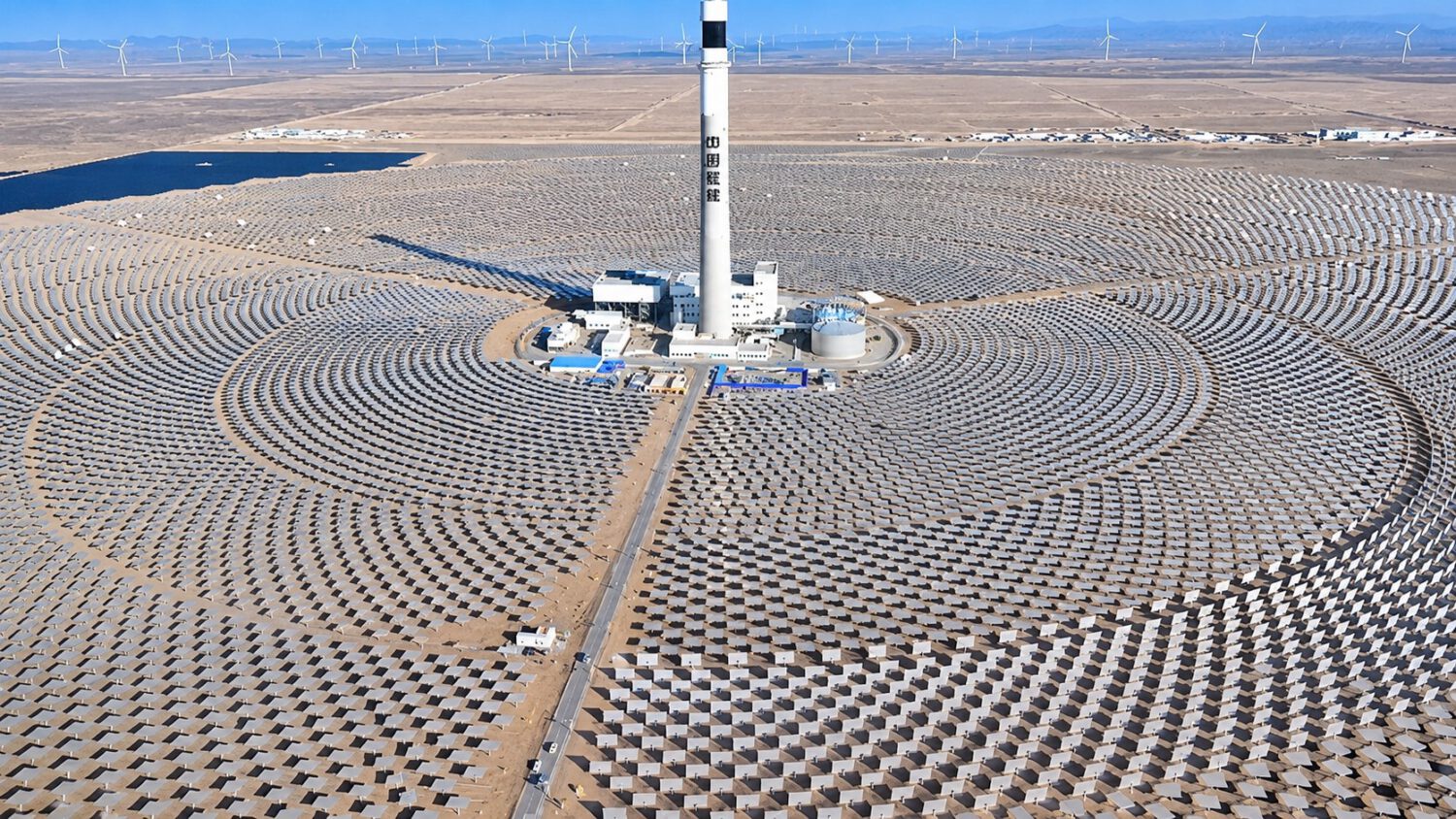
Solar panels go dark at sunset, but electricity demand does not, and China is deploying a technology designed to close that gap.
That mismatch is the central challenge of large-scale solar deployment. China is addressing it by pairing photovoltaic installations with concentrated solar power (CSP) tower plants across the Gobi Desert and Xinjiang’s arid northwest.
Mirrors, Molten Salt, and a Very Tall Tower
CSP plants store heat rather than electricity, and that distinction changes what they can do on the grid.
A CSP tower plant works through a field of heliostats: thousands of large, computer-controlled mirrors that continuously track the sun and focus its light onto a receiver mounted atop a central tower. The concentrated heat transfers into molten salt circulating through the receiver.
That hot salt moves into insulated storage tanks, acting as a thermal reservoir that holds energy as heat rather than electric charge. When the grid needs power, the stored heat generates steam to drive a conventional turbine, producing electricity hours after the sun has gone down.
Desert Logic: Why Xinjiang and Gansu
Extreme solar irradiance, sparse population, and available land make China’s northwest the practical choice for these installations.
The Gobi and surrounding desert regions offer strong solar resources, with relatively low cloud interference and room for the sprawling mirror fields these plants require. Many newer projects are being developed as components of integrated renewable-energy bases that combine PV, wind, and CSP on a single site.
The capacity numbers can be misleading at first glance. PV installations typically dwarf CSP in raw megawatts, but CSP’s value lies in timing: it gives operators greater control over when electricity can be delivered to the grid, not just how much total energy the site can produce.
Two Projects, Verified
Bole-Jinghe and Jinta offer the clearest confirmed picture of what China’s hybrid desert model looks like in practice.
The Bole-Jinghe integrated energy base in Xinjiang combines 1.8 GW of photovoltaic capacity with two 100 MW molten-salt tower CSP plants, bringing total installed capacity to 2 GW. According to SolarPACES, the first tower connected to the grid in July 2026 and the second followed on November 22, 2026, completing the base’s full configuration. The projects are reported to include eight-hour molten-salt storage systems.
At Jinta Zhongguang in Gansu, a 100 MW tower plant deploys 25,594 heliostats across roughly 770,000 square meters of solar-field area. That is approximately the size of 108 standard football fields, according to Gansu government records and heliocon.org. The receiver center is listed at approximately 220 meters above ground, with molten salt serving as both the heat-transfer fluid and storage medium.
Dunhuang, also in Gansu, is another established CSP tower location in the region. Detailed project specifications there require confirmation from an authoritative primary source before citation.
Shifting from Plants to Systems
Dispatchable solar storage represents a design philosophy, not just a technology choice.
CSP storage can shift solar generation into evening demand periods without relying solely on electrochemical batteries. These hybrid desert bases reflect a broader strategic direction in Chinese energy development: coordinating storage, transmission, and complementary generation types rather than building isolated power plants.
The Engineering Is Not Simple
Dust, distance, and heat loss present real costs that these projects must continue to manage.
Heliostat fields are expensive to build and require consistent cleaning in the same dusty desert conditions that make these sites attractive. Heat loss through storage and piping, molten-salt reliability over long operating cycles, and the distance between remote Xinjiang generation sites and eastern population centers remain recognized friction points for the technology and for the broader grid-integration challenge these projects represent.