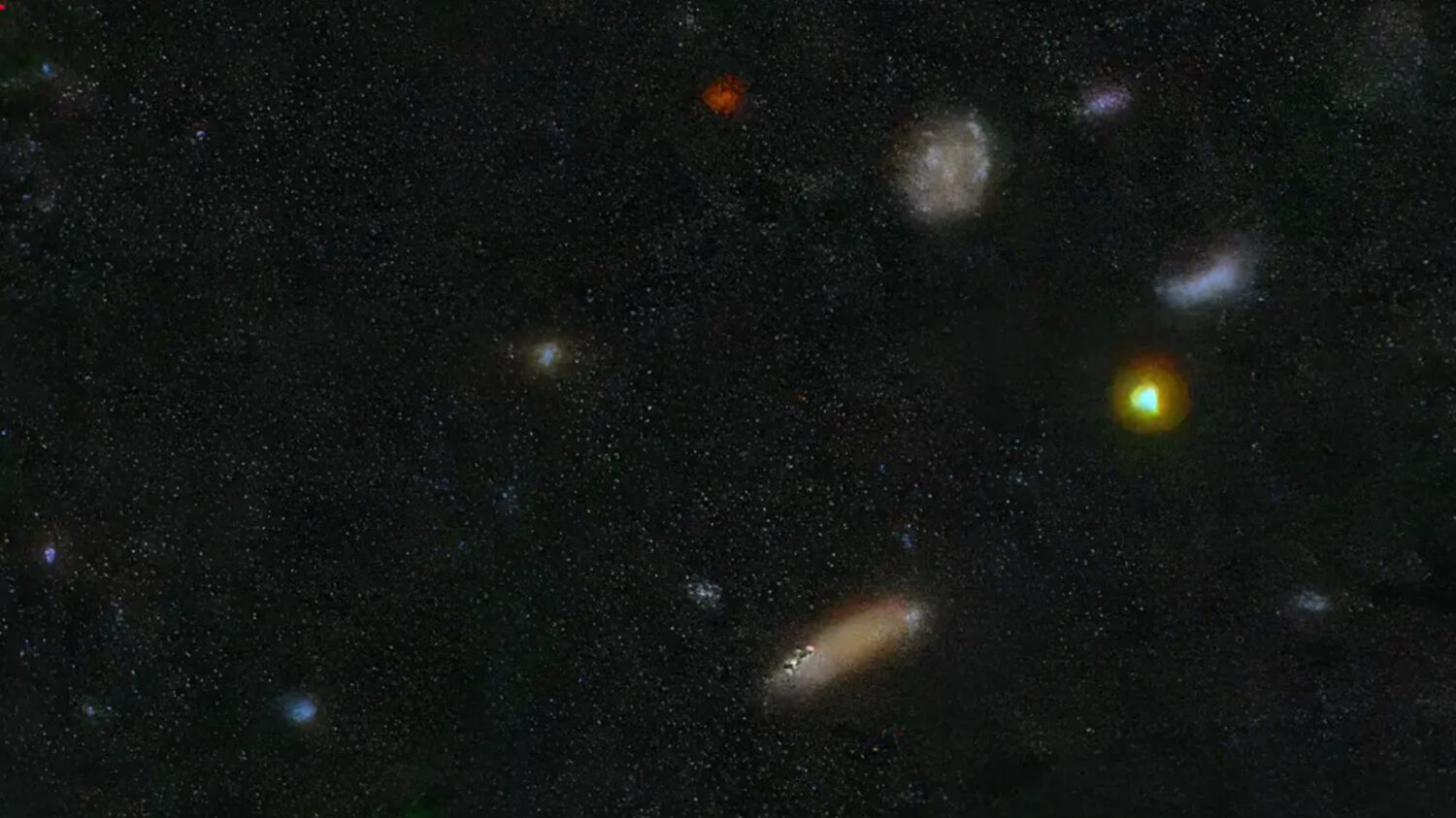
ESA’s Euclid telescope has confirmed the most distant quasar ever observed, and the physics behind it are forcing astronomers to rethink how supermassive black holes form.
A Record Set in Deep Time
A single discovery is rewriting the timeline for how the universe’s largest black holes came to be.
Astronomers have confirmed the most distant quasar ever observed: a luminous object designated J1504+6252 and nicknamed Dún Aonghasa, whose light has traveled roughly 13.1–13.2 billion years to reach Earth. At that moment, the universe was approximately 630 million years old, about 4.6% of its current age.
The core puzzle is immediate. A black hole weighing roughly 360 million times the mass of the Sun had already formed, and standard models struggle to account for that much mass accumulating that fast.
What a Quasar Actually Is
A quasar’s extraordinary brightness comes from the violent process of matter falling into a supermassive black hole.
A quasar is the intensely bright core of an active galaxy, powered by gas and other material spiraling into a supermassive black hole. Silvia Belladitta, a co-author on the study from the Max Planck Institute for Astronomy and INAF Bologna, described the process in reported comments attributed to Reuters: “As enormous amounts of gas, dust and matter fall toward the black hole, they form a swirling accretion disk that heats up to extreme temperatures and radiates tremendous amounts of energy, outshining the entire rest of the galaxy by factors of hundreds or even thousands.”
That luminosity is a primary reason quasars can be detected across billions of light-years.

How the Discovery Unfolded
Euclid identified the candidate, and a network of ground- and space-based observatories confirmed it.
ESA’s Euclid space telescope first flagged Dún Aonghasa as a candidate during its wide-field imaging survey. Follow-up observations from the Keck Observatory, the Hubble Space Telescope, the Large Binocular Telescope, and the James Webb Space Telescope established its redshift and physical properties, though the precise contribution of each facility should be confirmed against the final published paper.
The research was led by astronomer Julien Wolf of the European Southern Observatory, with Belladitta among the scientists involved in follow-up analysis. The findings were published in Astronomy & Astrophysics under the title “Euclid: Discovery of Dún Aonghasa, a quasar at z = 8.13 hosting a 360-million-solar-mass black hole.”
Wolf described the finding in reported comments attributed to Reuters: “Just 630 million years after the Big Bang, this black hole had already grown to about 360 million times the mass of the sun and was shining as a quasar.”
Euclid was designed to study dark matter and dark energy. This quasar emerged as a product of its broad survey imaging rather than a targeted search.
Understanding the Redshift Record
A redshift of 8.13 makes Dún Aonghasa the first confirmed quasar observed beyond the redshift-8 threshold.
Redshift measures how much a light wave has stretched during its journey through an expanding universe; a higher number corresponds to greater distance and an earlier point in cosmic history. The discovery pushes the quasar distance record roughly 40 million years earlier than the previous record holder.
Why the Size Creates a Problem
The black hole’s mass at this epoch places tighter constraints on standard formation models.
Under one conventional black-hole formation pathway, massive stars collapse into relatively modest black holes, which then grow incrementally through gas accretion and mergers. For context, the Milky Way’s central black hole weighs roughly 4 million solar masses; Dún Aonghasa’s was already about ninety times heavier at an era when the universe had barely begun. Reaching 360 million solar masses in 630 million years strains those constraints severely.
Dún Aonghasa adds evidence for an alternative: the direct collapse of massive gas clouds into heavy black-hole seeds, which would give early black holes a much larger starting mass. One object does not confirm a formation route. What the discovery does is tighten the constraints on competing models and place additional pressure on scenarios relying solely on ordinary stellar-remnant seeds.
What Comes Next
Continued study of Dún Aonghasa’s host galaxy may clarify whether this object is an outlier or a sign of a broader population.
Researchers say further study of the quasar’s host galaxy and surrounding environment could reveal whether it formed in an unusually dense region of the early universe or represents a wider population of rapidly growing black holes from that era. Much like Airborne LiDAR surveys that have rewritten human history by uncovering hidden civilizations, instruments like Euclid are rewriting cosmic history by revealing objects that challenge established timelines.