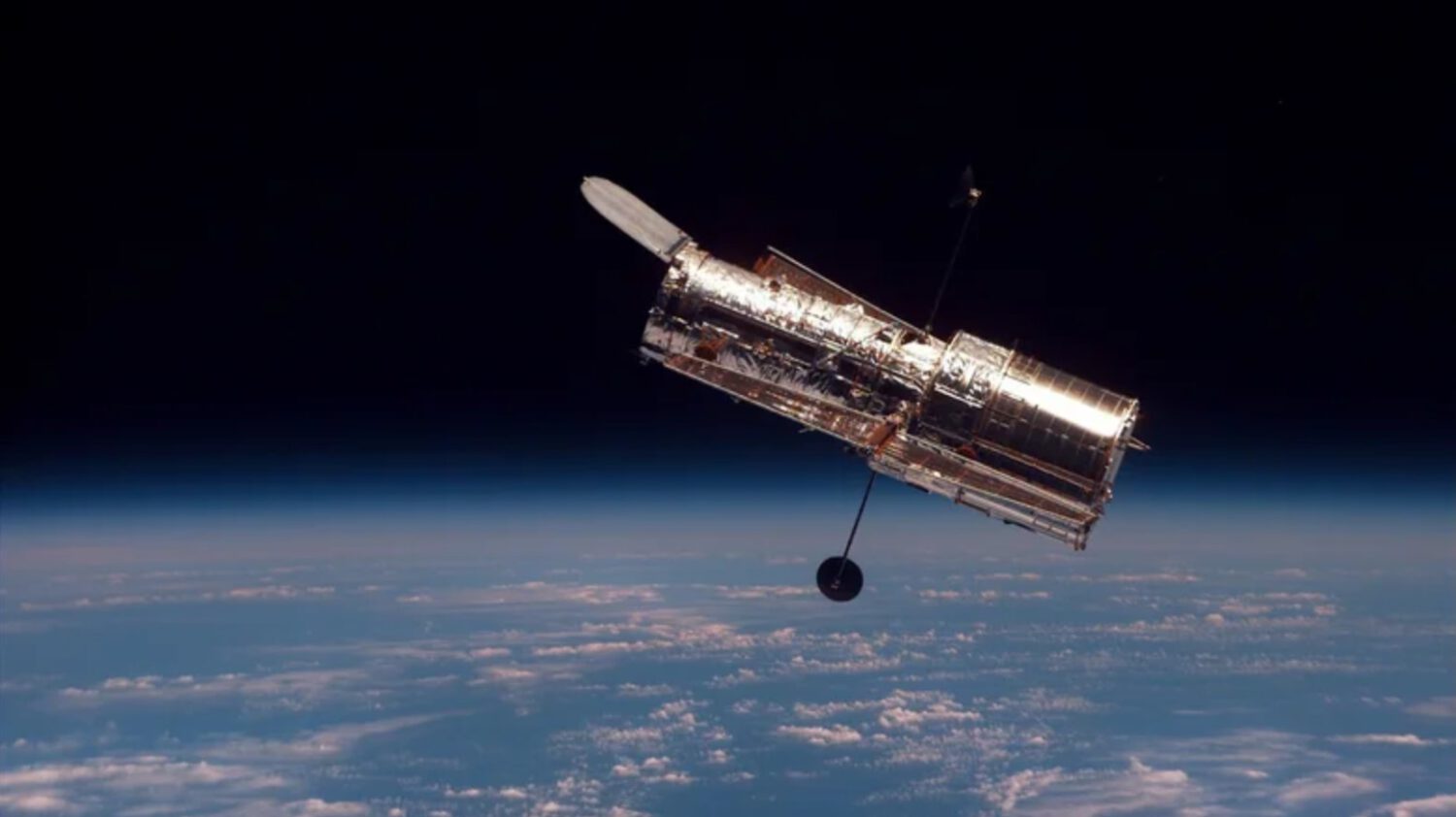
Hubble Space Telescope is falling. Not dramatically, not all at once, but steadily, orbit by orbit, pulled incrementally lower by atmospheric drag. Without intervention, NASA projects reentry somewhere around 2033 or 2034, and any mission capable of preventing that outcome needs to launch, rendezvous, and execute by approximately 2032.
NASA’s response is a Request for Information, not a rescue announcement. The agency issued the RFI asking private companies to submit ideas by 3 p.m. Eastern on November 30, 2026. It is an exploratory information-gathering exercise, and no mission has been selected, approved, or funded.
Three Options on the Table
NASA is not committed to a rescue; the RFI asks industry to weigh in on three distinct paths, including a managed end of mission.
The RFI identifies three distinct possibilities for Hubble’s future. The first is a boost mission: capture the telescope and push it to a higher orbit above Earth. The second is in-orbit servicing, which could mean repairing aging systems or upgrading scientific instruments.
The third option is a controlled disposal, a managed reentry if neither of the first two proves practical. By framing the request around all three possibilities, NASA is asking industry to report what is actually feasible before the agency commits to a path.
Why There Is No Easy Fix
Hubble has no propulsion system of its own, and the Space Shuttle that once serviced it no longer exists.
Hubble was not designed to maintain its own orbit. It carries no propulsion system capable of counteracting atmospheric drag, and solar activity fluctuates in ways that alter the drag rate and can shift the reentry timeline in either direction. The telescope depends entirely on external intervention to change its altitude.
The last time anyone intervened was 2009, when Space Shuttle astronauts conducted a final servicing mission. The Shuttle fleet has since been retired. Any modern mission would require a commercial spacecraft capable of approaching, capturing, and stabilizing an aging observatory that was never designed for routine commercial servicing.
The Administrator’s Prior Involvement
Jared Isaacman explored a Hubble reboost concept before becoming NASA administrator, and he is now broadening that effort to the full commercial sector.
NASA Administrator Jared Isaacman is not new to this problem. In 2022, while leading the Polaris Program, he participated in a study examining whether a SpaceX Crew Dragon mission could boost Hubble to a higher orbit. That study did not result in an announced operational mission.
As NASA administrator, Isaacman is now broadening the ask to the entire commercial sector. He has stated that Hubble “still has important science ahead of it” and that extending its life could generate “more discoveries, more science, and more opportunities to expand our understanding of the universe,” according to NASA.
Webb Did Not Make Hubble Obsolete
Hubble and the James Webb Space Telescope observe different parts of the electromagnetic spectrum, making them complementary rather than interchangeable.
The James Webb Space Telescope is extraordinary, but it does not replace Hubble. Webb’s primary strength is infrared observation, allowing it to peer through dust clouds and study the early universe in ways previously impossible. Hubble observes ultraviolet and visible light, parts of the electromagnetic spectrum where Webb’s capabilities do not replicate what Hubble provides.
The two observatories are complementary rather than redundant. Losing Hubble would create a genuine capability gap in ultraviolet astronomy even if Webb continues operating at full capacity. That distinction matters for understanding why NASA is treating a potential rescue mission as worth serious consideration.
Hubble has completed more than 1.7 million observations and contributed to more than 23,000 scientific papers. Its data helped provide key evidence that the universe’s expansion is accelerating and supplied foundational evidence that supermassive black holes are common at the centers of large galaxies. It also revealed thousands of previously unseen galaxies through deep-field imaging and contributed to research on the atmospheres of planets orbiting other stars.
If No Rescue Materializes
A failure to extend Hubble’s life would not end space-based astronomy, but it would permanently close a decades-long scientific record with no direct replacement.
A failure to extend Hubble’s operational life would not end space-based astronomy. Newer observatories would continue operating, and the scientific community would adapt. It would, however, permanently retire a uniquely productive ultraviolet-and-visible-light platform with a decades-long record of scientific output.
If no viable extension mission emerges, NASA’s RFI explicitly permits industry to propose a controlled disposal: a managed reentry designed to minimize risk rather than leaving Hubble to come down on an uncontrolled trajectory.
A Test Case for Commercial Orbital Servicing
Hubble’s situation raises a question that will recur as more legacy government spacecraft age past their design envelopes.
Hubble’s situation points toward a broader question that will not fade as more legacy government spacecraft age out of their design envelopes. Can commercial providers perform complex orbital servicing on assets that were never designed for it? The answer, whatever industry proposes, will shape how NASA and other agencies think about preserving future observatories.
For now, the next step is straightforward. NASA will receive responses by the November 2026 deadline, and every decision about Hubble’s future follows from what industry actually submits.