Up to 200,000 people could soon be submitting their health questions to an AI and helping researchers understand what happens next. Apple has launched the Apple Health AI Usage Study, a virtual U.S. research program examining how ordinary people use, comprehend, and respond to conversational AI chips for health information.
What the Study Actually Is
Apple built this program in partnership with OpenEvidence, a clinical AI platform, and delivers it through a dedicated iPhone app.
The program is conducted with OpenEvidence, a clinical AI platform that draws on peer-reviewed medical literature, according to Apple. Participants access the study through a dedicated iPhone app rather than through the standard Health app or Siri.
Who Can Join
Eligibility is narrow: you need a recent iPhone, a U.S. address, and to be at least 21 years old.
To participate, you must be a U.S. resident aged 21 or older. You also need an Apple Intelligence-compatible iPhone, starting with the iPhone 15 Pro, running iOS 26 or later.
What Participants Do
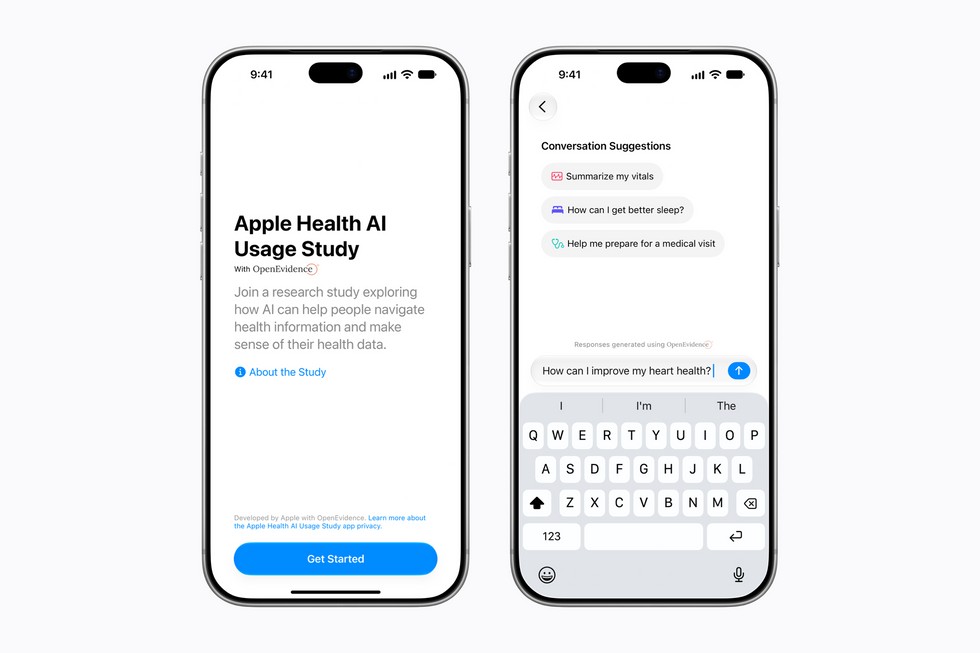
Participants ask everyday health questions in plain language and receive answers tied to peer-reviewed medical research.
Enrolled participants submit health questions through the app and receive responses written in accessible language, with links to supporting peer-reviewed research. According to Apple, the study may also examine whether AI helps people prepare for conversations with doctors.
Three Things the Study Measures
Answer accuracy is only one part of what researchers want to know.
The study tracks three areas: the technical quality of AI responses, whether users actually understand those responses, and what participants do afterward. That behavioral layer sets this apart from a simple accuracy audit.
Optional Health Data Sharing
HealthKit participation is voluntary, and Apple says the data will not feed AI training.
Participants can choose to share HealthKit data, including activity, sleep, resting heart rate, and laboratory results. Apple states that study data will not be used to train AI models. Readers considering enrollment should review the full consent and data-retention terms before deciding.
What the App Cannot Do
Safety prompts exist, but they do not replace a clinician or eliminate real risk.
Per Apple’s study materials, the app is not intended to diagnose or treat medical conditions and does not substitute for advice from a qualified healthcare professional. The app includes safety prompts designed to direct users toward professional care when questions raise concern. Those prompts do not eliminate the possibility that someone delays treatment after reading a general AI response.
Who the Study Leaves Out
The eligibility requirements mean findings will reflect a narrow slice of the population.
Android users, non-U.S. residents, people under 21, and owners of iPhones older than the 15 Pro are ineligible for this study. Because participation requires recent, premium hardware, results may overrepresent people with newer iPhones and greater technology access rather than reflecting the general public.
What Apple Might Do With the Results
No product announcement has been made, but the scale of this study is not accidental.
A dataset drawn from up to 200,000 participants could give Apple substantial evidence about how consumers interact with health AI. Apple’s announcement described the work as intended to inform responsible health-AI design for Apple and the broader industry, though no consumer product rollout was announced.
The Actual Point of This Research
Apple is studying how health AI should be designed and used responsibly, not declaring that an AI chatbot is ready to practice medicine.
This study is a research program, not a clinical service. The central question, as Apple frames it, is whether people can use AI health information responsibly and under what conditions that becomes possible. That question, by Apple’s own account, does not yet have a settled answer. What the study’s findings eventually reveal could shape how AI health tools are built across the industry. In the meantime, any responsible user should treat AI health responses as a starting point for a conversation with a clinician, not a substitute for one.