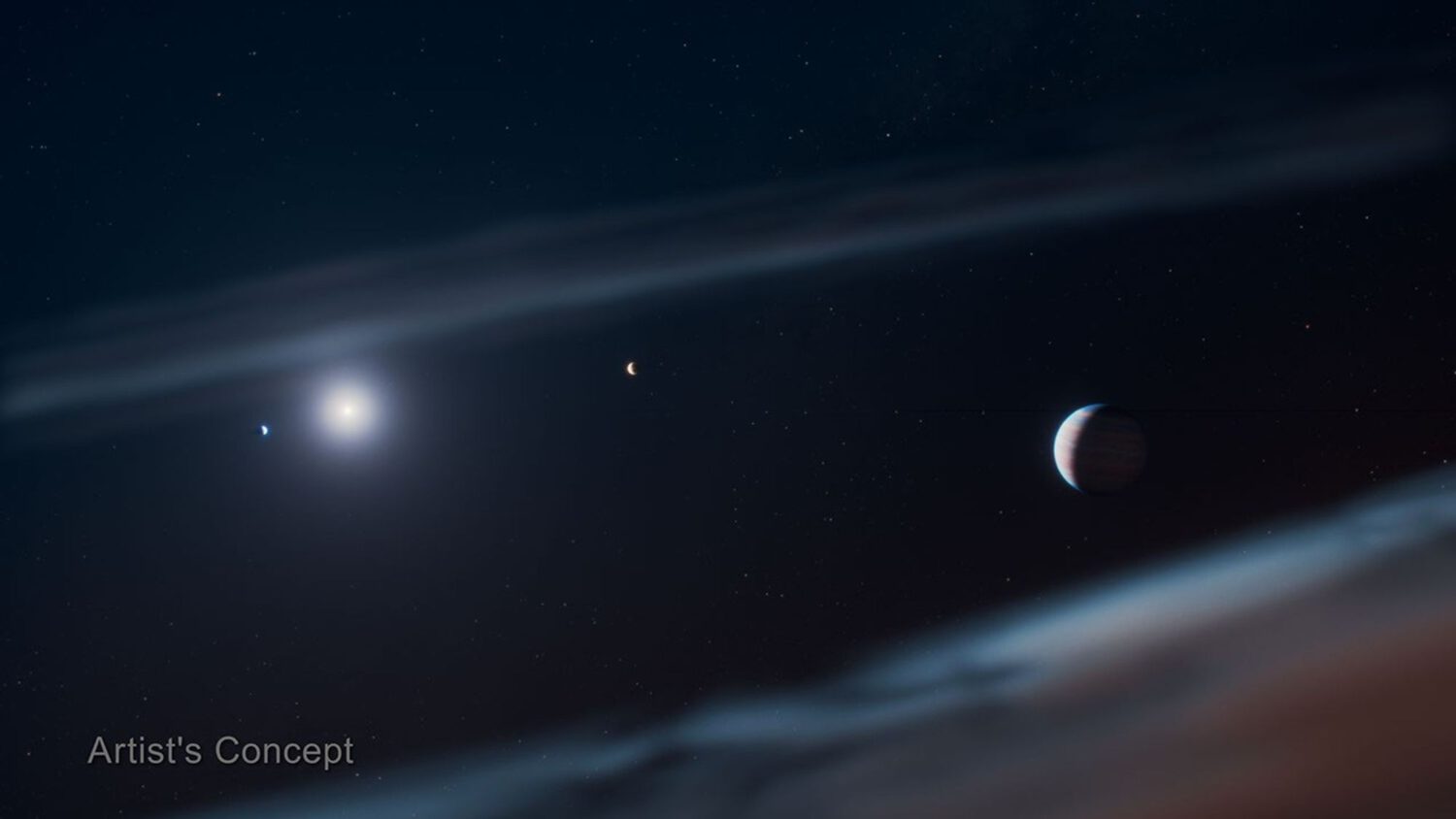
Astronomers were mapping the atmosphere of a planet they already knew when a pattern of molecular signals appeared where none was expected. That accidental discovery turned out to be Beta Pictoris d: a giant planet estimated at a minimum of twice Jupiter’s mass, orbiting roughly 30 astronomical units from its star, in a system sitting 63 light-years from Earth. NASA’s James Webb Space Telescope played a central role in the detection, and the method it used may matter as much as the planet itself.
A Young, Dusty System With a Complicated Past
Beta Pictoris was already a closely watched system before this discovery, and its structure helps explain why finding a third planet there was both significant and difficult.
Beta Pictoris is a star system roughly 23 million years old, already known to host two giant planets, designated b and c. Its bright debris disk, a wide band of dust and rocky material left over from planet formation, makes it one of the most studied young systems in astronomy. That same disk scatters light from the star, creating a cluttered visual environment where conventional direct imaging can struggle to detect planets.
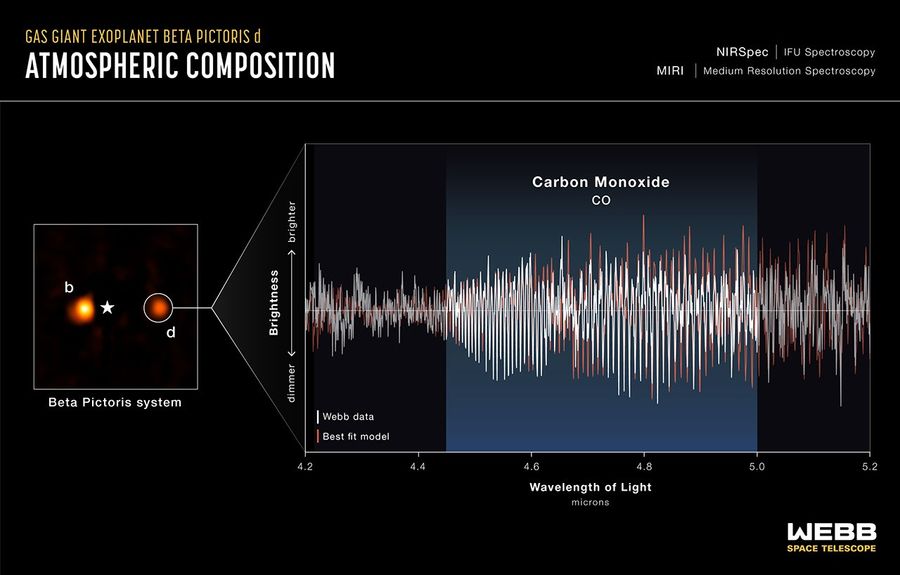
Image: NASA, ESA, CSA, STScI, Leah Hustak (STScI); Science: Aidan Gibbs (UC San Diego), Jean-Baptiste Ruffio (UC San Diego), Alexis Bidot (STScI); Image Processing: Alyssa Pagan (STScI)
The Signal Nobody Was Looking For
The discovery began not with a deliberate search but with an unexpected pattern in data collected while studying a different planet entirely.
Lead author Aidan Gibbs, a postdoctoral researcher at the University of California, San Diego, described the moment plainly: “We weren’t looking for a new planet. We were trying to understand one we already knew existed. Then, this telltale signal appeared in the data where we didn’t expect it.”
Webb’s NIRSpec instrument operates through its Integral Field Unit, which records both a spatial image and a full spectrum for every pixel it observes. While the team analyzed Beta Pictoris b’s atmosphere, a pattern of carbon monoxide absorption lines appeared at an unexpected location in the data. Those lines, repeating in a narrow, recognizable sequence, form what researchers describe as a chemical fingerprint or atmospheric “barcode.”
What a Spectrum Actually Tells You
Spectroscopy supplied not just a chemical identification but also the motion data needed to confirm the signal was a planet in orbit rather than a background object or dust structure.
Spectroscopy works by spreading light into its component wavelengths; different molecules absorb specific wavelengths and leave distinct gaps that identify their presence. Jean-Baptiste Ruffio, a research scientist at UC San Diego and principal investigator of the initial Webb observations, described the advantage directly: “A spectrum contains an incredible amount of information. You don’t just learn that something is a planet; you immediately begin learning about its temperature, chemistry, and motion.”
Confirming the signal as a planet rather than a dust clump or background star required additional steps. Doppler shifts in the spectral lines revealed the object’s radial velocity, its speed moving toward or away from Earth. That velocity, combined with its position and alignment with the debris disk, matched the behavior of an object in orbit around Beta Pictoris. Follow-up observations using Webb’s MIRI instrument then detected water vapor and methane, adding further atmospheric evidence supporting the identification.
Size, Orbit, and What the Planet May Be Doing
Beta Pictoris d is the lightest of the system’s three known giant planets, and its location inside the debris disk raises questions about its role in shaping that structure.
Beta Pictoris d is estimated at a minimum of twice Jupiter’s mass, making it the smallest of the three known giant planets in the system. Its orbit sits at approximately 30 astronomical units from its star, a distance comparable to Neptune’s distance from the Sun, and the widest orbit among the trio. It sits just inside the inner edge of the debris disk, and researchers hypothesize that its gravitational influence may help explain that disk’s sharply defined boundary and other structural features.
Independent Detection and Publication
A second research team, working with ground-based and space-based instruments, reached the same conclusion through a different observational approach.
A separate study used ESO’s Very Large Telescope, including its ERIS instrument, along with archival VLT data and Webb’s NIRCam instrument to detect Beta Pictoris d independently. That team was led by researchers from the University of Edinburgh and the European Southern Observatory. Both studies were published in the Astrophysical Journal Letters, and Beta Pictoris is now only the second planetary system known to contain at least three directly imaged planets.
Why the Detection Method Reaches Beyond This System
The technique used to find Beta Pictoris d points toward a broader capability for locating planets in environments where conventional imaging falls short.
In systems with bright debris disks, conventional direct imaging struggles because dust and scattered starlight can mimic or bury a planet’s faint signal. Atmospheric spectroscopy offers a different route: molecular absorption features are specific enough to help distinguish a planetary signal from dust artifacts, even in a visually crowded field, though the technique’s broader applicability will depend on future observations.
Researchers plan additional analysis of Webb’s existing observations to refine Beta Pictoris d’s mass, temperature, full atmospheric composition, and orbital eccentricity. Those measurements could clarify how the planet formed and how it continues to interact with the surrounding disk. The more immediate implication is methodological: studying one planet’s chemistry led to the accidental discovery of another, and that approach could potentially become a repeatable tool for finding worlds that conventional imaging has consistently missed.