Reaching remote clinics with intact vaccines is less like logistics and more like a relay race where the baton is a vial that spoils at room temperature. Dhruv Chaudhary, Mithran Ladhania, and Mridul Jain, students at Shishukunj International School in Indore, Madhya Pradesh, were 16 and 17 when they decided to address that problem directly.
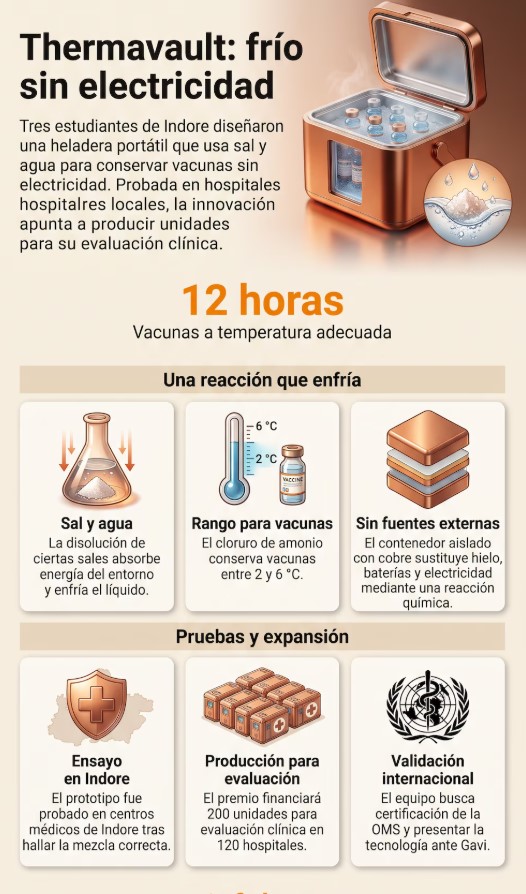
Their answer is Thermavault: an insulated plastic shell with a copper-lined inner chamber and an ammonium chloride solution sealed between the walls, requiring no electricity, no ice, and no battery.
The Science Behind the Salt
The device uses an endothermic dissolution process to draw heat from the inner chamber without any external power source.
When ammonium chloride dissolves in water, it absorbs heat from the surrounding environment, an endothermic process that pulls the inner chamber temperature down toward the 2–6°C range associated with many vaccine storage requirements. That range does not apply universally to every vaccine product, and temperature alone does not confirm suitability for any specific formulation.
The students did not simply reach for the first salt available. According to India Today, they screened roughly 150 candidate salts and narrowed the field to approximately 20. The most promising options were then tested at Indian Institute of Technology laboratories before the team settled on ammonium chloride for the 2–6°C application.
Recharging the system does not require a freezer. After use, the spent solution is heated to evaporate the water, the recovered salt is dissolved again in clean water, and the device is ready for another cycle, though practical purity and performance after repeated cycles have not been independently established.
What the Hospital Tests Showed
Participating medical personnel reported that the device held its target temperature range for 10 to 12 hours, though those results have not been independently validated.
Preliminary field testing at hospitals in Indore reportedly maintained the target temperature range for 10 to 12 hours, according to participating medical personnel, as reported by Education Times. Those results are early-stage and should not be read as confirmation by any regulatory body.
A physician involved in the evaluation suggested integrating a built-in temperature sensor, a practical addition that would allow health workers to verify conditions in real time rather than assume them.
The Award, the Grant, and the Road Ahead
The Earth Prize recognized Thermavault as its 2025 Asia regional winner and provided funding to begin a wider evaluation.
The Earth Prize named Thermavault the Asia regional winner for 2025, along with a grant of US$12,500. The team plans to use that funding to manufacture approximately 200 units for evaluation across 120 hospitals.
Their stated targets beyond that evaluation include WHO Performance, Quality and Safety certification and a presentation to Gavi, the international vaccine alliance. The students also tested barium hydroxide octahydrate, which reportedly reached sub-zero temperatures in controlled conditions. That raises the possibility of applications beyond vaccine transport, though further biomedical and regulatory work is needed before those claims carry weight.
Promising Prototype Is Not the Same as Certified Device
A meaningful preliminary result is still a long distance from the validated performance that large-scale immunization programs require.
Holding 2–6°C for 10 to 12 hours in a preliminary hospital setting is a meaningful early result. It is not sufficient evidence for large-scale cold-chain deployment on its own.
Before Thermavault could serve major immunization programs, it would need validated temperature uniformity across varied ambient conditions, contamination risk assessment, and material safety review. Repeatability data across many charging cycles is also required. Certification is the decisive milestone, not the prize.