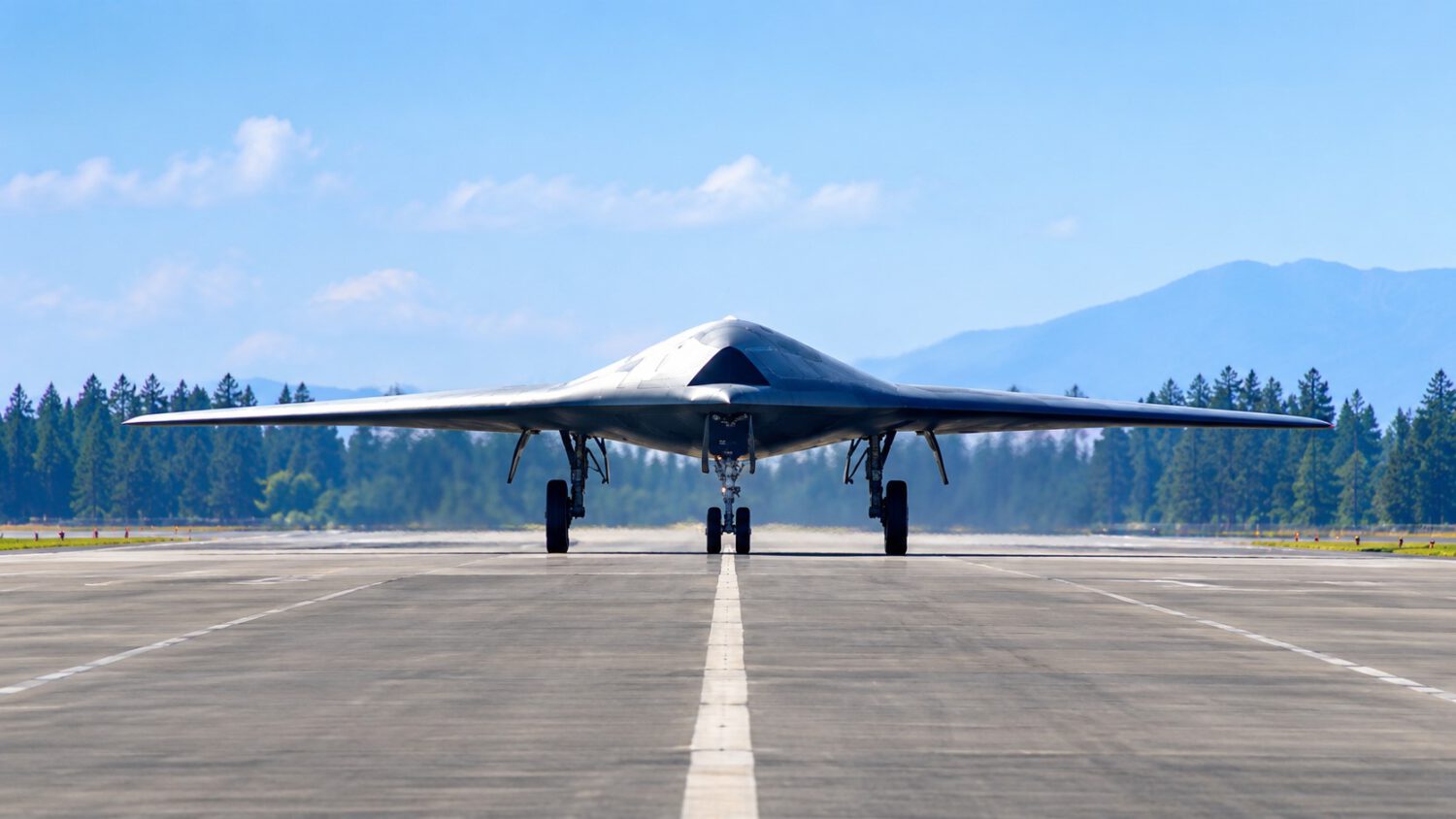
A Nov. 9, 2026 CCTV broadcast showed China’s GJ-11 “Xuanlong” stealth uncrewed combat aerial vehicle from multiple angles across a range of flight and ground sequences. Viewers could see the aircraft’s underside, rear fuselage, upper surfaces, and nose in enough detail to confirm several structural features that were previously a matter of outside assessment rather than documented fact.
The footage confirms two internal ventral weapons bays fitted with serrated-edge doors, a configuration that avoids the external pylons and stores that would generally increase radar signature and aerodynamic drag. A trapezoidal fairing beneath the nose is consistent with an electro-optical/infrared sensor installation, though its specific capabilities were not disclosed. CCTV stated the bays can carry a variety of air-to-surface munitions, but did not disclose bay dimensions, payload capacity, or which weapons have been integrated.
The airframe’s dorsal intake and flattened, shielded upper-rear exhaust are consistent with efforts to reduce radar and infrared signatures. A takeoff sequence shows retractable landing gear, including a twin-wheel nose unit, retracting cleanly after liftoff. Footage alone cannot establish the aircraft’s measured observability; the design features are suggestive, not definitive.

A Live-Fire Claim With Gaps
CCTV reported a successful first live-fire strike mission, but provided no date, location, target type, or weapon identification.
CCTV reported that the GJ-11 completed its first live-fire strike mission and hit its target. The broadcast identified operators Shi Xiaoran and Fu Ting as members of the People’s Liberation Army Air Force’s initial cohort of female drone operators. According to CCTV reporting cited by Janes and Global Security, Shi described cloud cover obscuring the target during the first pass; the aircraft circled, located the target, and released its weapon successfully on the second approach.
The report provides no date, location, target type, or weapon identification. Outside analysts note the program’s prior test history makes the phrase “first live-fire strike” difficult to interpret precisely. The phrase may refer to a specific weapon system, sensor mode, operational unit, or test phase rather than the program’s first weapons-related event overall.
A successful operator-directed strike, as described by CCTV, demonstrates weapons employment under human control. It does not establish autonomous target recognition, independent target prioritization, or fully independent tactical decision-making.
Flying With the Fighter Fleet
CCTV footage placed GJ-11s in mission-planning sequences with J-16 and J-20 fighters, offering the clearest public depiction yet of intended manned-unmanned teaming.
CCTV footage showed GJ-11s appearing in mission-planning sequences alongside Shenyang J-16 multirole fighters and Chengdu J-20 stealth fighters. In such formations, GJ-11s could carry weapons into defended airspace, extend the formation’s sensor coverage, or conduct suppression of enemy air defenses while crewed aircraft manage broader tactical coordination. The footage does not disclose the communications architecture, datalink architecture, or degree of autonomy available to the aircraft during teaming operations.

A Program on the Move, With Much Still Hidden
The latest footage strengthens the case for a maturing program, but leaves fleet size, operational capability, and core systems questions unresolved.
The GJ-11’s public history runs from the earlier Sharp Sword demonstrator through its appearance in China’s October 2019 National Day parade and a November 2025 PLAAF release showing the aircraft flying alongside a J-20 and a J-16D electronic-warfare platform. Satellite imagery reviewed by The War Zone documented repeated GJ-11 activity at the Malan test facility in Xinjiang, and three aircraft were reportedly observed at Shigatse, Tibet, between August and September 2025.
Chinese state media have also reported a launch-and-recovery milestone for the naval GJ-21 derivative aboard the Type 076 amphibious assault ship Sichuan, though that event has not been independently verified. The Nov. 9 broadcast strengthens the case that the GJ-11 has moved beyond a purely experimental prototype toward operational evaluation. It does not establish fleet size, initial operating capability, or sustained deployment, nor does it confirm whether China has resolved the harder systems challenges: reliable networking, resilient command and control, and effective autonomy in a contested electromagnetic environment.