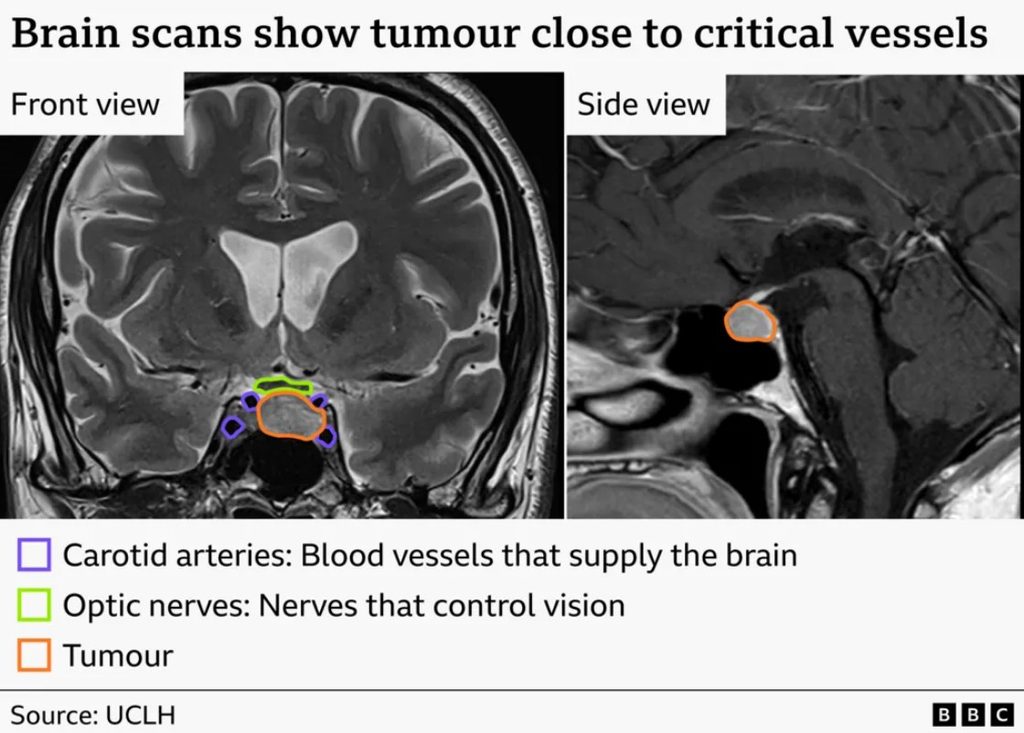
Rhys Hibbert, 48, from Bedfordshire, was out walking when he had a seizure. Imaging afterward found an approximately 11mm tumour on his pituitary gland, a small structure at the base of the brain that regulates hormones and sits close to the optic nerves.
The tumour was pressing on those nerves, and Hibbert reported that his peripheral vision had already begun to narrow. He also experienced fatigue, dizziness, and difficulty with balance, according to his account reported by UCL and the BBC.
Why This Operation Carries Unusual Risk
The surgical route to the pituitary gland is narrow, and the surrounding anatomy leaves little room for error.
Surgeons at the National Hospital for Neurology and Neurosurgery, part of University College London Hospitals, reached the tumour by passing a narrow camera-equipped instrument called an endoscope through the nose to the base of the skull. The surrounding anatomy is unforgiving: the carotid arteries and optic nerves run close by, and a small navigational error can cause blindness, stroke, or death.
Pre-operative scans are an important source of navigational information, but live tissue shifts and bleeds in ways a pre-surgery image cannot fully capture.
What the AI System Did, Precisely
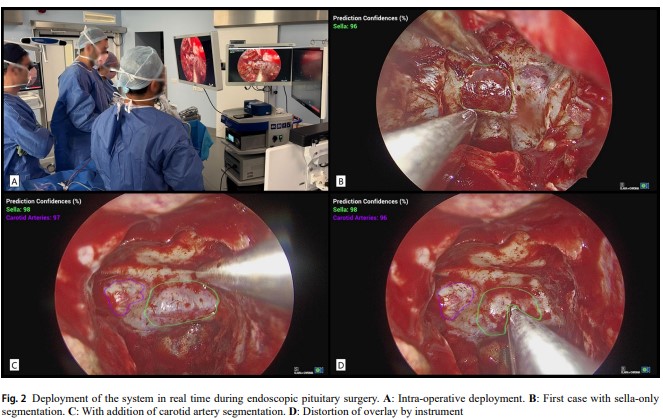
The system analysed live surgical video and highlighted critical structures, without touching an instrument or making a single clinical decision.
During the procedure, a UCL-developed AI system analysed the live endoscopic video feed in real time, overlaying highlights on blood vessels, nerves, and other structures the surgical team needed to avoid. It was trained on a large collection of annotated videos of pituitary tumour operations, with researchers labelling critical anatomy so the model could learn to recognise it under operating conditions.
The system did not control any instruments and did not make surgical decisions. Professor Hani Marcus performed the operation alongside Danyal Khan, a UCL neurosurgical resident and PhD candidate who led the research work. The surgical team retained full control throughout. UCL describes this as the first use of live AI assistance during neurosurgery.
The Outcome, Carefully Stated
UCL reports the surgery succeeded; Hibbert says his vision and energy returned, though these are his own reported experiences, not independently measured trial results.
UCL reports the tumour was successfully removed and Hibbert’s sight was protected. Hibbert said his vision improved after surgery and that his energy and other symptoms returned.
The operation was conducted within a clinical trial funded by the National Institute for Health and Care Research.
One Procedure Is Not a Verdict
A feasibility milestone confirms the system can work in a live operating room; it does not yet show whether the technology makes surgery safer.
A single successful operation does not establish that this AI system reduces complication rates, lowers the risk of stroke or vision loss, or outperforms conventional surgery. Those questions require larger studies with control groups and independent evaluation.
The UCL team is working toward a broader trial. This result should be understood as a feasibility milestone: evidence that the system can function in a live operating environment, not proof that it improves outcomes at scale.
Future trials will need to examine how the system performs across varied patient anatomies and how it handles cases unlike its training data. They must also clarify what happens when the system misidentifies a structure and how responsibility is assigned if a surgeon disagrees with its guidance. Advances in robotics, such as snake robots operating in complex real-world environments, offer a parallel example of AI tools augmenting human decision-making in high-stakes scenarios.
The Longer-Term Ambition
UCL researchers envision an advisory tool that gives surgeons a real-time visual aid they can consult and override at any point.
UCL researchers describe the goal as an advisory system that surgeons can consult in real time and choose to follow or disregard, functioning as a second pair of eyes in procedures where critical structures may not be directly visible. The research is funded by the National Institute for Health and Care Research.
The technology remains early-stage. Whether it makes surgery meaningfully safer for more patients is the question that larger trials now have to answer. For those curious about broader AI capabilities, AI-powered websites offer a glimpse into how the technology is already transforming everyday tasks beyond the operating room.