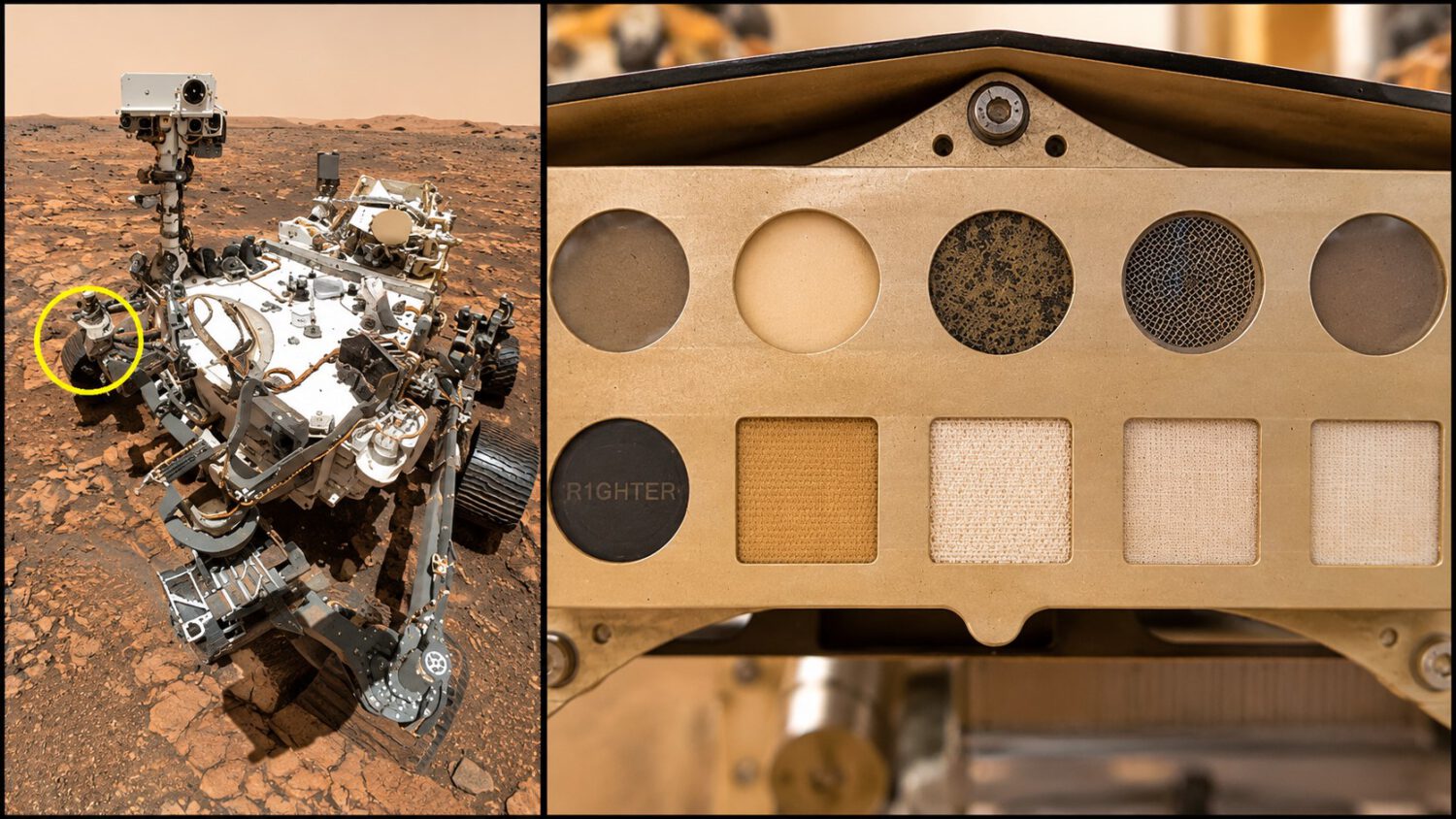
NASA’s Perseverance rover has detected Martian dust particles well below the size range earlier missions could resolve, reshaping what engineers know about contamination risks for future crewed flights. Using its PIXL and SHERLOC instruments, the rover analyzed dust accumulated on spacesuit material swatches and calibration targets over 1,645 Martian sols.
Previous measurements resolved Mars dust down to roughly 3 micrometers. Perseverance found particles below 2.5 micrometers and ultrafine particles ranging down to approximately 100–300 nanometers on certain materials.
A 100-nanometer particle is approximately 700 times thinner than a human hair.
Small Enough to Go Somewhere You Don’t Want It
Particles this fine can reach deep lung tissue, and terrestrial research suggests a plausible pathway to the brain that demands further testing.
Particles smaller than 2.5 micrometers can bypass the upper airway’s defenses and settle in deep lung tissue, creating a potential systemic toxicity concern. That is a plausible risk, not a confirmed outcome: no astronaut has inhaled Martian dust, and the study does not establish a Mars-specific disease.
Terrestrial studies show that particles around 100 nanometers can travel from the nasal cavity toward the brain along the olfactory nerve. Perseverance’s findings identify that pathway as worth investigating, not as proof that Martian dust will follow it.
It’s Not Just the Size
The chemical makeup of Martian dust adds hazards that particle dimensions alone don’t capture.
Perseverance found the dust is a mafic silicate enriched with phosphorus, iron, and sulfur. Iron, sulfur, chlorine, and perchlorates are among the chemical properties requiring toxicological characterization before exposure limits of Martian dust can be finalized; the latter were identified as potential hazards for further study rather than all being directly measured in every analyzed sample.
NASA has described a preliminary permissible exposure limit of 0.1 mg/m³ for particles smaller than 10 micrometers, averaged over 24 hours for scenarios lasting up to 30 days. That figure remains a preliminary standard, not an unrestricted occupational limit for all mission durations.
Smoother Than Moon Dust, But That’s Not the Win It Sounds Like
Martian grains appear less jagged than lunar dust, which may reduce abrasion, but microscopic particles that cling to suits carry their own set of problems.
After 1,645 sols, the spacesuit material swatches showed little visible abrasion. Martian grains also appear smoother than the jagged lunar dust documented during Apollo, which could reduce mechanical irritation to surfaces.
Less visible damage is not the same as less risk. Particles fine enough to slip past the upper airway don’t need sharp edges to cause harm.
Assumptions That Need Updating Before Humans Arrive
Suits, airlocks, filtration, and decontamination procedures were all designed around a dust-size picture that Perseverance has now revised.
Different materials retained different particle sizes: PIXL Teflon and SHERLOC Vectran swatches averaged about 2 micrometers, while the basaltic-glass calibration target and SHERLOC Teflon held particles down to 100–300 nanometers. Surface structure and static-electric effects appear to influence which materials attract and hold the finest particles.
NASA says the findings are intended to inform spacesuit design, airlock procedures, habitat filtration systems, and crew-health standards. Perseverance measured particles attached to exposed surfaces, not airborne concentrations inside a habitat, so understanding what happens when contaminated suits are brought indoors remains the critical next step.