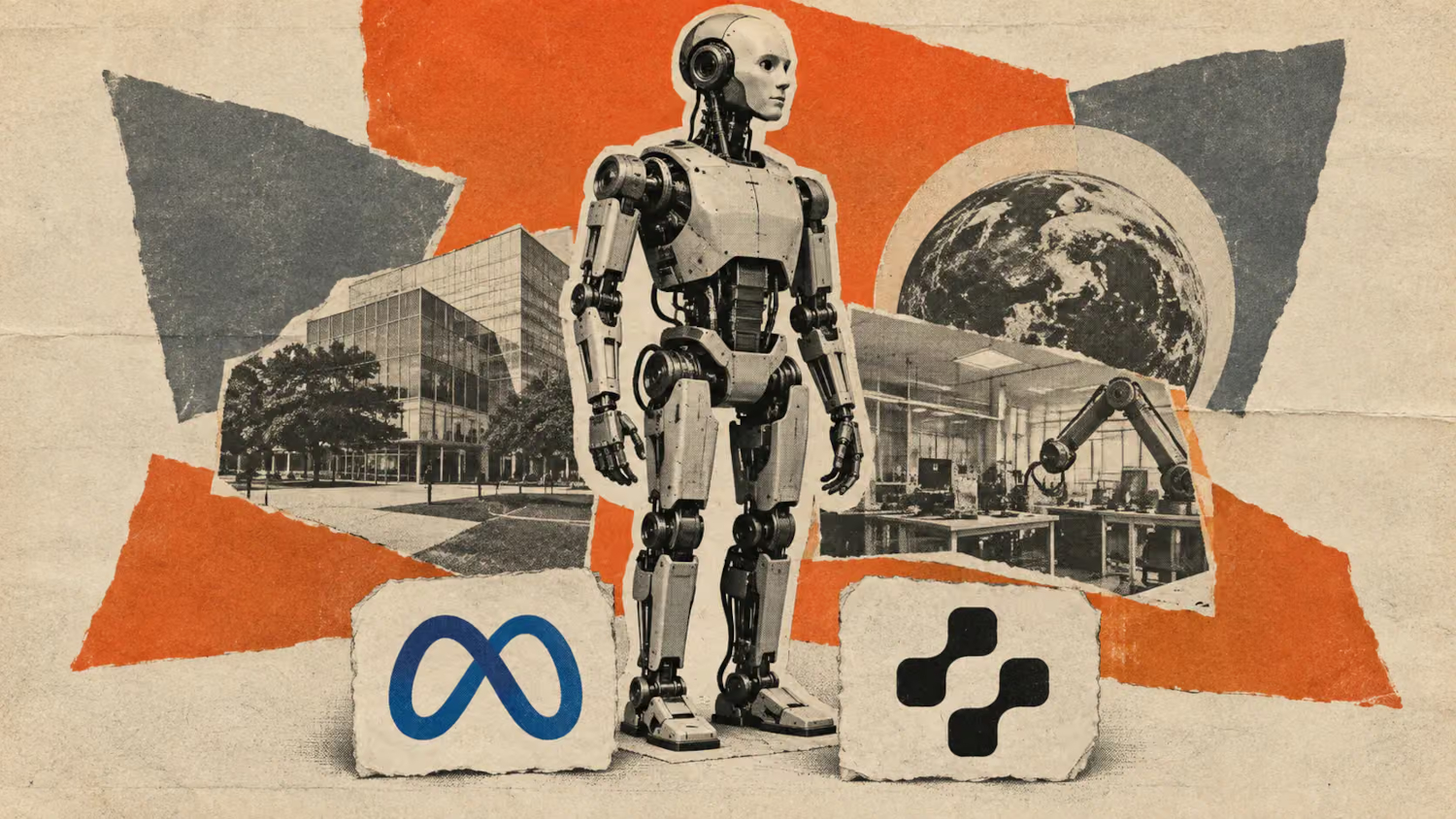
Three months is not a lot of time to build a humanoid robot. Yet Meta reportedly did exactly that, developing a prototype called Max through a partnership with Chinese robotics company Fourier.
Max stands approximately 1.5 meters tall, weighs around 48 kilograms, and runs on NVIDIA’s Jetson Thor robotics-computing platform. Meta says the collaboration is limited to internal research and experimentation, with no plans to sell the prototypes.
Designed to Watch, Listen, and Respond
The reported design priorities reveal what Meta is actually studying: the social layer between humans and machines.
According to reporting based on people familiar with the project, Max is built to recognize spoken commands from roughly five meters away and interpret gestures from approximately three meters. These are reported development targets, not independently verified performance benchmarks.
The robot reportedly includes a facial display capable of mimicking expressions, chest-mounted speakers, and five-fingered hands intended to handle small objects such as bottles and toys. The hardware is customized from Fourier’s existing humanoid platforms rather than designed entirely from the ground up.
The Hardest Problem: Letting People Know What It’s Thinking
Meta’s reported focus on operating-state communication suggests the company is studying human-robot trust as much as movement.
Meta reportedly wants Max to signal to users whether it is listening, processing, speaking, or uncertain. The reported requirements suggest that Meta is studying not only how a robot moves but also whether a person can understand and trust one while it does.
That is a harder problem than it sounds, and it may be the most revealing design priority in the entire project.
Max 2 Is Already in Development
Before the first prototype reached its reported design targets, Meta had reportedly begun work on a successor.
A second prototype, reportedly called Max 2, entered development in September 2026. Planned changes include a redesigned torso, improved hands, a projector, and additional sensors intended to support environmental understanding and stair navigation.
Meta personnel reportedly worked with Fourier in Shanghai during the development process. The pace suggests active investment, not a casual side project.
What Max Cannot Do
Picking up a small object is a narrow demonstration; reliable domestic operation is a fundamentally different challenge.
Picking up a bottle is a long way from doing useful work in an occupied home. Reliable domestic operation requires robust perception and dexterous manipulation across unpredictable objects and layouts. It also demands safe movement around people and the ability to recover from errors without human intervention, much like the challenges explored with a robotic knee exoskeleton designed to assist humans in demanding environments.
The available reporting does not establish that Max has solved these problems. No public launch date or consumer product roadmap has been reported for Max or Max 2.
The Bigger Strategic Picture
Meta’s Fourier partnership positions the company to test embodied AI concepts quickly, though whether that research ever becomes a product strategy remains an open question.
Meta’s reported interest in embodied AI connects Max to the company’s broader work on AI agents. That work centers on software that can plan, reason, and act on a user’s behalf, and a physical robot would extend that capability into the real world , a challenge that deployment-focused projects like Snake Robots have begun to tackle in unstructured environments.
The Fourier partnership gives Meta access to existing humanoid hardware, enabling faster experimentation without designing every component from scratch. Whether that research strategy ever becomes a product strategy remains, for now, an open question.