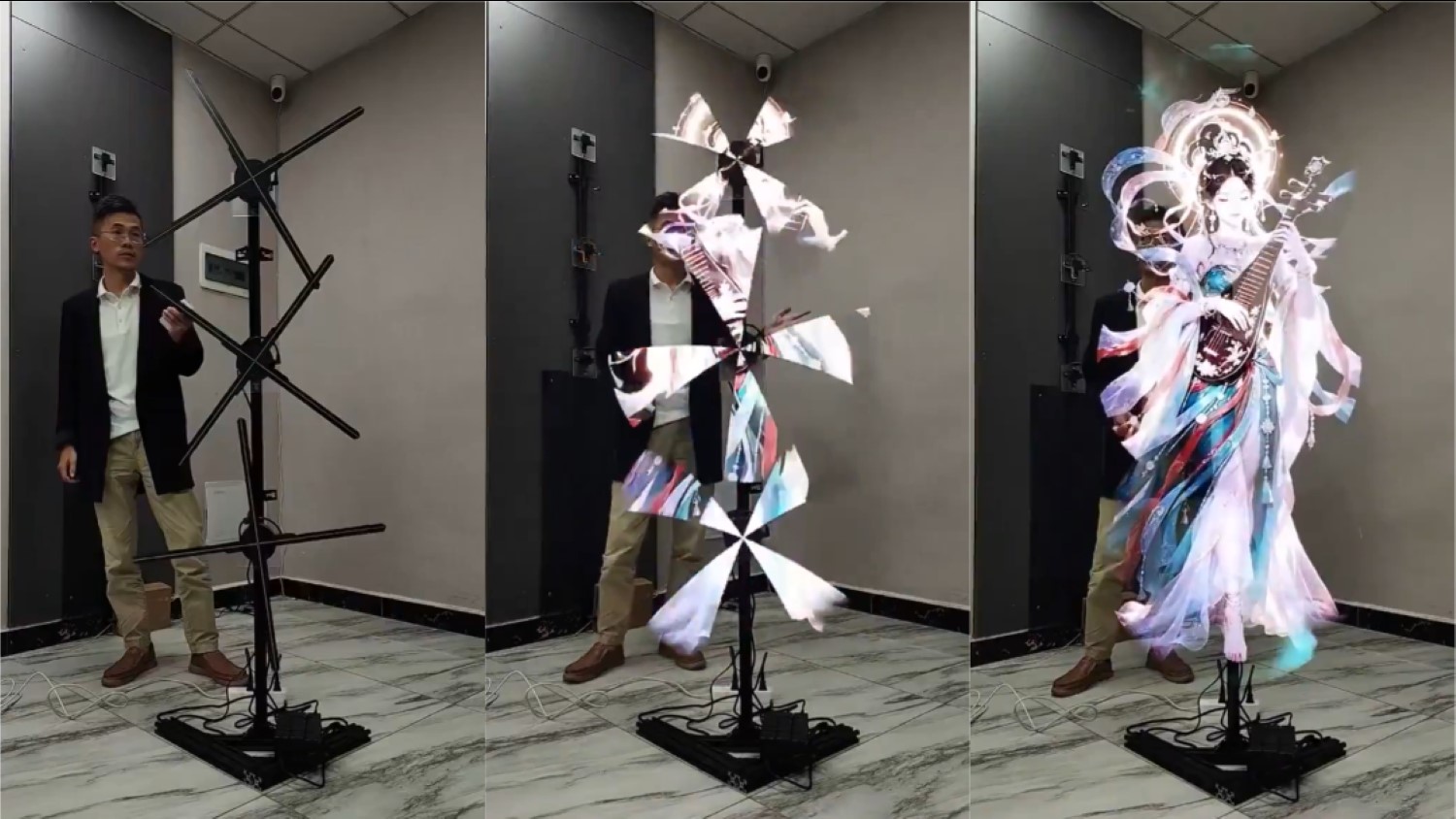
A spinning line of LEDs and precise timing create the illusion. Your brain supplies the rest. Mounted along one or more rotating fan blades, the LEDs form a thin, moving line of light rather than a fixed screen. A controller synchronizes individual LED states with the blade’s rotational position, switching each light on or off at precisely timed points during every revolution.
Your Visual System Fills the Gaps
Persistence of vision is the silent collaborator in every POV display.
Repeated at high speed, those flashes merge into a stable image through persistence of vision, the same principle that makes film frames look like continuous motion. The unlit areas between active LEDs remain visually transparent, so the illuminated portions appear to float in open air rather than rest on a solid rectangular surface.
Depth Is Animated, Not Projected
The 3D effect comes from content design, not volumetric physics.
What the display produces is a sequence of two-dimensional light patterns swept across a rotating path. Perceived depth comes from perspective, shading, lighting, and motion cues built into the animation, according to research published in the International Journal of Creative Multimedia.
Synchronization Is the Critical Variable
A simple LED array with precise sync can outperform a denser display running out of step.
When timing drifts from blade position, points of light smear, wobble, or duplicate across the frame. Accurate synchronization requires coordinated motor speed, rotational-position sensing, and LED refresh timing. That coordination keeps every visual element anchored to its intended location through each full revolution, according to holofanco.com. A modest LED count with well-tuned timing can produce a cleaner image than a denser display whose sync has slipped.
“Hologram” Is the Wrong Word
The correct term is pseudo-holographic, or simply a POV display.
These devices do not create true optical holograms or independently viewable volumetric objects, as the IJCM journal analysis confirms. True optical holograms use light interference patterns to reconstruct a wavefront; POV displays use timed LED flashes to create a visual impression of depth. The viewing experience depends on the rotating display plane and the observer’s position relative to it, so the illusion can shift or weaken as a viewer moves around the unit.
More Blades Help, but Safety Comes First
Scaling up the display adds image density and smoothness, not a fundamentally different technology.
Multiple synchronized blades increase image density and reduce visible gaps between frames, producing smoother curves and finer detail. Moving blades create real mechanical hazards, so commercial installations should use protective housings, controlled viewer access, and manufacturer-approved operating procedures.
A user-generated video posted to Reddit’s r/oddlysatisfying community shows synchronized LED fan blades producing a seamless floating animation. The post is unverified; any technical claims within it require independent confirmation before being treated as evidence.
The Lesson the Display Teaches
Synchronization separates a convincing illusion from a flickering mess.
Strip away the marketing language and what remains is a precise engineering problem: keep the LEDs firing at the right moment through each revolution, and the human visual system integrates those flashes into something that looks solid, dimensional, and suspended in midair. Resolution matters, but timing is what makes the image hold together. Readers curious about how visual tech has evolved may find the story of Disco-Era Gadgets a useful companion to understanding how display innovation developed over decades.