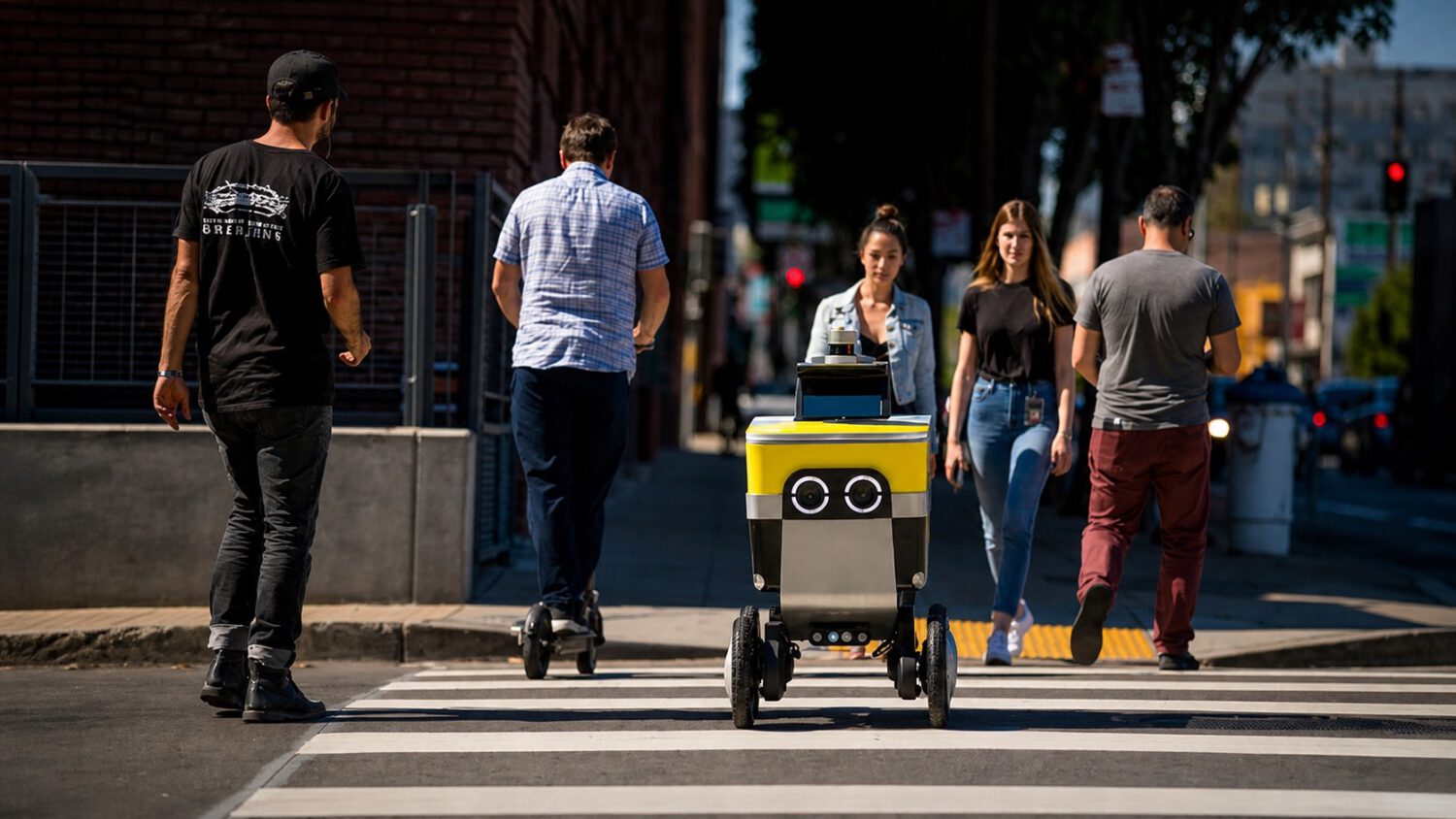
You pick up your DoorDash order from a knee-high robot on a Chicago sidewalk, grab your bag, and walk away. According to two proposed class-action lawsuits filed Oct. 9 in Cook County, that brief exchange may have been enough for the machine to measure your face and hands without your knowledge.
The complaints target Coco Robotics and Serve Robotics, alleging both companies collected customers’ biometric information without the written notice or consent required under Illinois law. Both companies deny the allegations, and nothing has been proven in court.
What the Lawsuits Claim
Two plaintiffs, two delivery platforms, one core accusation.
Plaintiff Mitchell Breidinger alleges that a Coco robot delivering his DoorDash order recorded his face, head, and hands using onboard cameras. The complaint further alleges that LiDAR, a technology that fires laser pulses to map surrounding environments by measuring distances, captured the geometry of those same body parts while a remote operator watched the delivery in real time.
In the second case, plaintiff Barry Schain alleges a Serve robot collected and retained biometric data during an Uber Eats delivery. His complaint raises the additional concern that the information could be used to train artificial intelligence systems or licensed to third parties, according to the Associated Press.
Coco Robotics and Serve Robotics told the Associated Press that their robots do not collect biometric information from customers or people who pass by them.
The Law Behind the Claims
Illinois enacted one of the country’s strictest biometric privacy statutes in 2008.
The Illinois Biometric Information Privacy Act, known as BIPA, requires companies to provide written notice before collecting biometric data. Firms must also obtain written consent and publish a policy stating how long data is retained and when it is destroyed.
Face geometry and hand geometry are among the identifiers the complaints identify as protected under the statute.
The financial stakes are concrete: $1,000 per negligent violation and $5,000 per intentional or reckless violation, plus attorneys’ fees and potential court orders requiring compliance.
The central legal question is whether sensor data gathered for navigation qualifies as biometric information under BIPA. Courts will also weigh whether the companies met the statute’s notice and consent obligations before that data was captured.
Why This Matters Beyond Chicago
The consent problem here is different from anything buried in an app’s terms of service.
The lawsuits allege that customers were not given a notice-and-consent checkpoint equivalent to accepting a privacy policy when downloading a surveillance app. With a sidewalk robot, you are simply there, and the machine is sensing.
The Schain complaint raises a further concern, which must be understood as an allegation and not an established fact: data collected to help a robot navigate a sidewalk could potentially be repurposed for AI model training or licensed to commercial third parties. Courts have not determined whether that occurred.
Chicago launched a Personal Delivery Device pilot in 2022. The program is scheduled to run through May 2027, and sidewalk congestion and pedestrian safety have been among the issues city agencies have assessed throughout the pilot.
What Comes Next
How courts rule here could reshape disclosure requirements for every sensor-equipped machine operating in public space.
The litigation could pressure delivery-robot operators to rethink sensor disclosure, consent flows, and data-retention policies, though any broader effect will depend on court rulings and settlements. If courts find that navigation sensors can trigger BIPA obligations, the implications could extend well beyond food delivery.
How judges answer that question may define what any autonomous machine operating in public space must tell you before it starts measuring.