Apple’s fourth-generation Apple TV 4K replaces the search-and-scroll remote experience with a hands-free, conversational Siri interface. Apple announced the device on October 13, 2026, with preorders open and retail availability beginning November 13; Apple lists a U.S. starting price of $299, which MacRumors also reports.
The headline shift is behavioral: Apple is positioning this box as an AI-driven living-room hub, not just a faster streamer.
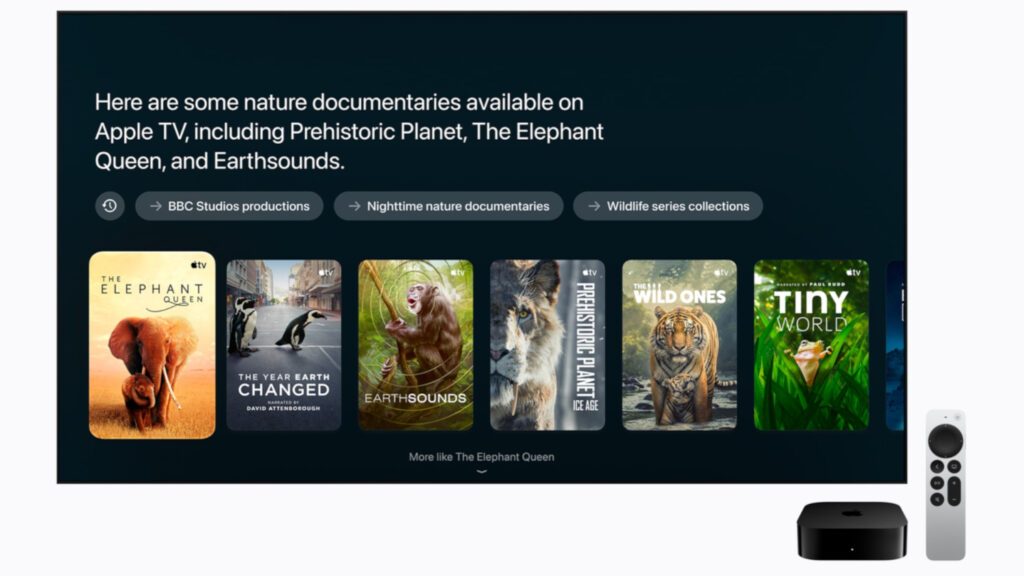
Siri Does the Searching Now
An entirely new version of Siri turns content discovery into a conversation, with the remote optional.
Three far-field microphones and advanced echo cancellation let Siri respond to voice requests without touching the remote. That includes mid-playback queries while audio is already running.
Ask for an award-winning documentary or request the show a friend texted you about as illustrative examples of what Apple describes. When paired with an Apple Intelligence-enabled iPhone, Siri can draw on personal context to answer that kind of request.
The practical value will depend on response accuracy, supported languages, app integration, and regional availability. No independent benchmarks were identified in the available reporting, so treat Apple’s claims as a preview rather than a verdict.
What’s new in the fourth-generation Apple TV 4K:
- A19 chip with up to 50% faster CPU and up to 2x GPU performance, per Apple
- Three far-field microphones for hands-free Siri, with advanced echo cancellation
- AV1 hardware decoder for more efficient high-quality streaming, per Apple
- Wi-Fi 7, Bluetooth 6, HDMI 2.1, and 128GB storage, reported by MacRumors
- Siri Remote with Find My support and Precision Finding via a compatible iPhone
A Wireless Home Theater, If You Already Own the Speakers
Four-speaker HomePod surround sound arrives, but the total cost tells the real story.
For the first time, Apple TV 4K can anchor a four-speaker surround-sound setup using four HomePod mini 2 units, or HomePod (2nd generation) speakers arranged in matched front and rear pairs. The system automatically detects speaker positions and calibrates audio timing and levels to the room.
Four HomePod speakers represent a meaningful additional investment on top of $299. This is a feature built for households already inside Apple’s audio ecosystem, not a budget soundbar alternative.
Smart-home capabilities continue on the same foundation. HomeKit, Matter, and Thread handle connected accessories, and doorbell notifications surface on-screen so you can see and speak with visitors without leaving your show. Apple says Apple Intelligence generates camera-activity descriptions and summarizes Home app notifications.
Privacy and the Always-On Mic Question
Apple outlines its data protections for the built-in microphones; independent verification is not yet available.
Three microphones always listening in your living room is worth pausing on. Apple says microphone data is processed in Secure Exclaves, isolated from the rest of the system. Siri requests use either on-device processing or Private Cloud Compute, and Apple states it does not store or access that data. Apple says HomeKit Secure Video footage remains end-to-end encrypted.
Those are Apple’s assurances. Independent verification was not identified in the reviewed sources.
If your household runs on Apple hardware and you want a TV experience built around asking questions rather than clicking through menus, the fourth-generation Apple TV 4K is aimed at you. Everyone else will want to wait for real-world testing before committing $299, plus the cost of any HomePod speakers. The device becomes available November 13, 2026, in the United States and 29 other countries and regions.