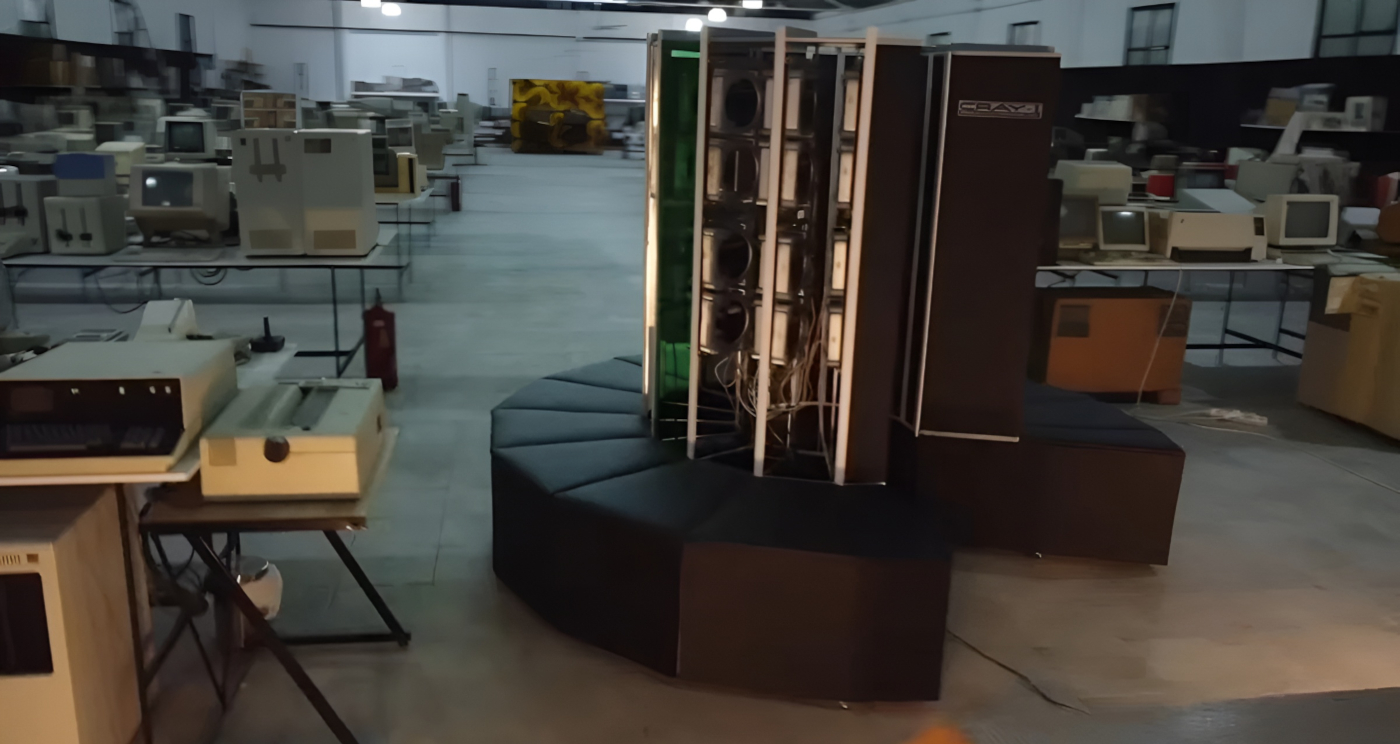
Inside a small museum in Extremadura, Spain, one of history’s most recognizable supercomputers has come back to life, sort of. The Museo de Historia de la Computación in Majadas de Tiétar, Cáceres, unveiled a full-scale Cray-1 replica in September 2026, built around 30 Mac Minis functioning as a live distributed-computing cluster.
The project took approximately 18 months to complete. It was designed to mark both the Cray-1’s 50-year legacy since its 1976 debut at Los Alamos and Apple’s 50th anniversary.
Thirty Consumer Computers, One Legendary Chassis
The cluster packs 64 active processing cores into a chassis styled after one of the 1970s’ most celebrated scientific machines.
The hardware breakdown is straightforward: 25 dual-core Intel Core i5 Mac Minis and five quad-core Intel Core i7 Mac Minis, primarily 2012 models, providing 64 active processing cores total.
The museum attributes up to 1.5 teraflops of combined performance to the full system. After one node went offline, measured output dropped to approximately 1.3 teraflops, according to AppleInsider reporting.
The original Cray-1 ran at roughly 160 megaflops.
That produces a nominal ratio of about 9,375 times faster, but treat that figure carefully. The Cray-1 used specialized vector processing hardware designed to handle groups of data simultaneously for scientific workloads, while the replica coordinates general-purpose consumer CPUs through distributed software. The comparison illustrates how far computing has come; it does not describe equivalent machines doing equivalent work.
The exhibit’s key technical and design details:
- Exterior follows the original Cray-1’s curved green-and-glass form; the interior uses a steel structure with aluminum supports
- Mac Minis are arranged vertically; passive cooling through aluminum trays replaces the original’s substantial refrigeration infrastructure
- The system runs macOS Mojave, with nodes communicating through a message-passing arrangement
- Visitors can observe matrix-multiplication demonstrations and watch the cluster operate with varying numbers of active nodes
- A custom terminal styled after 1970s supercomputer consoles connects via an additional Mac Mini; flat-panel displays replace CRTs for practical reasons
A Quiet Machine With Ambitious Plans
The replica runs nearly silently today, but the museum’s expansion plans point toward considerably noisier ambitions.
Sixty-four active cores generate far less heat than the original Cray-1’s refrigeration-dependent hardware, and passive cooling keeps the replica quiet. The Ethernet switches connecting the nodes are reportedly the primary source of noise.
The museum is reportedly considering an expansion of 70 to 80 additional Mac Minis, possibly including newer M4 models, with crowdfunding under discussion to source the hardware. The long-term ambition, according to AppleInsider, is to qualify for the TOP500 list of the world’s fastest supercomputers.
That goal remains exactly that: an ambition. TOP500 qualification requires meeting specific benchmark, testing, and submission requirements well beyond simply adding processors to an existing cluster.
What the exhibit does achieve is more immediate. Computing history tends to flatten into numbers on museum placards, abstracted and inert. Seeing 30 consumer Mac Minis collectively outrun a machine that once required purpose-built hardware and a dedicated cooling system makes the performance arc of the last five decades genuinely tangible. For a small museum in rural Spain, that is a considerable thing to put on display.