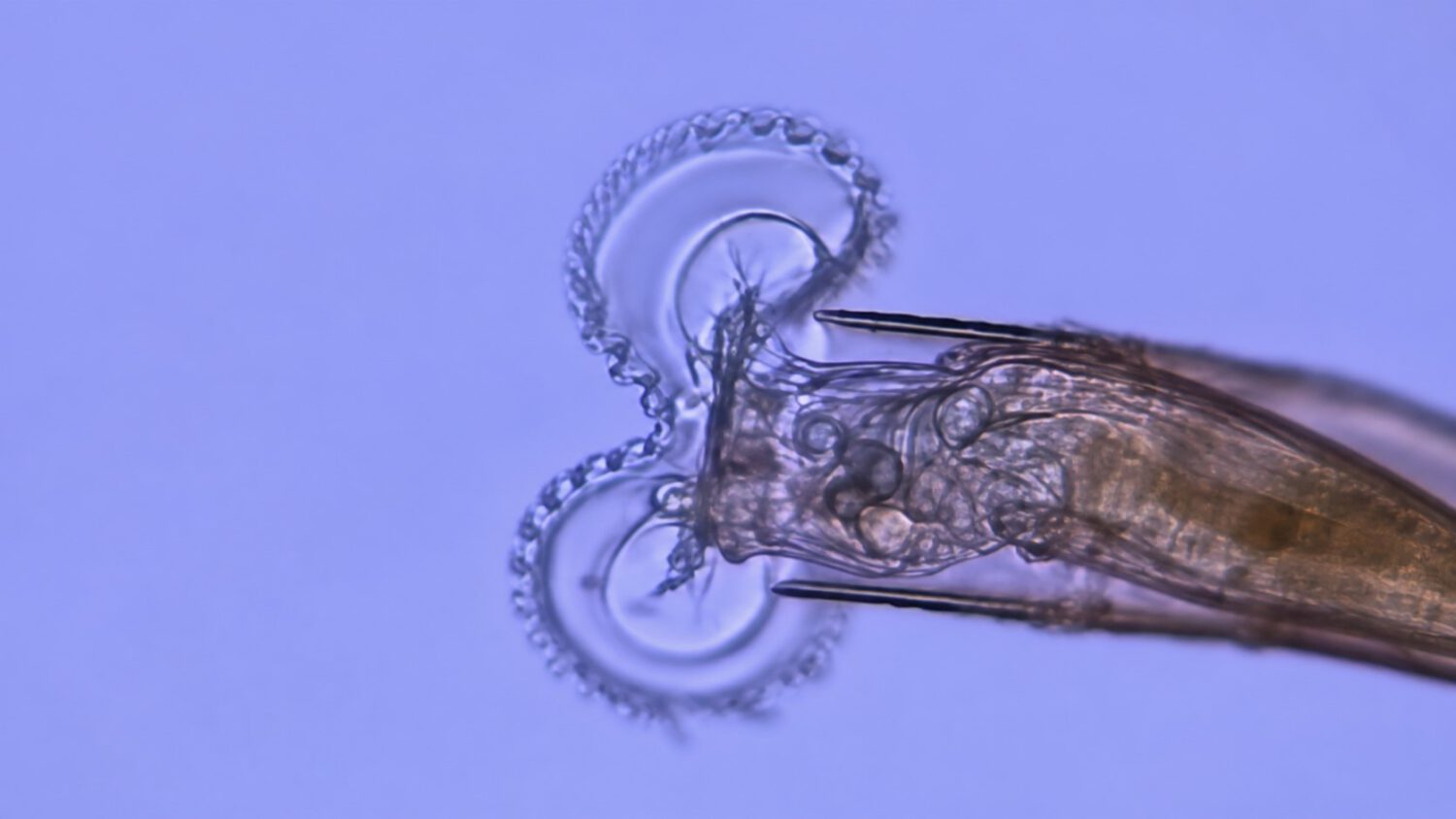
Watch enough microscope footage online and you will eventually encounter it: a tiny creature whose front end appears to spin like a chainsaw blade. The spinning structure is not a mouth, and it does not rotate.
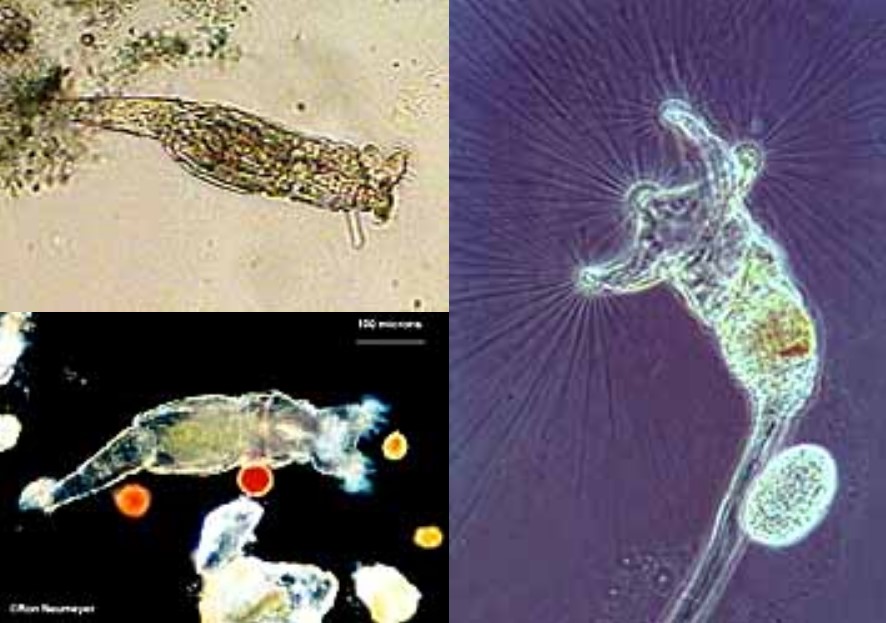
What you are seeing is the corona, a ring or pair of ciliated regions at the front of the animal’s body. The organism is a rotifer, a microscopic aquatic animal sometimes called a “wheel animal” for this exact optical effect.
What the Corona Actually Does
The corona’s dramatic appearance comes from biology, not mechanics.
Coordinated waves, not a spinning mechanism, produce the illusion of continuous rotation. Think of a stadium crowd doing the wave: a stationary gesture that appears to travel around the arena.
Two distinct jobs fall to the corona: locomotion and feeding. Those beating cilia generate a localized water current that draws suspended particles toward the animal’s mouth.
Many rotifers, including bdelloid species, are suspension feeders. Algae, bacteria, and detritus ride that current toward the mouth, carried by the ciliary activity the corona produces continuously.
The Hidden Jaw Inside
The structure doing the actual work is invisible in most microscope footage.
Past the mouth lies the part the “chainsaw” label completely ignores: the mastax, a muscular pharynx that functions as the rotifer’s actual processing chamber. Inside the mastax sit the trophi, hard jaw-like structures with ridged surfaces that grind food before it continues into the digestive tract.
In bdelloid rotifers such as Philodina, the trophi are specifically adapted for grinding. Their ridged surfaces work against one another the way a grain mill works, just at a scale measured in micrometers.
The corona draws food in. The mastax and trophi process it. They are separate systems, and only one of them is visible in the footage that generated the viral label.
Appearance Versus Anatomy
The “chainsaw” analogy captures the look of the corona while misidentifying what the corona is.
It describes the appearance of a feeding funnel and locomotion structure while implying the animal possesses a single violent cutting apparatus. The corona is the intake mechanism; the trophi are the grinders in Philodina and related bdelloids. Collapsing both into one dramatic visual shorthand skips the more interesting part of the biology entirely.
High-speed phase-contrast microscopy is making ciliary motion easier to observe in fine detail. The next time you see the footage, you will know the spinning wheel at the front is the setup. The real action happens deeper inside, in a muscular jaw chamber most casual viewers never realize is there.