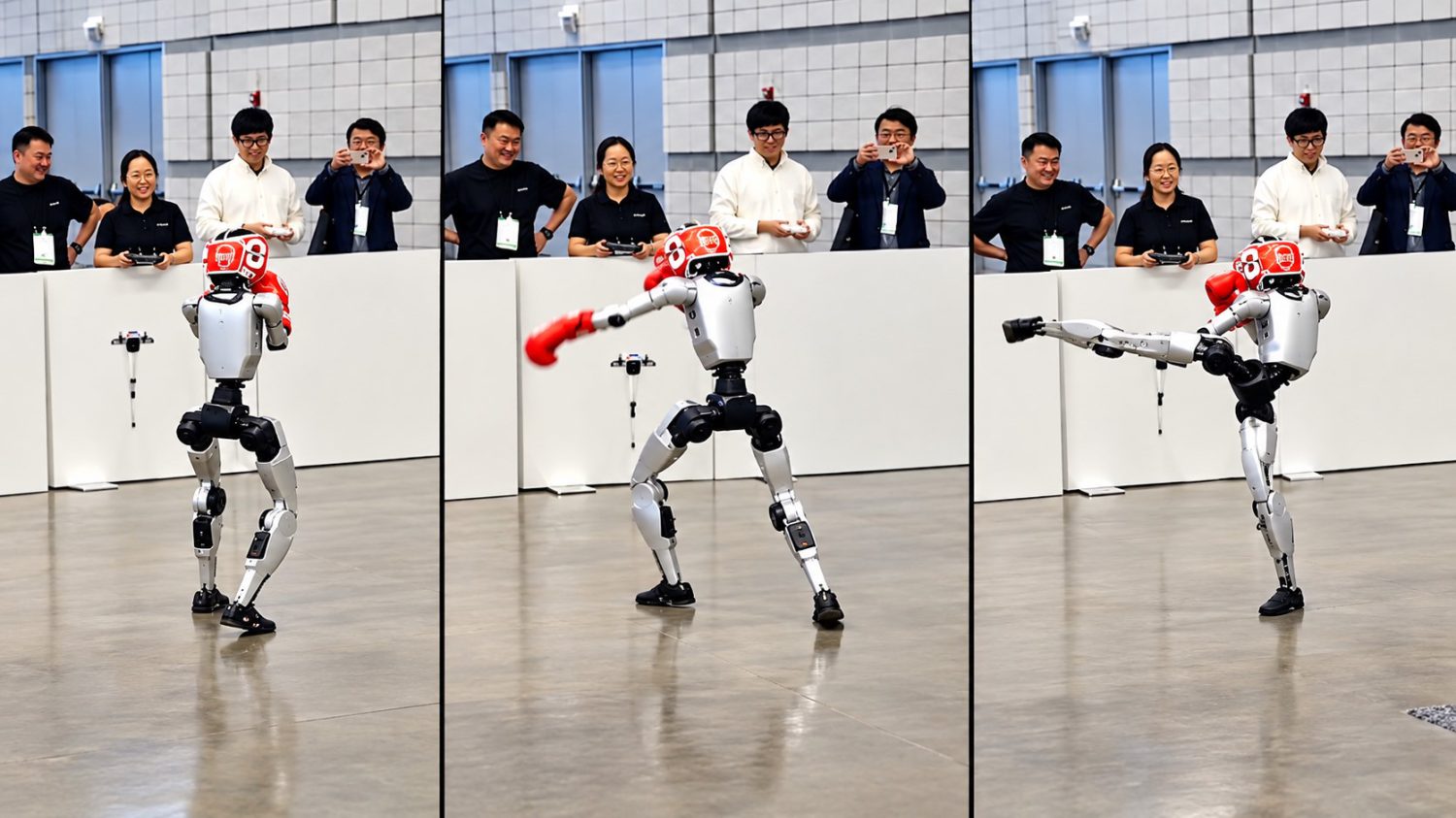
At IROS 2026, according to the supplied brief, a Unitree Robotics G1 humanoid robot encountered a HopTo Technology Hopcopter jumping drone in a shared demonstration area. The G1 reportedly resolved the situation by kicking the drone out of its path, which is either impressive robotics or a protocol failure dressed up as one, depending on your perspective.
Call it the robot equivalent of two self-driving cars arriving at a four-way stop with no shared traffic protocol: technically capable machines, suddenly unhelpful to each other.
What the Kick Actually Reveals
The moment raises a genuine engineering question, and the footage alone cannot answer it.
Without developer logs or official statements, it is impossible to know whether the G1 autonomously decided to kick the drone, executed a scripted move, triggered a reactive balance behavior, or responded to an operator input. Details remain unclear from available sources, and asserting any single explanation would mean getting well ahead of the evidence.
What the reported moment does expose is a real coordination gap. When two independently programmed robots share a floor, the absence of a shared safety protocol turns a routine encounter into an unpredictable one.
The Gap Between Independent Robots and Coordinated Ones
Collision avoidance between machines from different manufacturers demands more than basic obstacle detection.
A jumping drone is not a stationary cone. Its predicted landing zone, upward trajectory, and lateral drift all need to be part of another robot’s planning model, not just its current position. Research published in Frontiers in Robotics and AI in 2026 describes systems where robots continuously share joint states and planned trajectories with a central coordination layer. That shared data lets each machine replan before committing to its next move.
That replanning cannot depend solely on wireless communication. Packet loss, latency, and incompatible protocols are real failure conditions, and each machine needs local sensing and fallback behaviors that function independently when the network drops at the worst possible moment.
Physical Contact Is a Failure Mode, Not a Strategy
A robot that clears its path by displacing an object has only moved the hazard somewhere else.
When you see a robot launch something into the surrounding space, that is not a clean solution. The object now poses a risk to bystanders, nearby equipment, or, somewhat ironically, more robots.
As humanoids and drones increasingly share conference floors, warehouses, and eventually public spaces, shared safety protocols will matter far more than impressive hardware. Right-of-way rules, conservative motion envelopes (the buffer zones each robot maintains around its planned path), and human-supervised escalation paths are not optional refinements. They are what separates a controlled demonstration from an incident report.