An internal U.S. government assessment warns that Latin American drug cartels are rapidly upgrading their drone capabilities and that American and Mexican counternarcotics authorities may be unprepared for the shift. Five U.S. officials and one Mexican official described the assessment anonymously to The Washington Post.
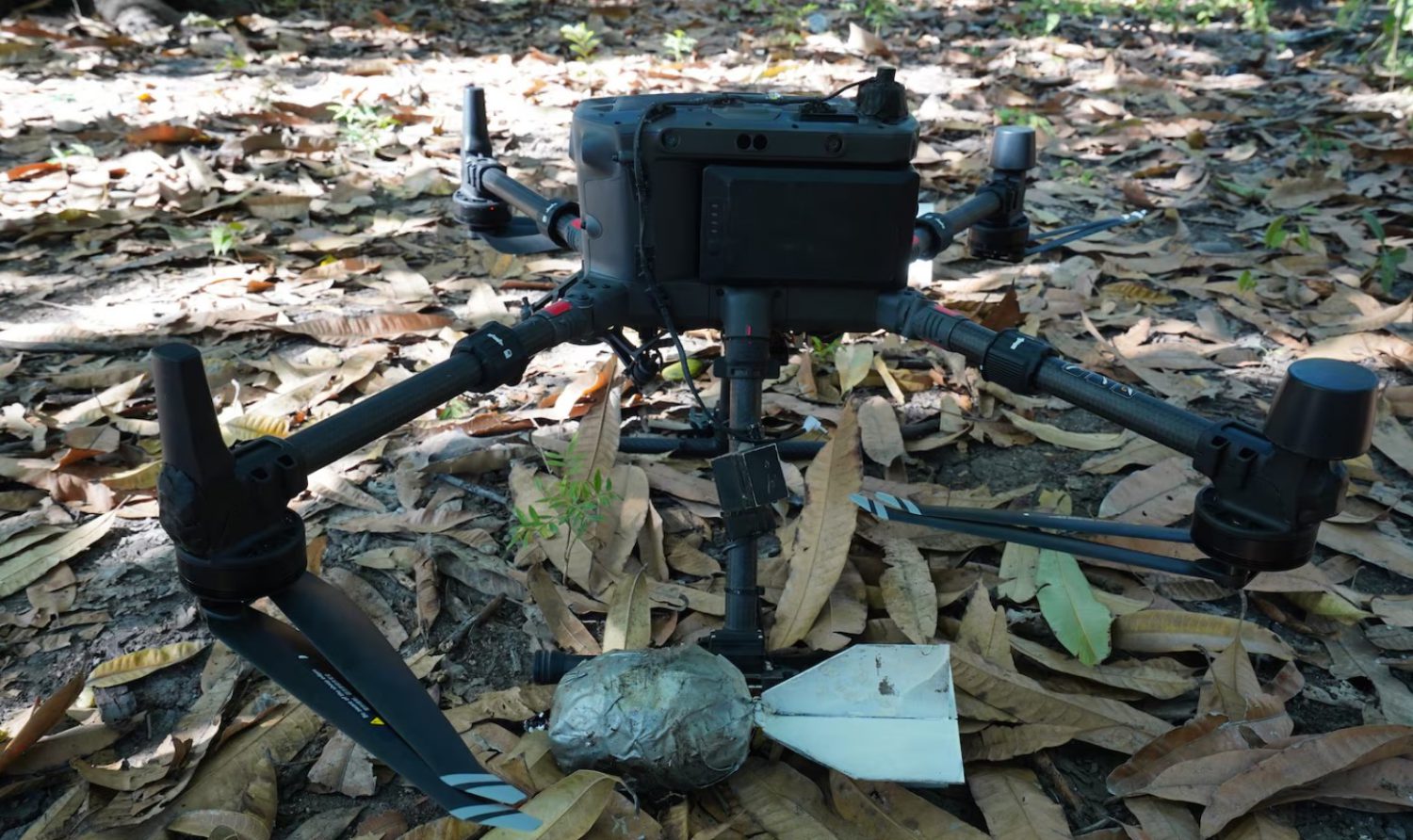
The core concern is speed. Battlefield tactics refined in the Russia-Ukraine war, including improvised explosive payloads and radio-frequency hopping (a technique that makes it harder for jamming systems to disrupt the link between a drone and its operator), are reportedly diffusing into criminal networks faster than governments can update their defenses.
From Surveillance to Weapons Delivery
Officials say criminal groups have moved well beyond basic reconnaissance, and the capability gap is growing.
Mexican cartels already use drones to monitor law-enforcement activity and map smuggling routes on both sides of the U.S.-Mexico border. According to an intelligence document reviewed by The Washington Post, Mexican authorities believe at least one cartel possesses a multirotor aircraft with six to eight propellers, capable of flying for hours and carrying more than 150 pounds. That claim has not been independently verified.
A Mexican intelligence official told The Washington Post that one cartel sent personnel to China to purchase drones that could be equipped with rifles. Officials added that criminal groups are studying radio-frequency hopping and other methods to defeat counter-drone jamming systems.
Skills Imported From a War Zone
Anonymous official accounts describe a recruitment network connecting the Ukraine battlefield to trafficking organizations.
U.S. officials told The Washington Post that Mexican cartels are recruiting Colombians with recent Ukraine combat experience and sending affiliates to the war zone on training contracts. Some officials alleged that families of recruits have been threatened to ensure their return; those claims rest on anonymous accounts and have not been publicly corroborated.
A senior State Department official said the U.S. government is aware of Colombian fighters who served on both sides of the Russia-Ukraine war and returned with drone knowledge that has directly or indirectly benefited trafficking organizations. A Colombian fighter interviewed by The Washington Post described a two-month Ukrainian drone-piloting course covering the operation and arming of aircraft, though his account does not establish that he worked for any cartel.
Ukraine’s Defense Ministry pushed back on the broader implication. Taras Palianytsia, an official with the ministry’s foreign-recruitment office, said international volunteers have varied motivations and undergo background checks intended to identify malicious intent.
A Regional Surge in the Data
Independent tracking shows a sharp acceleration that predates any confirmed cartel recruitment pipeline.
The Armed Conflict Location & Event Data project recorded 38 weaponized-drone events in Colombia in 2024, 149 in 2025, and more than 200 by early September 2026. Across Latin America, roughly 72% of approximately 670 total weaponized-drone events tracked since 2018 occurred after January 1, 2025. The data confirms a regional surge but does not, by itself, establish that Ukraine veteran recruitment caused it.
“What’s the next major problem we’re going to have? Drones are it,” one anonymous U.S. counternarcotics official told The Washington Post.
Lasers and Coordination
High-energy lasers are now in the field, yet procurement timelines still favor the cartels.
The State Department said it is coordinating with U.S. law enforcement and Ukrainian counterparts to limit the transfer of battlefield drone skills. The U.S. military has deployed high-energy laser systems and credited them with downing 11 cartel-linked drones between August 24 and September 4, according to military officials; the locations, engagement circumstances, and independent verification procedures for each interception were not specified in available reporting.
VanHerck placed the greatest near-term danger not at the U.S. border but deeper inside Mexican territory, where explosive-laden drones could target Mexican security forces and rival criminal groups. Cartels can change routes, payloads, and frequencies quickly, while counter-drone jamming authorization, and agency coordination require far more time.