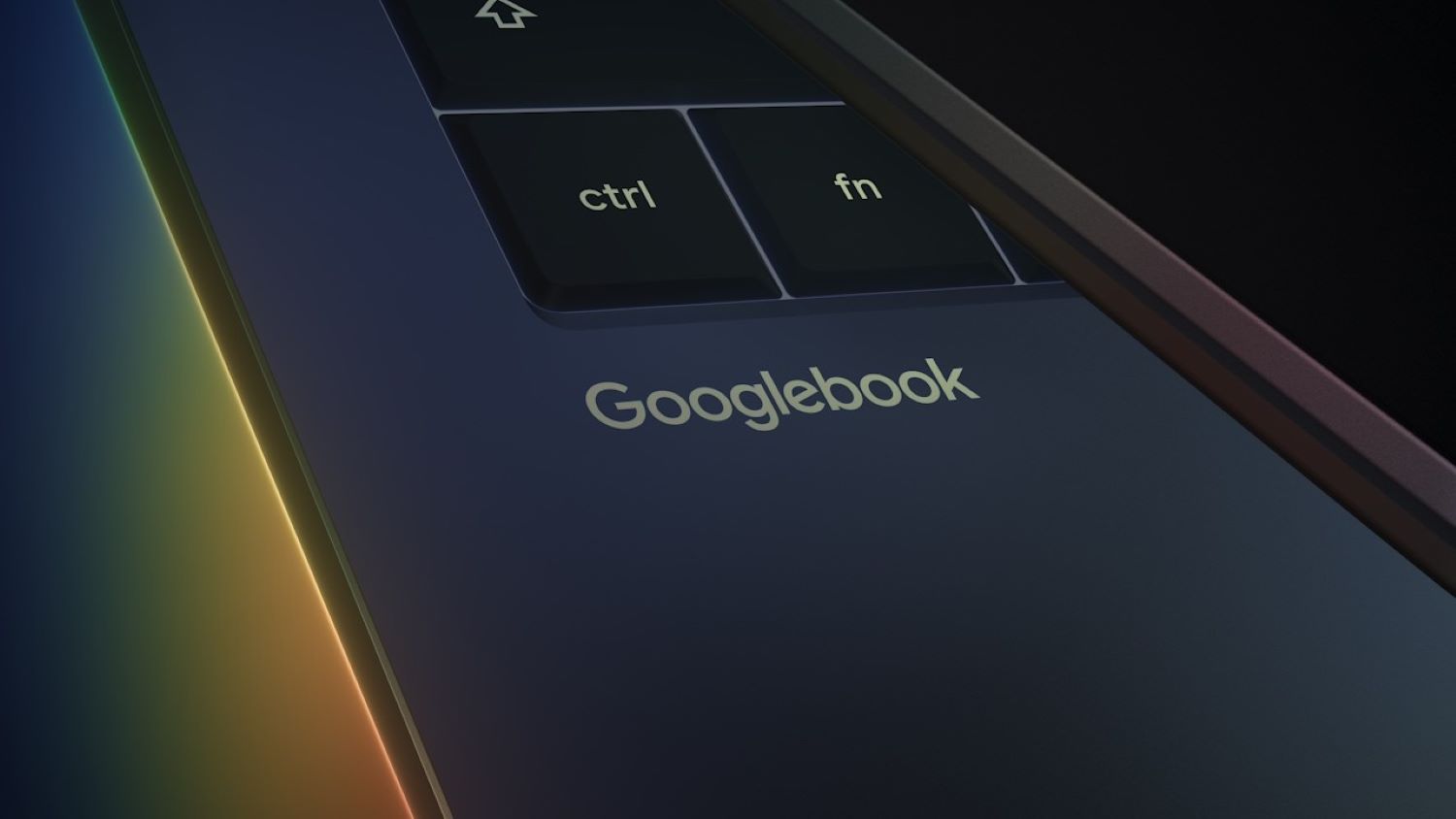
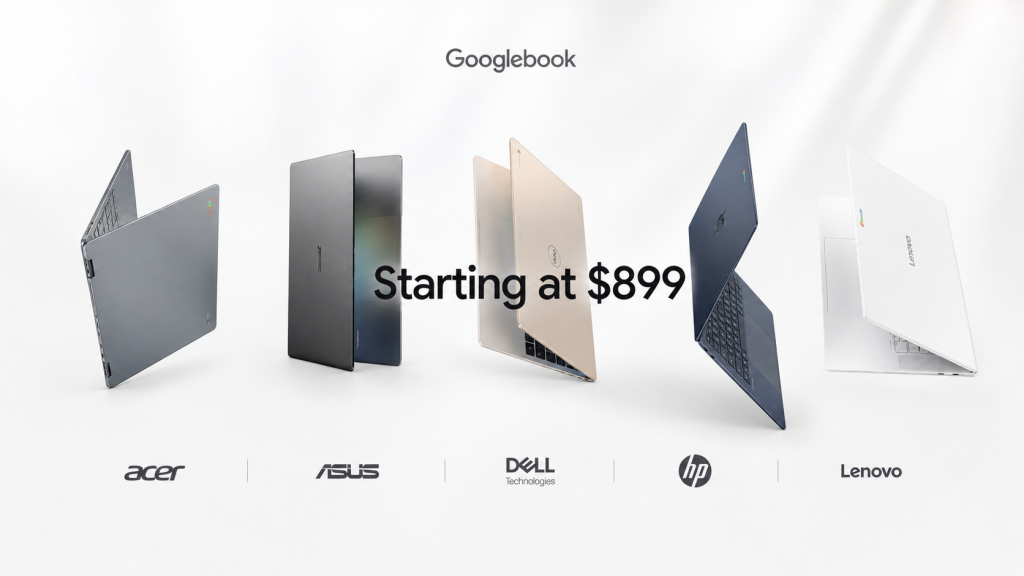
Googlebook starts at $899 and runs to $1,299, putting it squarely against the MacBook Air and premium Windows laptops rather than the Chromebook shelf at your local big-box store. Google is signaling, with some clarity, that it wants to compete at the premium tier of personal computing.
The underlying bet is straightforward: Android phone owners represent a vast potential audience, and Google’s proposition is a laptop that works like a natural extension of that phone, the way an iPhone and Mac do. That premise shapes every software decision in Googlebook.
A New Category, Not a Chromebook Sequel
Googlebook combines an Android-based operating system with ChromeOS-derived desktop foundations, running Android apps, a full Chrome browser with extensions, and Gemini at the OS level.
Five manufacturers are on board at launch: Acer, ASUS, Dell, HP, and Lenovo.
Dell and HP models use Qualcomm Snapdragon X Elite processors; the others use Intel Core Ultra chips. Base configurations include 16GB of RAM and 512GB of storage.
Displays range from the Dell XPS Googlebook’s 13.4-inch 2.5K LCD touchscreen to a 15.3-inch panel on the Lenovo model. Most other models use 14-inch 2.8K OLED touchscreens. A Titan C2 security chip is standard across every model, according to Google’s announcement.
U.S. pre-orders opened September 21, 2026, through the Google Store, Best Buy, and selected retailers. Retail availability begins October 4 in the United States. Canada, the U.K., Ireland, France, Germany, and Australia follow on October 5.
The Phone Is the Point
At first launch, saved passwords, Wi-Fi credentials, and settings migrate directly from a connected Android phone, cutting the usual new-laptop friction considerably.
Files and messages from your phone are also accessible on the laptop once the devices are linked, according to Google’s announcement.
The bigger pitch is cross-device task continuity: start something in a mobile app, then pick it up on the laptop. That experience will depend on how many developers build handoff support into their Android applications and how well those apps handle a large screen and keyboard input.
Apple has run this playbook since Handoff launched in 2014. Google is running the same route, but with five hardware partners instead of one and an open ecosystem that gives buyers more choice while giving Google less control over the finished experience.
Gemini, Rambler, and the AI Layer
Gemini operates at the system level rather than inside a browser tab, and two additional tools extend that AI layer into productivity and personal automation.
A feature called Rambler transcribes spoken input and organizes it into structured documents, headers, and checklists. An AI-agent platform called Antigravity reportedly lets users build custom widgets and lightweight applications, though no primary-source confirmation of its full capabilities was available at publication.
Together, these tools position Googlebook as an AI productivity device rather than simply an Android tablet with a keyboard attached. Independent testing of how reliably they perform in real workflows is not yet available.
Pricing and the Real Question
At $899 for the Acer entry model and up to $1,299 for HP, ASUS, and Lenovo configurations, Googlebook lands in direct comparison with the MacBook Air and mid-range Windows laptops.
That comparison demands the software justify the price, not just the specs.
Google promises up to 10 years of content and feature updates. The “up to” qualifier matters: the announcement does not specify which conditions apply to security updates versus feature updates, or whether every model receives identical coverage.
The hardware exists and the ambition is evident. The real test is whether developers commit and whether Android apps actually behave well on laptop displays. Google must also stay the course long enough for Googlebook to become a platform rather than a well-funded experiment.