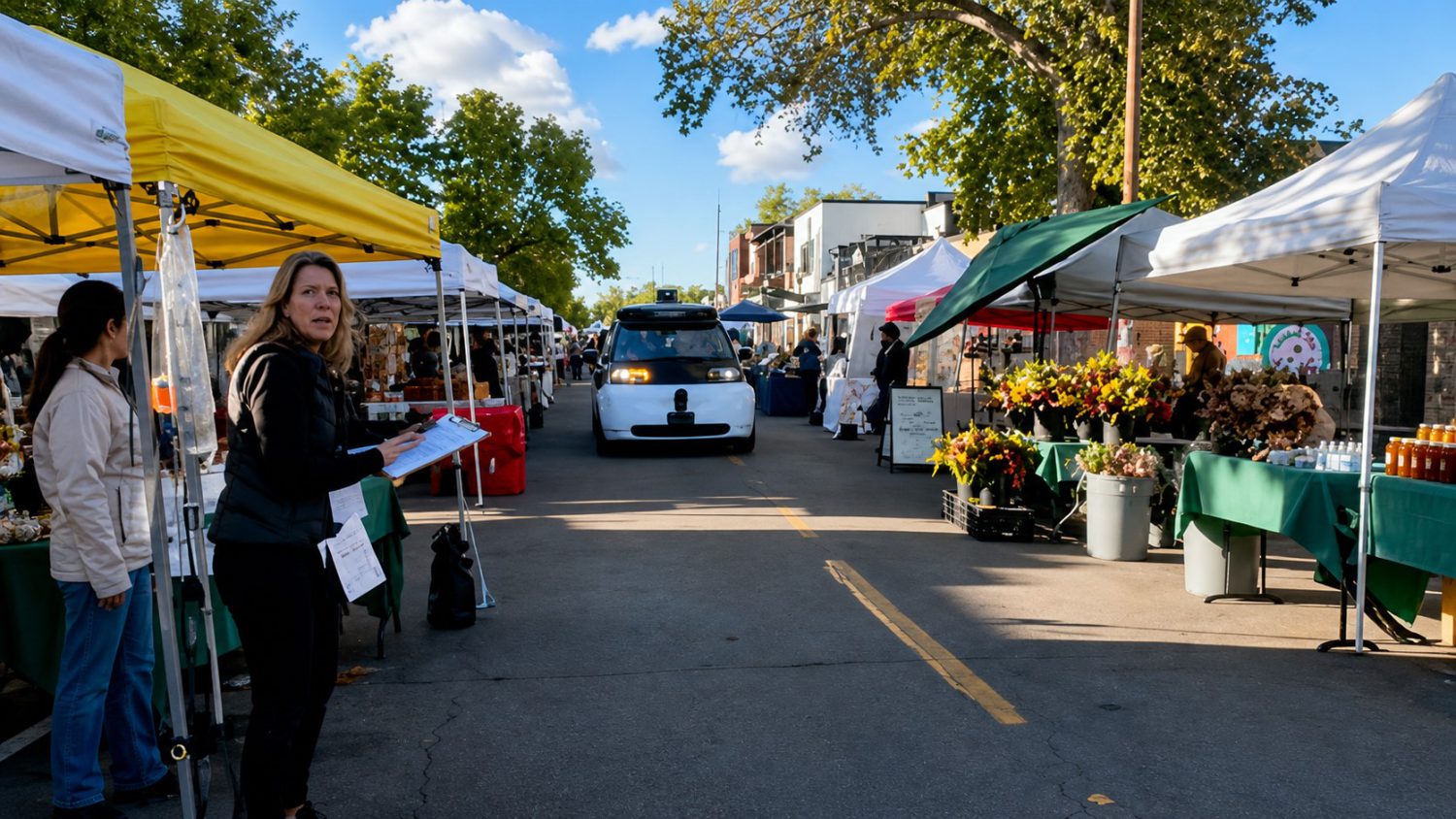
Sunday morning on South Pearl Street, vendors were still setting up stalls when a driverless Waymo rolled past barricades, past a stop sign, and into the farmers market. There was no driver to flag down, no window to knock on; market staff had to walk alongside it and usher it back to the street.
Theodore Subbotin, market manager for Hearth Denver, confirmed staff had to “usher it out.” No injuries were reported, and no collision was reported.
Nobody Could Write a Ticket
The incident quickly revealed a gap in Colorado’s enforcement framework that goes beyond one vehicle’s unusual route.
Denver Police confirmed they had no legal mechanism to issue a citation when no driver is present to receive it. Colorado State Patrol offered the same assessment, adding that, to its knowledge, no trooper had previously contacted a Waymo vehicle.
That does not mean autonomous vehicles are free to ignore traffic rules. Colorado’s enforcement infrastructure, however, was not built to handle the moment a violation allegedly occurs and no human is sitting behind the wheel.
The 2017 Law That Didn’t See This Coming
Colorado’s foundational autonomous-vehicle statute authorized driverless operation without establishing a process for citing it.
Colorado’s Senate Bill 17-213, passed in 2017, authorized highly automated driving systems at SAE Levels 4 and 5 to operate in the state. They must comply with applicable state and federal law. The framework was permissive by design, intended to attract autonomous-vehicle development without layering on local regulatory inconsistencies.
The law does not appear to establish a conventional citation process for alleged violations during an ordinary driverless trip. Colorado’s traffic-code provisions were written with a human driver in mind, and when that seat is empty, the legal hand-off has nowhere to land.
What Waymo Said
Waymo acknowledged the incident but stopped short of explaining why the vehicle entered the market.
Waymo stated that community trust and safety are its top priorities and that it is committed to learning from the incident. The company’s available statement did not identify a technical cause or announce a specific corrective measure.
Waymo separately noted that the vehicle identified the situation and maneuvered out of the market area. Staff guidance was also part of that process, according to separate reporting.
The Technical Challenge
An expert on autonomous systems says unexpected environments expose a fundamental weakness in current AI.
Missy Cummings, a professor of mechanical, electrical and computer engineering at George Mason University and a former senior safety adviser at the National Highway Traffic Safety Administration, offered a precise diagnosis.
Cummings said unexpected environmental changes can challenge autonomous systems, and Colorado’s regulatory response has not kept pace with deployment. Her comments represent expert analysis, not an official determination about this specific incident.
California Already Has an Answer
California’s notice-and-review process offers one model for how states can assign accountability without a human driver.
California developed a direct alternative: a “notice of autonomous vehicle noncompliance” that identifies the alleged violation, the vehicle, and routes the matter to the manufacturer rather than a nonexistent driver. A peace officer issues the notice, the manufacturer submits it to the California DMV, and the DMV determines what action is appropriate, including possible permit restrictions or suspension for repeated violations.
Colorado has no equivalent manufacturer-directed notice process.
The Regulatory Gap Exposed
The South Pearl Street incident made an abstract policy problem visible at street level.
The incident exposed a regulatory framework written before Colorado addressed what accountability looks like when the driver’s seat is empty. The state’s entire citation system was built on the assumption that someone is sitting in it.