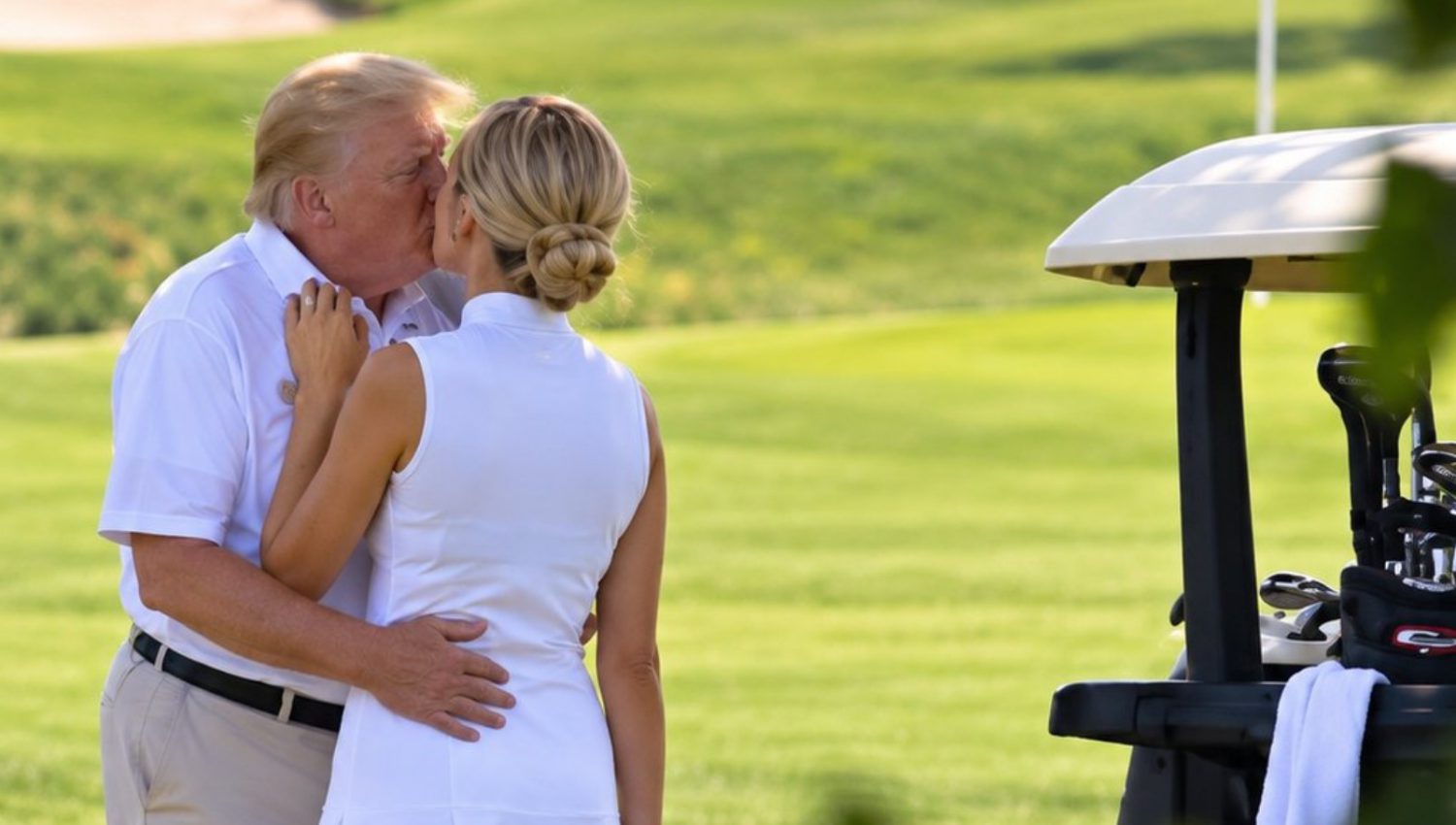
The image has been everywhere. A golf course, a kiss, and Natalie Harp right there in the frame. Harp is the White House aide known in Trump circles as the “human printer,” reportedly churning out flattering articles and social posts for the president on trips and at golf outings. Your first instinct is probably a question about whether it is real. The more important question is what it means that multiple AI systems looked at the same photo and mostly could not tell you either.
What the Chatbots Actually Said
The AI tools assigned to spot fakes evaluated photographic realism and mostly gave the image a passing grade.
Gizmodo ran the image past several AI systems, and the results ranged from inconclusive to almost comically beside the point. Claude reportedly praised the photo’s “natural depth of field falloff” and “consistent lighting direction,” adding that “hands, fingers, and the golf club are anatomically consistent.” Microsoft Copilot and ChatGPT gave similarly hedged readings, leaning neither clearly toward fake nor verified real. Google’s Gemini noted the absence of a SynthID watermark from its own tools but still allowed that the image might be AI-generated.
Not one of them led with the six fingers.
That is the core irony: the systems evaluated photographic realism and found it satisfactory, while missing the most elementary anatomical tell a careful human spotted in seconds. It is roughly equivalent to a content-moderation algorithm flagging the copyright disclaimer while the deepfake plays uninterrupted.
Six Fingers and a Watermark
The forensic evidence against this image is straightforward, and it starts with a hand that has one finger too many.
In the high-resolution version circulating online, Harp’s gloved hand reportedly has six fingers. According to Snopes, OpenAI’s verification tool detected a watermark consistent with its own generative AI tools in that same sharp version. Deepfake detection expert and GetReal co-founder Hany Farid told Snopes directly: “The high-resolution version was clearly derived from the lower-resolution version and has a SynthID watermark.”
No AP wire photo, no Reuters frame, no White House photographer has a matching image. That absence is as damning as the extra digit.
The upscaling counterargument deserves a fair hearing: technically, someone could have taken a blurry genuine photo and AI-enhanced it into a six-fingered mess. Gizmodo and forensic reviewers describe this scenario as unlikely. Modern cameras do not produce images that require that kind of intervention, and no credible original has surfaced anywhere.
The Liar’s Dividend
This stops being a gossip story the moment you understand what AI fakery does to every piece of authentic evidence that follows it.
Legal scholars Chesney and Citron named the dynamic back in 2019: once AI fakes are common enough, every piece of inconvenient authentic evidence can be dismissed as generated, and some portion of the audience will accept that without needing proof. The technology does not even need to be deployed. The possibility alone does the work.
Trump has already tested this playbook, reportedly calling real events “AI” while seeding his own feeds with synthetic imagery that blurs satire and propaganda. This photo runs the same dynamic in reverse. It is a likely fake used as apparent evidence, while the White House called it “clearly a fake photo” and offered no authenticated golf photographs for comparison.
What You Should Actually Do With This
Single-tool AI detector verdicts are one clue; provenance is the check that actually holds up.
Treat any “86% likely AI” confidence score the way you would treat a weather forecast: directionally useful, not definitive. Check provenance by asking who posted it first, whether a trusted photo agency has a matching image, and whether the hands look anatomically plausible. As image generators improve and anatomical errors like extra fingers disappear, that provenance check becomes the only verification method the same tools cannot fake their way past.