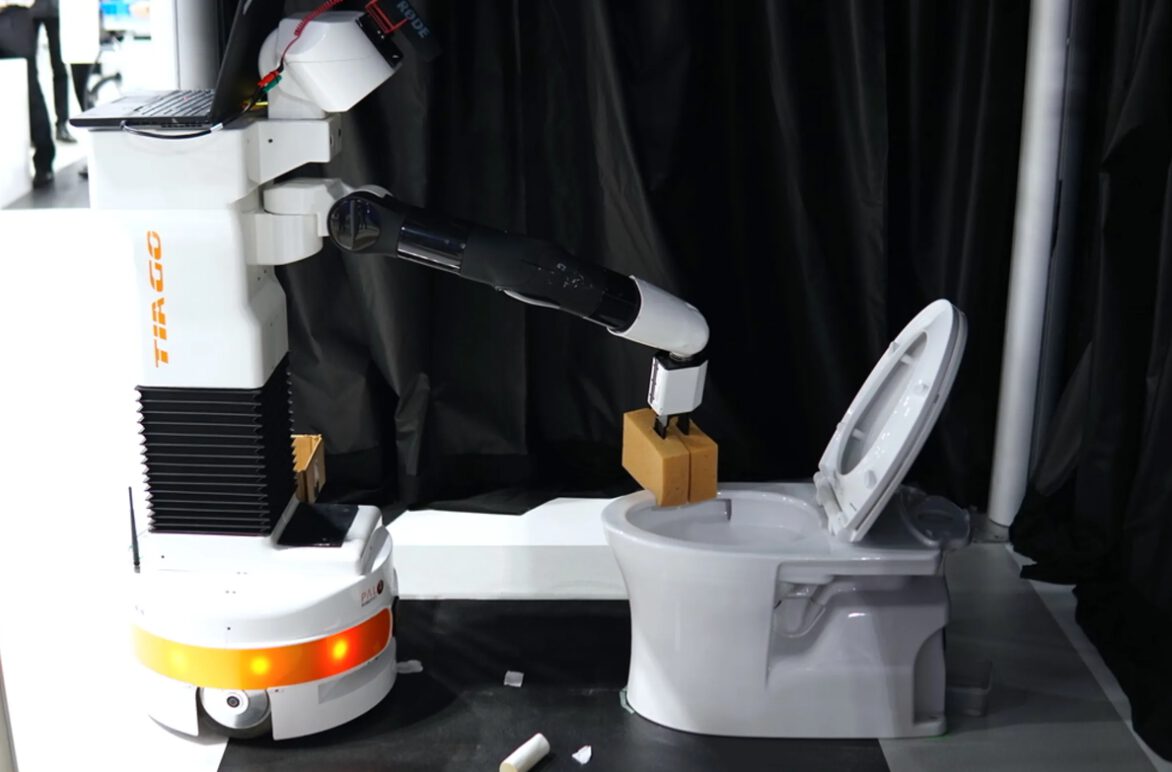
You’re making coffee for the third time today, except this time there’s a phone strapped to your forehead recording every hand movement. Welcome to the latest chapter in AI training, where companies are paying gig workers in Los Angeles to perform mundane tasks while head-mounted cameras capture their every gesture. These recordings become “ground truth” datasets that teach robots how to fold laundry, wash dishes, and navigate kitchens without destroying everything they touch.
The Mechanics of Human Data Harvesting
Simple headbands with phone mounts transform workers into walking motion capture studios.
The setup couldn’t be more dystopian or more straightforward. Platforms like Sunain distribute basic headbands fitted with smartphone mounts to over 1,400 contributors in Los Angeles. Workers then record themselves performing scripted household tasks—making coffee, scrubbing toilets, washing dishes—while the camera captures precise hand and body movements. This isn’t just happening in tech-savvy LA; workers in other countries operate dedicated facilities where they record human movements for robotic training, creating a global marketplace where human movement becomes a commodity.
When Your Side Hustle Becomes Surveillance
Hundreds of families earn supplemental income by turning their daily routines into robot training material.
The economic reality driving this trend is impossible to ignore. Entire families participate in these recording sessions, earning extra income by documenting everything from cooking to cleaning. According to Jason Saltzman, head of insights at CB Insights, “Humans are supplying ground truth, judgment, or structured feedback that models can’t reliably produce on their own yet.” The irony cuts deep: workers are literally training the robots that might eventually replace them, all while struggling to make ends meet in an increasingly expensive gig economy.
The Data Gold Rush Behind Humanoid Robots
Physical AI needs human demonstrations because robots can’t learn complex movements from text and images alone.
This surge in human motion recording stems from a fundamental limitation in current AI systems. While language models can scrape the internet for text data, robots learning physical tasks need to see actual human demonstrations. The scarcity of quality movement data has created a micro-economy where your morning routine becomes valuable intellectual property. Companies developing humanoid robots need these datasets to teach machines how to navigate the messy, unpredictable world of human spaces—and they’re willing to pay workers to provide it, one head-mounted recording at a time.
The next time your smart home assistant can’t figure out how to load a dishwasher, remember: somewhere, someone wearing a camera headband is probably teaching it right now.