
Osteoporosis causes roughly 37 million fragility fractures globally every year, approximately one every second, and current drugs can slow the damage but cannot reverse it. Researchers now report that a single infusion of engineered stem cells was followed by a 94% drop in fracture rates among 10 high-risk women, according to a study published in Cell.
Published in Cell, the study by José M. Moraleda and colleagues at the University of Murcia marks the first time glycocalyx-edited mesenchymal stem cells have been tested in humans for osteoporosis. It marks the first time glycocalyx-edited mesenchymal stem cells have been tested in humans for osteoporosis, and the early results point toward a possible shift from managing bone loss to rebuilding it.
What the Therapy Actually Is
Researchers solved a decades-old navigation problem that has kept stem cell therapies from reaching their target.
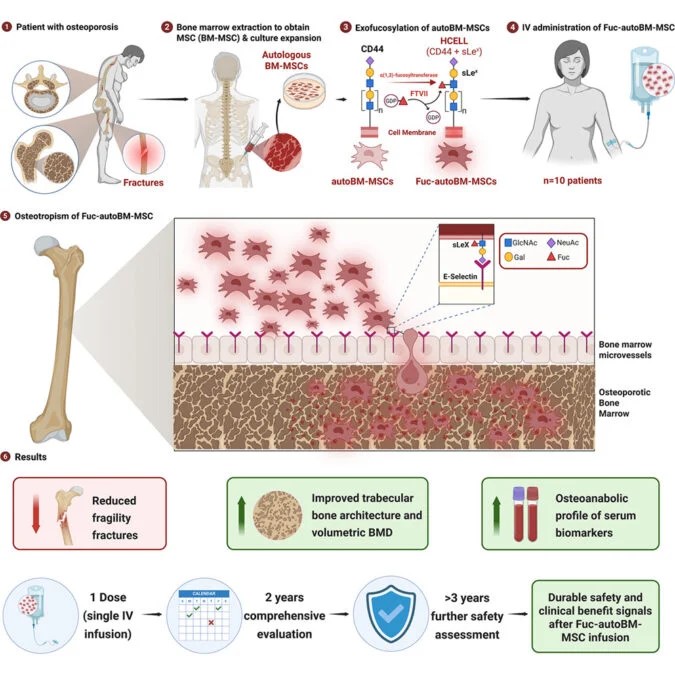
Mesenchymal stem cells (MSCs) are adult stem cells capable of differentiating into osteoblasts, the cells responsible for forming bone. When grown outside the body and reinfused intravenously, however, these cells are poor navigators and rarely find their way back to bone marrow.
The team’s solution was glycocalyx editing. Researchers added a sugar molecule called sialylated Lewis X to the cell surface, functioning essentially as a postal code that routes the cells toward bone marrow tissue.
What the Trial Found
A single infusion preceded two years of sharply reduced fractures and measurable bone regrowth.
Ten women aged 51 to 72 with advanced osteoporosis each received a single intravenous infusion of their own modified cells, designated Fuc-autoBM-MSCs in the paper. In the two years before infusion, the group experienced 8 fractures per year; in the two years after, that figure fell to 0.5, the authors report.
Bone biopsies at approximately 120 days post-infusion showed increased bone tissue area in 7 of the 10 patients. Imaging confirmed density gains in trabecular bone, the spongy tissue most vulnerable in early osteoporosis.
“Though subjects in this study were clinically at ‘very high risk’ for recurrent fragility fractures, the refracture incidence dropped precipitously.” , José M. Moraleda et al., Cell
Safety
The trial’s primary goal was safety, and the infusion met that standard across the full follow-up period.
Safety was the trial’s primary endpoint, and the infusion was well tolerated with no treatment-related serious adverse events reported. Prior interim reports from the same research team, summarized in the Annals of the Rheumatic Diseases, had similarly shown no major short-term adverse effects in the early cohort.
Limitations
Significant design constraints prevent the authors from drawing definitive conclusions, and they say so plainly.
Enrollment covered 10 women at a single center, with no randomization, no control group, and no blinding, making it impossible to attribute the fracture reduction solely to the treatment. The sample includes no men, no younger patients, and no meaningful ethnic diversity, constraining how broadly these findings can be applied.
Context Against Existing Treatments
Current medications manage bone loss; this approach aims to reverse it, but decades of preclinical effort show how hard that target is to hit.
Current standard treatments, including bisphosphonates, denosumab, and anabolic agents such as teriparatide, slow bone loss or modestly stimulate formation but do not reverse the disease. Unmodified MSCs tested in earlier preclinical and human studies consistently underperformed because of poor bone marrow homing, a specific bottleneck the glycocalyx engineering here is designed to address.
Moraleda et al. frame the broader implication directly in the Cell paper: “Precision glycocalyx editing effectuates MSC-based therapy to reverse osteoporosis, thus potentially shifting therapeutic strategies for this disease from pharmacologic approaches to regenerative medicine.”
What Comes Next
Randomized trials, regulatory hurdles, and unresolved cost questions stand between this signal and any patient.
Larger randomized controlled trials are the necessary next step before any clinical adoption is possible. In the EU, this therapy would be classified as an advanced therapy medicinal product, requiring rigorous manufacturing consistency, long-term safety surveillance, and regulatory review. Questions of cost, GMP-grade cell processing at scale, and equitable patient access remain entirely unresolved.
For a disease affecting an estimated 500 million people worldwide, according to ScienceAlert’s coverage of the study, a promising early signal pointing toward regenerative medicine is worth watching. Whether that signal holds under the scrutiny of controlled trials is the question that defines what comes next.