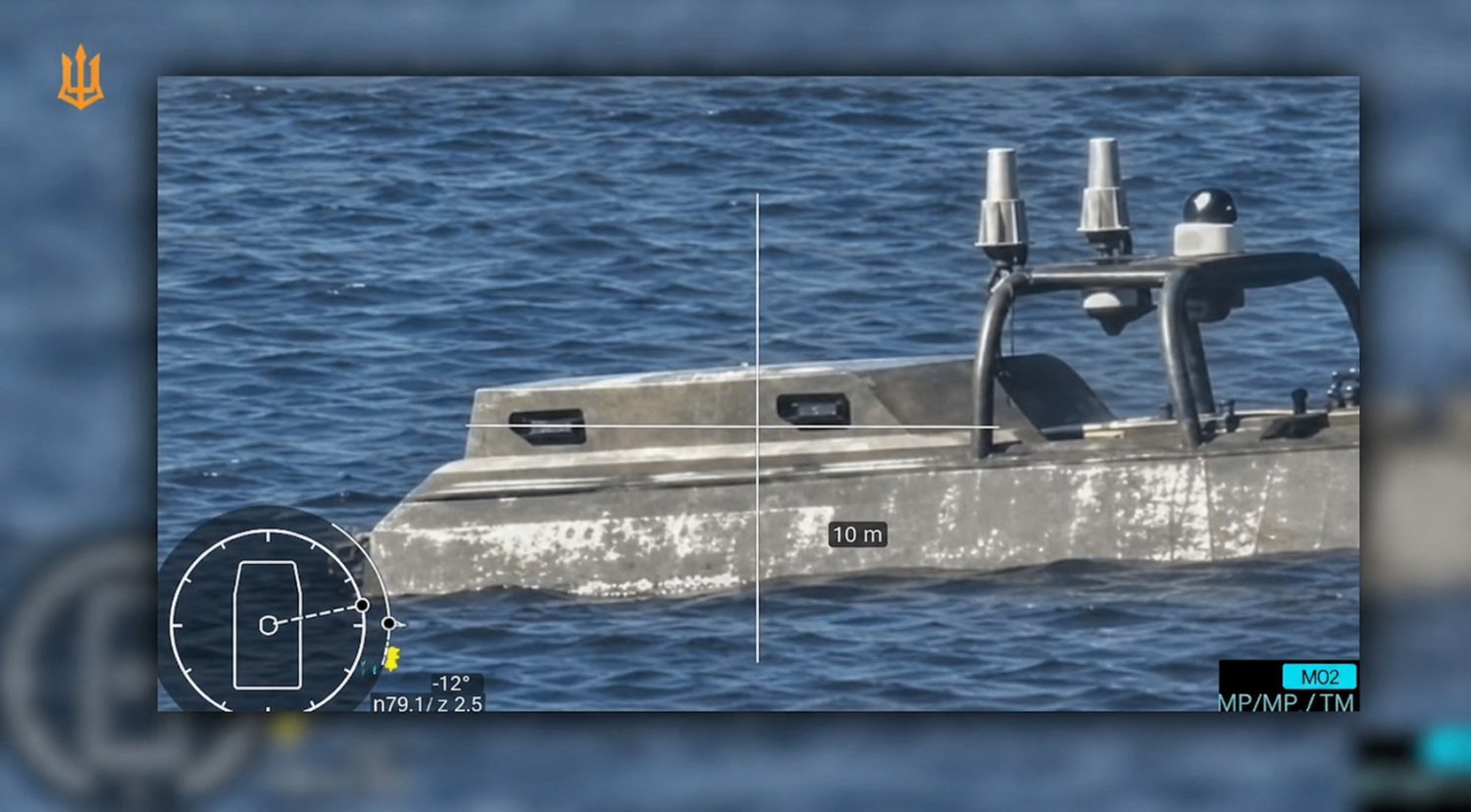
A remotely operated Ukrainian drone boat reportedly used a stabilized machine-gun turret to close on and sink a Russian drone boat in the Black Sea, with no human crew on either vessel. According to the Ukrainian Navy, this makes it the first drone-vs-drone naval battle in recorded history, though that characterization comes entirely from Ukrainian official sources and has not been independently confirmed.
What the Video Shows
The footage published on the Ukrainian Navy’s official Telegram channel shows a small, fast surface vessel approaching another craft at sea, firing multiple bursts from a mounted automatic weapon. Smoke rises, at least one visible explosion occurs, and the target craft dips nose-first before sinking.
Aerial footage, apparently captured by unmanned aerial vehicles supporting the operation, provides an overhead view of the sinking. The footage documents the engagement, but the identification of the target as a Russian MBeK-class unmanned surface vessel relies entirely on Ukrainian official statements.
The Sargan 3000: What It Is and What It Carries
An unmanned surface vessel, or USV, is essentially a remote-controlled boat capable of carrying sensors, weapons, or both, operated by humans at a distance. The Sargan 3000 is Ukraine’s domestically developed platform for this role, entering service in April 2026.
Open-source reporting puts its key specifications as follows:
- Length: approximately 6.9 m (about 23 ft)
- Combat radius: up to 1,600 km (nearly 1,000 miles)
- Top speed: around 50 knots
- Payload capacity: up to approximately 450 kg (about 990 lb)
- Modular design: configurable with weapon stations, missile containers, or FPV-drone launchers
- Estimated production rate: roughly 25 units per month (unconfirmed figure)
That modular payload system separates the Sargan 3000 from earlier Ukrainian naval drones, which were primarily explosive-laden strike craft. Swap the warhead for a gun turret and the platform becomes something closer to an armed patrol boat, minus the crew.
The Weapon: Remote Fire Without Exposing Anyone
The weapon used in this engagement was a 12.7 mm Protector remote weapon station, described in reporting as Swedish-made and similar in concept to the Kongsberg Protector systems deployed on NATO warships and vehicles. A remote weapon station, or RWS, is a stabilized, remotely operated turret with integrated optics.
This was not an autonomous kill. Human operators were in the loop, directing the Sargan 3000 and pulling the trigger via remote control.
How the Engagement Unfolded
Ukraine’s Defense Intelligence directorate, known by its Ukrainian acronym GUR, reportedly detected the Russian MBeK vessel first. Intelligence, surveillance, and reconnaissance assets, including aerial drones providing real-time overhead imagery, tracked the target and handed off the engagement to the Sargan 3000 for the kinetic strike.
The engagement was not a chance encounter. It was a coordinated action involving detection, targeting, and remote weapons employment across multiple unmanned platforms.
Russia has not issued a public statement on the incident. Technical specifications for the MBeK remain sparse in open sources, and its identification as such relies on Ukrainian official channels.
Context: From Crewed Ships to Drone Targets
In mid-July 2026, Ukrainian forces used a Sargan 3000 to sink the Russian FSB border patrol vessel Izumrud, a crewed ship. That engagement was drone against a crewed vessel.
September’s reported engagement marks the next step: drone-vs-drone. That progression, from striking human-crewed vessels to engaging unmanned ones, is the basis for the Ukrainian Navy’s “first-ever” claim.
What It Means, Carefully Stated
Analysts note this validates the operational case for modular, armed USVs paired with robust intelligence, surveillance, and reconnaissance networks. It may accelerate demand for counter-USV defenses, hard-kill gun systems, electronic warfare, and dedicated anti-drone surface vessels. That mirrors the pattern the aerial drone era established for anti-UAV technology.
Unanswered questions remain. Rules of engagement for remote lethal systems operating at sea are not yet codified in international frameworks, and the exact date and location of this engagement have not been publicly disclosed by Ukraine.
The Verification Gap
The “first-ever” label is the Ukrainian Navy’s characterization, reported by the Kyiv Independent, The War Zone, EuroMaidan Press, and multiple international outlets. No neutral military authority has independently confirmed the claim or ruled out earlier unreported engagements that may not have surfaced publicly.
A documented proof of concept for fully unmanned naval combat now exists. Whether this is truly the first instance or simply the first publicly confirmed one, the practical question for defense planners is the same: how do navies defend against an armed drone boat when they have no crew to put at risk on their own?