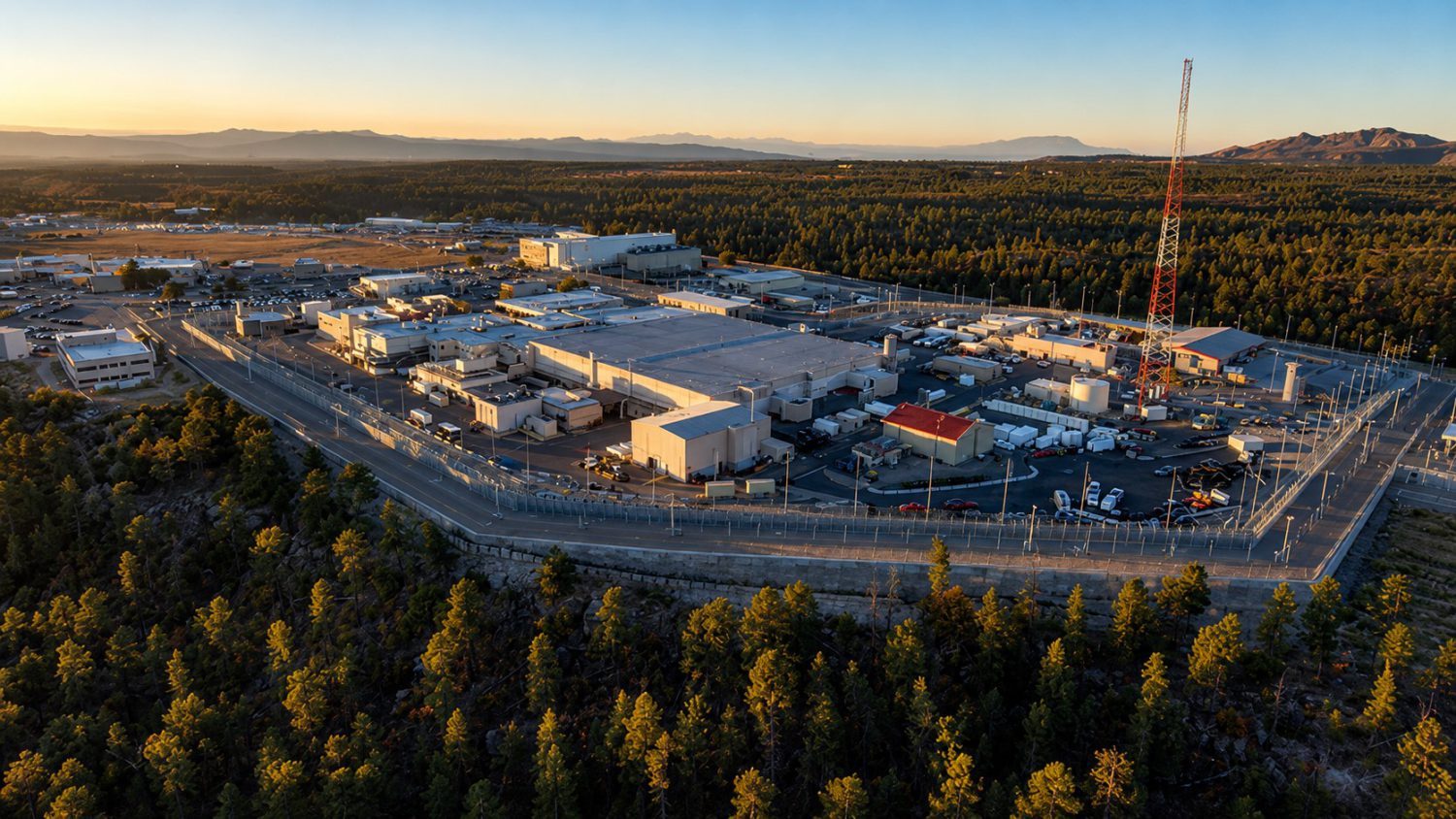
In October 2024, the National Nuclear Security Administration verified and “diamond stamped” the first war-reserve plutonium pit for the W87-1 warhead at Los Alamos National Laboratory, restoring a manufacturing capability the U.S. had not sustained since the Rocky Flats Plant closed in the late 1980s. What should concern you is what is happening to the institution designed to ensure that achievement does not come at the cost of worker and public safety. At the exact moment pit production is accelerating toward a congressional mandate of 30 pits per year, the Defense Nuclear Facilities Safety Board is telling Congress that the Department of Energy is blocking its access in ways the board describes as “the most significant in its history.”
What Is Being Built, and Why It Matters
Plutonium pits are the fissile cores of nuclear warheads, and right now exactly one building in the United States is capable of making them at scale.
Plutonium Facility Building 4 at Los Alamos, known as PF-4, is that building. NNSA intends to produce at least 30 war-reserve pits per year there, with a complementary facility at the Savannah River Site eventually bringing total national capacity to 80 pits annually, according to a 2025 Congressional Research Service report. The production goal is congressionally mandated and tied directly to the modernization of multiple warhead types, including the W87-1, as nations continue developing hypersonic missiles and other advanced delivery systems.
LANL director Thom Mason told an industry publication in January 2026 that the laboratory “exceeded all” objectives for pit production and that the diamond-stamped W87-1 pit has become a model for subsequent work, though exact production numbers remain classified. On its own terms, the production program is succeeding.
The Watchdog Being Locked Out
The Defense Nuclear Facilities Safety Board was created specifically to provide independent technical scrutiny of facilities like PF-4, and it currently cannot do that job.
DNFSB is an independent federal board whose statutory purpose is to identify safety problems at DOE defense nuclear facilities before those problems become accidents. Its 36th Annual Report to Congress states that the access constraints it encountered in 2026 are “the most significant in its history,” describing denied and delayed access to safety-basis updates and exclusion from safety and operations meetings. These are not procedural quibbles; they describe a board that cannot independently verify whether the conditions it is supposed to monitor are safe.
The structural problem runs deeper than access alone. Two board members departed during 2025, leaving only one sitting member. A single member cannot form a quorum, which means the board’s formal governance and decision-making capacity is compromised precisely when it needs to be at full strength.
A transparency gap compounds both problems. As of July 30, 2026, the most recent DNFSB weekly resident-inspector report publicly posted for LANL covers the week ending June 26, according to the American Nuclear Society. A new sensitivity-review process under development between DNFSB and DOE has paused posting of technical documents, cutting off the timely public visibility that weekly reports exist to provide.
A Fire, and a Warning History Already Wrote
A June 2026 glovebox fire at PF-4 was contained, but it surfaced pre-existing safety concerns that independent inspectors had already flagged.
On June 15, 2026, a fire broke out inside a glovebox at PF-4 during a thermal-treatment test involving non-nuclear material. A glovebox is an enclosed handling chamber used to manipulate hazardous substances without direct contact; the fire posed no criticality risk, but the glovebox remained out of service as of the last publicly posted weekly report. The incident itself was manageable. The context around it is less reassuring, echoing vulnerabilities seen across critical infrastructure when oversight gaps go unaddressed.
DNFSB’s resident inspectors had previously raised concerns that many PF-4 gloveboxes lack automatic fire suppression. A March 2026 DNFSB weekly report noted an internal letter of non-concurrence with a glovebox fire-hazard evaluation, indicating that safety professionals inside the oversight process were already disagreeing about how seriously fire risks were being assessed.
The historical baseline for PF-4 makes those disagreements consequential. During a criticality-safety crisis that began around 2011, documented near-misses and management-culture failures contributed to partial shutdowns and years of remediation at the facility. DNFSB correspondence from that period found that at least one modeled accident scenario produced public dose consequences exceeding 100 rem, requiring additional safety controls. That episode unfolded at the same building, under similar pressure to perform.
What Needs to Change
The dispute between DOE and DNFSB over access is a policy problem, and Congress is the only institution positioned to resolve it.
DOE’s position is that DNFSB sometimes seeks information or jurisdiction beyond its statutory authority, and that security obligations justify restricting certain access. DNFSB counters that DOE’s current interpretation conflicts with a 2021 memorandum of understanding both parties negotiated and agreed to. That disagreement should not be resolved through competing executive-branch memoranda. Congress must clarify the board’s access rights in statute, because the consequences of getting this wrong at a plutonium facility are not correctable after the fact.
Cost oversight faces a parallel gap. GAO has found that NNSA lacks a comprehensive lifecycle cost estimate for pit-production capability that meets GAO best practices, and such an estimate remained incomplete despite major production milestones already having passed. Congressional oversight of a program this consequential cannot function without credible, complete cost and safety information flowing to the people responsible for authorizing it.
The path forward is not complicated, even if it is politically inconvenient. Congress should restore DNFSB to full membership, put the board’s access rights beyond executive interpretation, and set a firm deadline for resolving the sensitivity-review process that has halted public posting of technical reports. Independent safety oversight is not a bureaucratic friction cost. It is the mechanism that makes sustained, credible production possible.
The United States spent decades rebuilding the expertise and infrastructure to manufacture plutonium pits safely at scale. Weakening the institution designed to verify that safety, at the precise moment throughput pressure is highest, is exactly how hard-won lessons get unlearned. The country can afford the oversight. The record at PF-4 makes clear what it cannot afford without it.