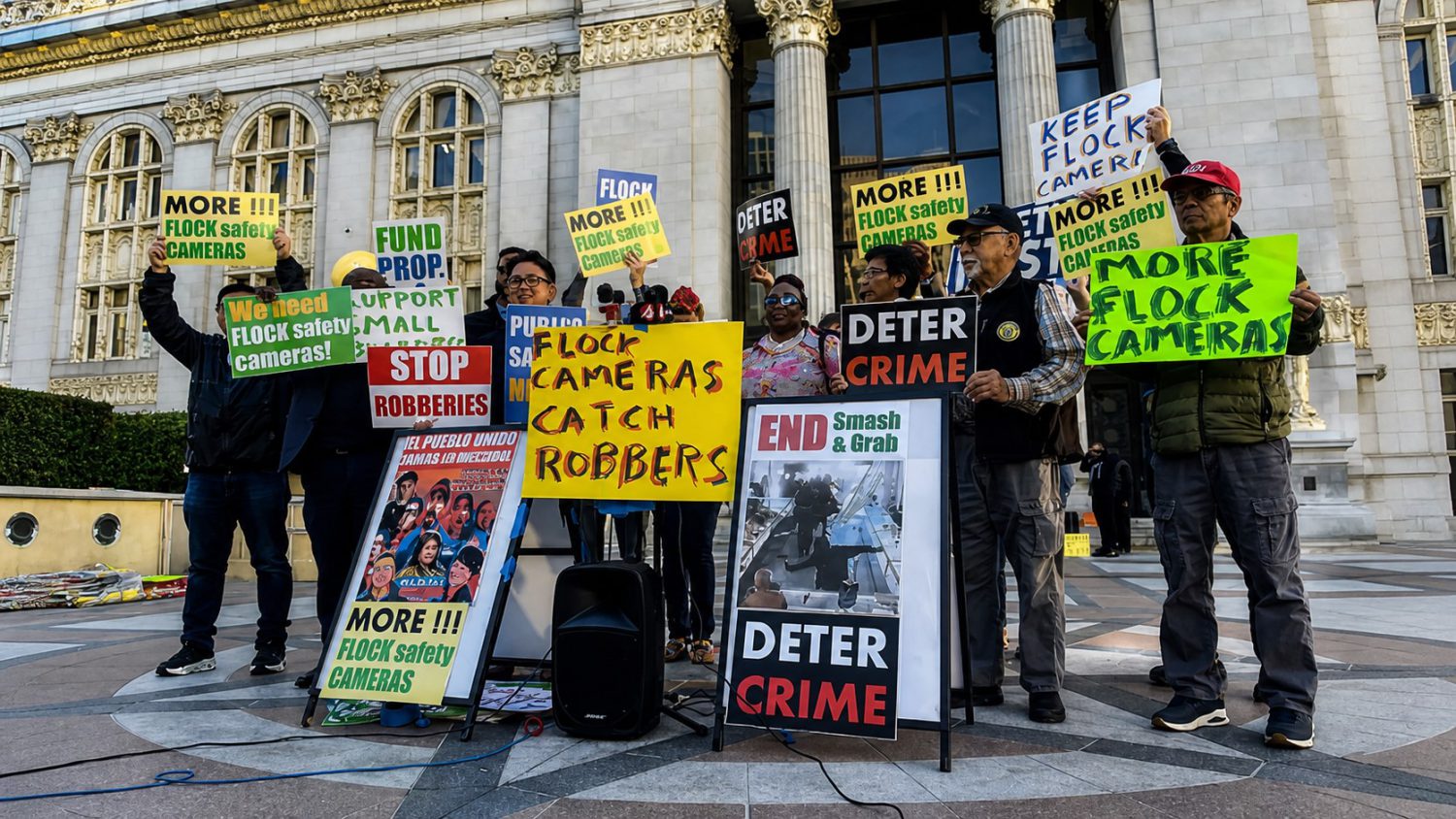
A grid of live camera feeds. A protest march filling the streets below. A company representative narrating the whole thing for a room full of officers. That’s the scene from a leaked Flock Safety training webinar, reported by Reuters, where an employee walked police through monitoring a hypothetical No Kings protest in real time — tracking traffic, watching live footage, and flagging when conditions were “starting to go sideways.” Flock Safety sells automated license plate reader (ALPR) systems to law enforcement, marketed primarily for crime investigation and stolen vehicle recovery. The webinar is the clearest demonstration yet of the gap between how that product is sold and how it can be deployed. Learn how a surveillance app was built to target political groups in a related case.
What the Video Actually Shows
The leaked training session reveals capabilities that go well beyond recovering stolen vehicles.
The webinar, also summarized by Yahoo News, shows a Flock employee guiding an incident commander through live feeds, vehicle tracking, and traffic monitoring during a protest scenario — with language about knowing when the environment is “starting to shift.” Flock pushed back, telling Reuters the clip was edited and stripped of context, including language clarifying that use must align with First Amendment-protected activity. The company says its platform targets active incidents and public safety emergencies, not lawful demonstrations.
Key findings from the Electronic Frontier Foundation’s (EFF) 2025 investigations:
- 19 agencies logged searches tied to No Kings protests in June and October 2025, across states including Washington and Texas
- EFF reviewed more than 12 million searches by more than 3,900 agencies between December 2024 and October 2025
- Hundreds of those searches explicitly referenced political demonstrations
- Some search language was deliberately vague — the EFF characterizes that as potential concealment
- Flock maintains agencies bear responsibility for using the technology consistent with law and local policy
“Its platform supports public safety at large events, emergencies, and active incidents — not surveillance of lawful protest activity,” according to Reuters’ account of Flock’s position.
The Mission Creep Problem
The webinar didn’t create this issue — it just made it impossible to look away from.
Think of it like the early days of Venmo’s public transaction feed: the tool was designed for one thing, the architecture quietly enabled another, and the guardrails arrived late. The EFF data shows agencies were already running protest-related searches before the webinar ever leaked. That context matters — this controversy didn’t start with a viral clip. Flock Safety has faced similar civil-liberties tensions in other jurisdictions.
A policy limit and a technical capability are not the same thing. Parallel concerns have emerged around government apps secretly tracking users at regular intervals, underscoring how vendor and government-side tracking can diverge from stated purposes.
Expect growing scrutiny of vendor training materials, audit logs, and contract language across jurisdictions sensitive to civil liberties concerns. The central question for you to watch isn’t whether Flock intended its system for protest monitoring — it’s whether policy guardrails can reliably constrain a network that is, by design, built to track movement at scale.