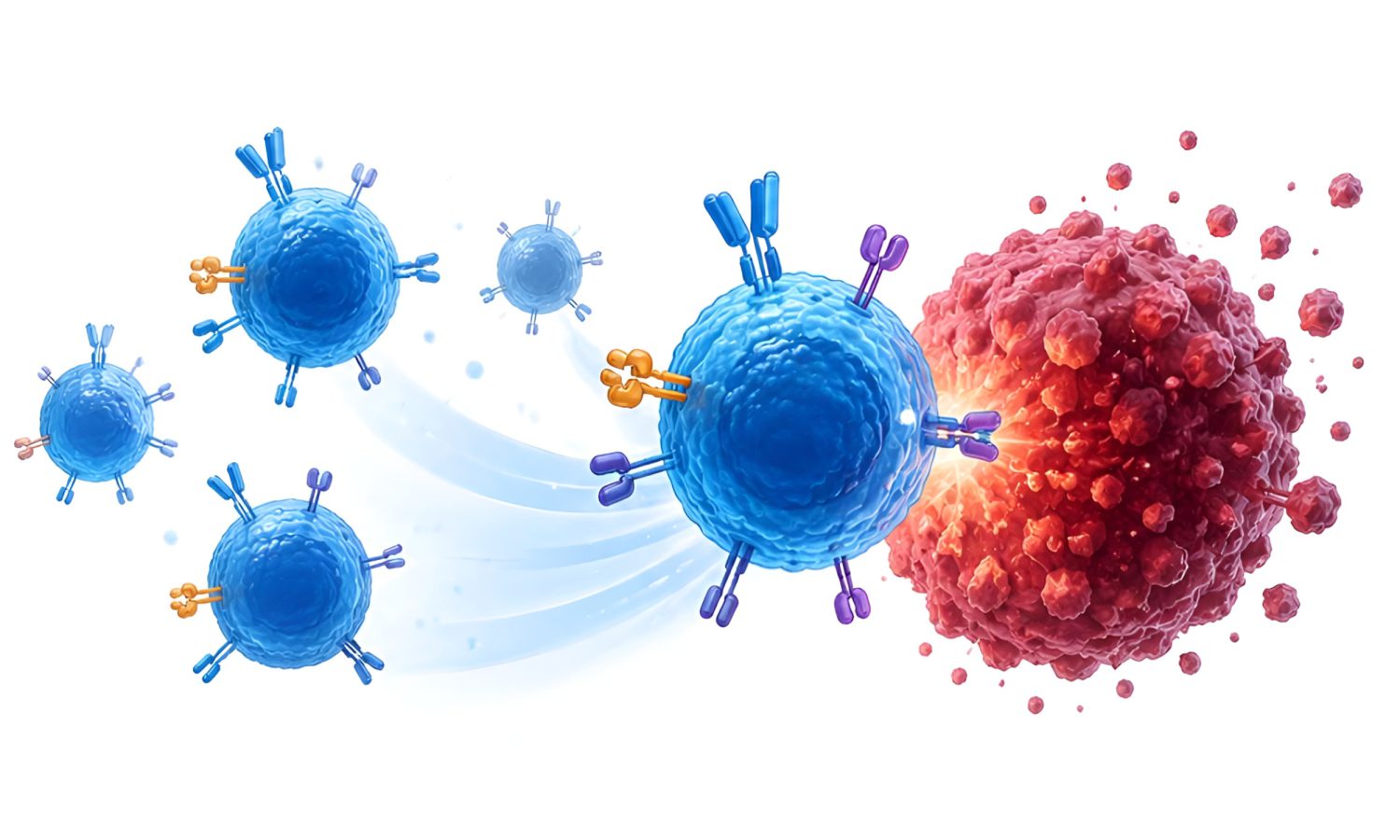
Autologous engineered T-cell therapies cost hundreds of thousands of dollars per patient, take weeks to manufacture, and require harvesting cells from the same person they’re meant to save. UCLA researchers published findings in Cell Reports Medicine in August 2026 describing AlloESO-T cells — engineered from donated cord blood, frozen, and ready to ship — with an estimated cost around $5,000 per dose. That cost contrast is significant. So is the caveat: this is preclinical. Mouse models only. No human trials yet.
The target is solid tumors — ovarian cancer, melanoma, prostate — where existing cell therapies have largely stalled.
How These Cells Work (and Why That’s Hard)
TCR therapy reaches inside cancer cells to find targets that CAR-T simply cannot.
CAR-T therapy targets proteins sitting on the outside of cancer cells. It works well for blood cancers, but solid tumors are trickier — their key driver proteins are locked inside the cell. TCR therapy accesses those internal proteins through HLA molecules, which flag peptide fragments on the tumor’s surface like a shipping label on a sealed package. AlloESO-T cells carry a TCR engineered to read one specific label: NY-ESO-1, a protein expressed across melanoma, ovarian, and lung tumors.
What Makes AlloESO-T Different
Four engineering decisions separate this platform from conventional donor T-cell approaches.
- Cord-blood stem cells receive the NY-ESO-1 TCR before maturing into T cells — so every resulting cell carries the same receptor, with no rogue endogenous TCRs triggering graft-versus-host disease.
- NK cell receptors serve as a backup targeting system, killing tumor cells that attempt to hide by downregulating NY-ESO-1.
- In mouse models, cells expanded roughly 100-fold after infusion, migrated to tumors, and left healthy organs alone — while conventional donor T cells in the same studies caused organ toxicity consistent with GvHD.
- One cord-blood donation produces trillions of therapeutic cells within about six weeks.
Engineering the TCR at the stem-cell stage solves the GvHD problem by design. As co-first author Yichen Zhu explained, “essentially all of the resulting cells carry the same receptor and go after the same tumor target.” The comparison group — donor-derived TCR-T cells — partially controlled tumors but damaged healthy tissue. Uniform, defined mission versus unpredictable receptor mix.
Solid tumors are also notorious for antigen escape: they shed or hide the protein a therapy targets, leaving a precision treatment with nothing to hit. The NK receptor layer addresses that directly. In vitro tests against melanoma, ovarian, and prostate cancer cell lines showed the dual-targeting system killed tumor cells even when NY-ESO-1 was downregulated — closing a known escape route that undermines single-target approaches.
The Platform Play – What’s Still Missing
The real ambition here is a manufacturing architecture that scales across multiple solid-tumor targets.
Swap in a validated TCR for a different tumor antigen and the same system produces a new targeted product. It functions less like a single drug and more like an app store for immune cell therapies — same underlying infrastructure, different payloads. Co-senior author Lili Yang describes the vision as a future where “the product is already made, frozen and ready to go as soon as the patient needs it.” Co-senior author Yanruide Li puts the estimated per-dose cost at around $5,000, a potential order-of-magnitude drop from current bespoke therapies. CIRM has funded related work, and UCLA Health’s Center for Advanced Biotherapies supports manufacturing infrastructure for the broader platform.
Mouse results frequently overestimate human outcomes — that’s not pessimism, it’s the field’s track record. AlloESO-T cells have not entered human trials and carry no FDA approval. What merits continued attention is the manufacturing efficiency and the safety profile observed in preclinical models. If early-phase human trials confirm both, solid-tumor patients may have access to a cell therapy built for scale — rather than one reserved for those who reach a top academic center at exactly the right moment.