You are on a two-lane road at night. An oncoming truck crests a hill. For a fraction of a second — the kind that matters — you’re effectively blind. That’s not bad luck. That’s physics and policy failing at the same time.
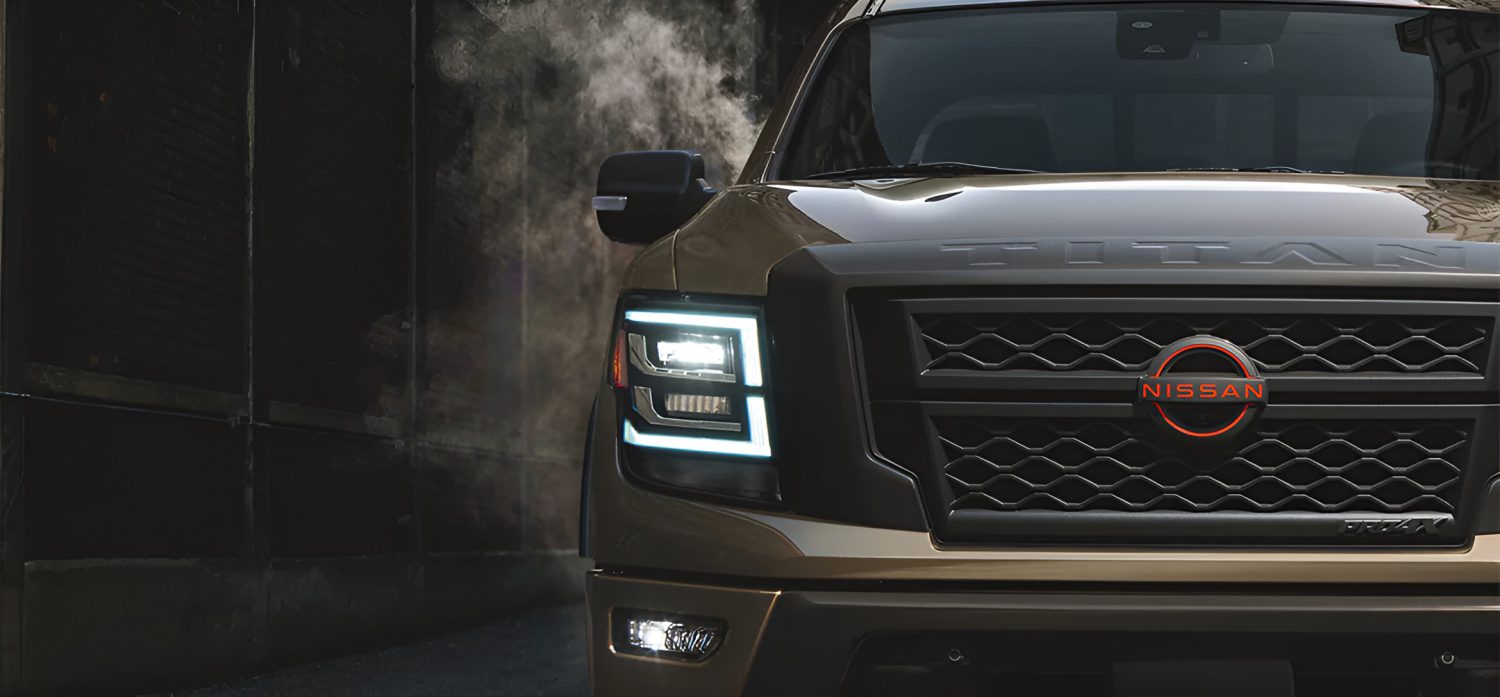
Eyewear company Overnight Glasses analyzed IIHS headlight ratings across 257 vehicles, combining raw glare measurements with vehicle height to build a “glare index” that reflects how much light actually lands in other drivers’ eyes. The second-generation Nissan Titan (2017–2024) came out worst, clocking headlight glare 615.1% above IIHS’s glare threshold. The rest of the podium reads like a truck-stop parking lot:
- Nissan Titan — glare index 100 (615.1% over IIHS threshold)
- Chevrolet Silverado 1500 — 2nd
- Ram 1500 — 3rd
- GMC Sierra 1500 — 5th
- BMW X5 xDrive45e — index 95.6 (certain configurations reach 677.8% over IIHS limits in raw glare, but lower ride height keeps it off the top spot)
- Ford F-150 — 10th, notably more moderate than its full-size peers
The BMW X5 is the instructive outlier. Its worst-case raw glare actually exceeds the Titan’s, but because its headlights sit closer to sedan height, more of that light hits the road rather than oncoming drivers’ eyes. Vehicle height isn’t just a styling choice — it’s a targeting system.
Outdated Rules, Modern Headlights
Federal lighting standards haven’t explicitly addressed discomfort glare in any human-factors sense, and automakers are well aware.
While automakers point confidently to federal compliance, FMVSS 108 — the U.S. regulation governing vehicle lighting — does not explicitly regulate discomfort glare based on human-factors criteria, relying instead on photometric limits. IIHS’s threshold (no more than 10 lux at 5–10 meters from an oncoming driver) is voluntary, influential through ratings and consumer pressure rather than law. Running today’s high-output LED arrays under rules written for a different era is essentially asking modern apps to run on a decade-old operating system. Something’s going to break.
“Six in 10 U.S. drivers say headlight glare is a problem when driving after dark, and nearly three-quarters believe the problem has worsened over the past decade.” — AAA national survey, March 2026
To be fair, IIHS data show glare cited in only 1–2 of every 1,000 nighttime crashes. Inadequate visibility — not enough light — is statistically the larger safety problem. There is genuine progress, too: roughly 21% of tested headlight systems produced excessive glare for 2017 models; for 2025 models, that figure has dropped to 3–5%. But six in 10 drivers reporting a problem isn’t a niche complaint. That’s a product failure at scale — the lighting equivalent of a streaming platform that keeps raising volume until nobody wants to watch anymore. Adaptive driving beam headlights, already standard across Europe, can dynamically shape beams around oncoming drivers without sacrificing visibility. U.S. regulations are only now beginning to allow them.
What You Can Actually Do Right Now
Federal rules may move slowly, but your next purchase decision doesn’t have to wait.
IIHS headlight ratings are free, searchable, and updated regularly. Before your next truck or SUV purchase, check the headlight score alongside towing capacity — it deserves equal weight. The Titan’s glare problem isn’t a secret anymore. Neither is the regulatory gap that made it possible.