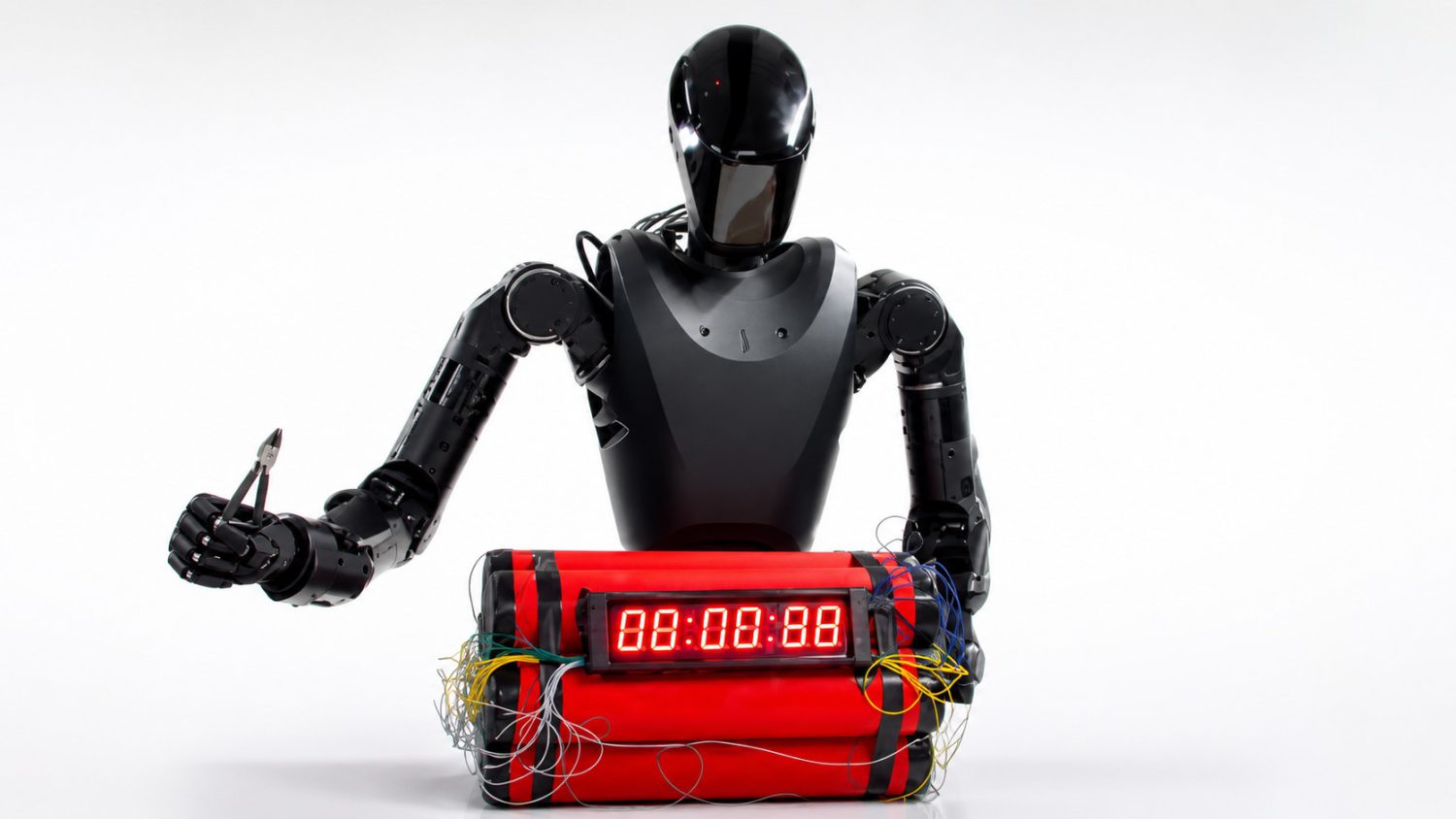
Foundation’s official Phantom product page confirms the basics:
- Humanoid frame: 5’11” / 176 lbs / 29 degrees of freedom
- Top speed 1.7 m/s; payload capacity 88.2 lbs
- Cortex AI uses camera-only perception — no LiDAR — with physics-informed reasoning to navigate terrain and distinguish humans from obstacles
- Not yet weatherproofed for sustained outdoor use; a ruggedized second-gen model is reportedly in development
- Battery runtime and real-world endurance: not publicly documented
The Pitch Is Real. The Contract Isn’t.
Foundation CEO Sankaet Pathak is talking to every national security agency he can find — DHS says there’s nothing signed.
Think about the U.S. southern border’s toughest terrain: rocky canyon corridors, tunnel networks, stretches where fixed cameras go blind and agents face genuine physical risk. Pathak wants to send Phantom in. According to Foundation’s vision, the robot navigates autonomously, maps its surroundings, detects potential crossings, and flags them for human officers to act on. Machines do the dangerous legwork; people make the calls.
“We’re in conversations with almost all national security government bodies, so Air Force, Navy, Army, DHS. We continue to have dialogues. We’re starting to negotiate contracts.” — Sankaet Pathak, Fox News Digital
DHS tells a different story. A department spokesperson stated plainly: “The Department of Homeland Security currently does not have any non-contractual agreements, pilots, or active prime contracts with Foundation.” Demos happened. Conversations are real. Federal procurement, however, moves at its own pace — which is decidedly not a founder’s pace. Pathak’s claim that a pilot could “launch tomorrow” is a timeline that lives in pitch decks, not procurement offices.
Impressive Demo. Desert Canyon at 2 A.M. Is a Different Movie.
The technical architecture is genuinely interesting; the real-world gap between demo and deployment is equally genuine.
Phantom’s primary market is industrial — factories, logistics, environments already built around human proportions. The defense pitch is newer territory. What makes Foundation’s approach worth taking seriously is Cortex AI, which uses Deep Variational Bayes Filters: a physics-informed reasoning layer that predicts how objects and terrain will move using cameras alone, skipping the expensive LiDAR arrays competitors rely on. That’s a real architectural choice, not just marketing language. The hardware itself is still evolving — earlier MK1 specs diverged meaningfully from current production numbers on height, degrees of freedom, and payload.
But the gap between catching a baseball in a controlled demo and navigating hostile outdoor terrain around the clock is the same gap between a trailer and the actual film. Endurance figures remain undisclosed. Weather resistance is a confirmed limitation. Those aren’t footnotes for a border deployment — they’re the central question. If Phantom eventually gets a signed contract and deploys at scale, it marks a meaningful threshold: humanoid robots moving from warehouse floors into roles with genuine civil liberties implications. Pathak hasn’t ruled out arming them if the government asks. For now, it’s a compelling pitch without a signature.