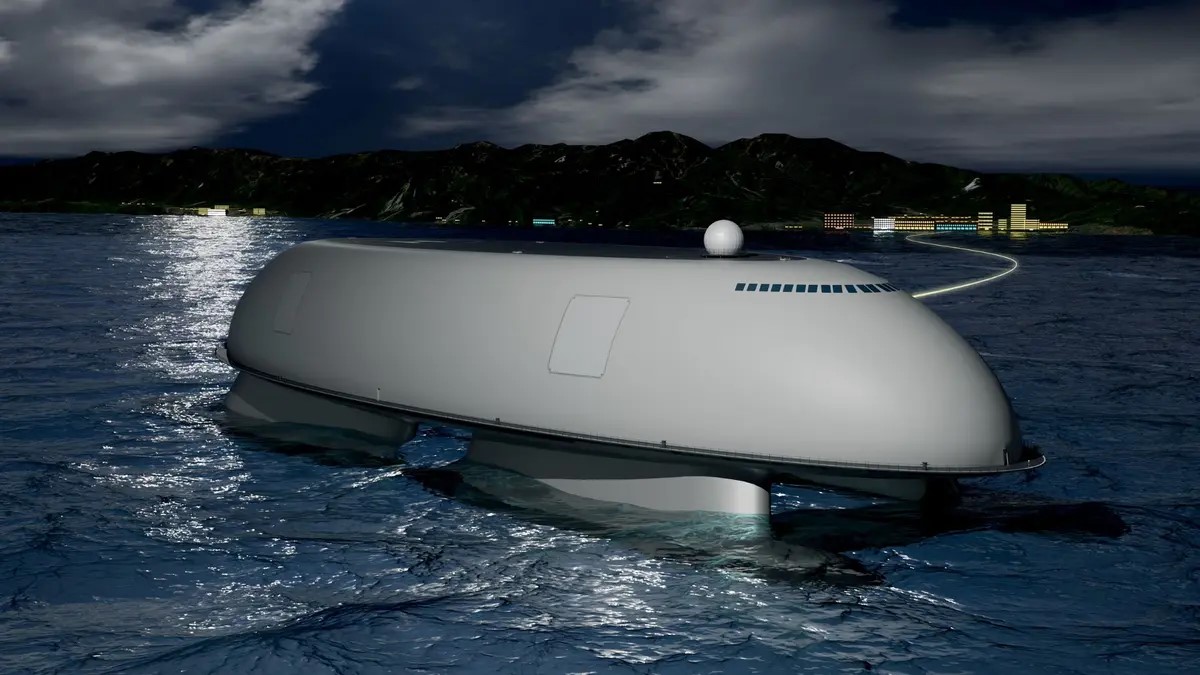
Anchored off a coastline with none of the usual infrastructure attached, the VITAL 100 MW Kraaken reportedly delivers electricity to 32,000 homes and fresh water to 150,000 people simultaneously. That’s the pitch from Optimal Transit for its floating platform, built on a SWATH hull — a twin-hull form designed for offshore stability — and powered by the company’s patented Digital Ocean Thermal (DOT) engine, which draws energy from ocean temperature gradients rather than combustion.
The numbers Optimal Transit is publishing:
- 40 MW of clean electricity exported to shore — enough for roughly 32,000 homes
- 7.9 million gallons of desalinated fresh water per day, serving an estimated 150,000 people
- 60 MW retained onboard for high-performance AI compute and sovereign data workloads
- Zero-emission, fuel-free operation via the DOT engine
- A quick-disconnect umbilical system that allows full relocation within hours
Where conventional desalination plants demand years of permitting and construction, the Kraaken deploys and connects. Optimal Transit contends that building equivalent land-based infrastructure runs between $750 million and $1.33 billion — framing the vessel as the faster, cheaper alternative. That comparison originates from the company itself, so apply the appropriate grain of salt.
The mobility argument, though, stands on its own: if conditions change, the platform leaves.
“Serve the equivalent of a small city offshore without connection to the existing grid.” — Jeff Kline, president of InMar Technologies
Who Actually Needs This
The Kraaken’s most credible use cases are in the places conventional grids have consistently failed.
Pacific island nations running diesel generators around the clock. Coastal communities across sub-Saharan Africa where grid access remains largely theoretical. Parts of South and Southeast Asia where a single storm can erase infrastructure for months. These are the markets where the Kraaken’s promise stops sounding like a press release and starts sounding like genuine relief.
The vessel is also positioned for disaster response — essentially a plug-in city utility that could arrive within days of a crisis, delivering power and clean water before permanent rebuilding begins.
Scale up to five vessels operating as a cluster — Optimal Transit’s “Sovereign Power Park” concept — and the numbers reach 200 MW of power, 40 million gallons of water daily, and 300 MW of compute capacity. It’s the modular approach applied to national infrastructure: standardized, stackable, and repositionable, not unlike the way containerized cloud computing replaced the era of single-purpose data centers.
The concept is ambitious. The execution is entirely unproven. No independent engineering validation appears in available reporting — everything here flows from Optimal Transit’s own announcements. That’s not disqualifying on its own. It’s simply where the story actually stands, and that gap between a compelling announcement and a commissioned vessel is the part worth watching.