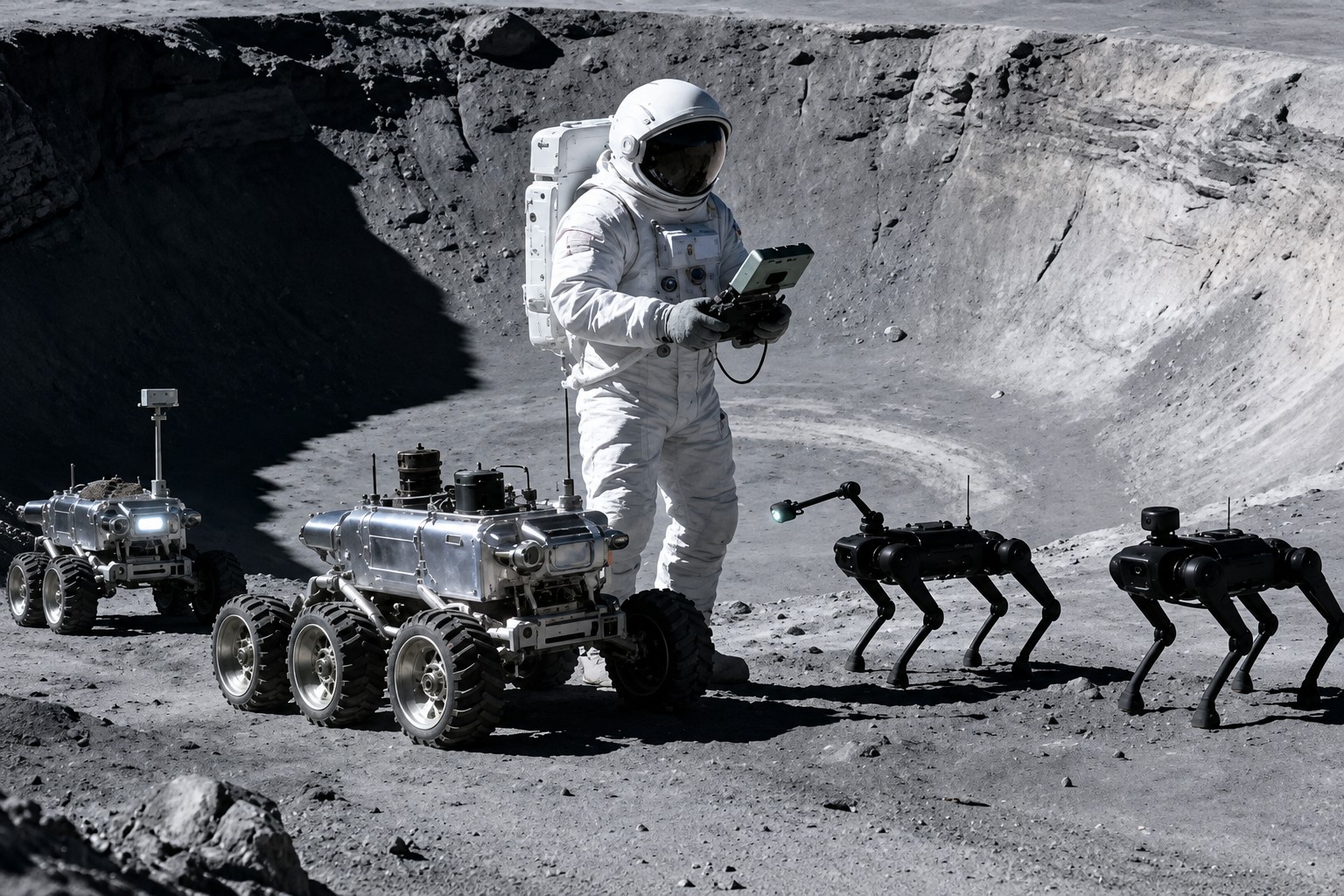
A 2024 blueprint from China Academy of Space Technology-affiliated researchers proposes a Moon base where the construction crew walks on four legs. China’s International Lunar Research Station — a joint CNSA-Roscosmos project targeting basic construction by 2035 — includes a concept for two quadruped robots working alongside three astronauts on the lunar surface. This isn’t a confirmed mission manifest. It’s a research proposal, detailed and specific enough to take seriously, but still years from anything resembling a launch date. Think of it as the architectural sketch before anyone’s signed the permit.
The Job Description Nobody Asked For
These robot dogs wouldn’t fetch — they’d patrol, build, and reportedly offer emotional support.
The proposed duties, outlined in the journal Chinese Space Science and Technology, read like a LinkedIn profile written by an overachieving golden retriever:
- Patrolling the research station and scouting hazardous terrain
- Identifying scientifically useful rocks and collecting samples
- Supporting construction and infrastructure assembly
- Running station inspections, environmental checks, and maintenance
- Providing psychological and emotional support during long-duration isolation (yes, really)
That last bullet deserves a raised eyebrow. But the engineering logic behind quadrupeds is genuinely sound. Wheeled rovers choke on rubble, cave openings, and tight inspection corridors. Four legs handle obstacles the way Boston Dynamics’ Spot handles warehouse floors — with adaptability that wheels simply can’t match. Lava tubes, uneven regolith, narrow station corridors: legs win.
According to the researchers’ framework, astronauts would handle higher-level decision-making while robots execute autonomous tasks — scouting, hauling, monitoring — without constant human direction.
Here’s the hard problem. Every autonomous system trains on Earth data. The Moon offers none of that. No GPS. No familiar terrain maps. No pre-existing communication infrastructure. China is planning a lunar communication network — anchored by the already-launched Queqiao-2 relay satellite and its Tiandu pathfinder companions — but that constellation remains in active development. The gap between concept and operational capability is real, and worth naming clearly.
From Explorer to Construction Worker
China’s lunar strategy signals a fundamental shift in how robots earn their keep in space.
The robot-dog concept fits a larger pattern inside CNSA’s roadmap. The vision isn’t machines that look around anymore — it’s autonomous infrastructure workers handling construction, logistics, and station maintenance before large-scale human habitation begins. A team from Peking University has already tested two prototype quadrupeds inside a lava-tube cave in northeastern China, chosen specifically for its lunar-underground similarities. Near-term progress looks like that: Earth-based simulation, not a dog-shaped rocket payload.
The timeline gap mirrors any ambitious deep-tech rollout you can name — directionally credible, engineering-honest, and perpetually dependent on prerequisites that aren’t solved yet.
The robot dog Moon base isn’t science fiction. It isn’t a booked flight either. What it represents is China’s clearest articulation yet of how autonomous systems could underpin long-duration human habitation beyond Earth.
Whether quadrupeds actually set paw on lunar soil depends on solving communication, navigation, and AI-training problems that currently have no off-the-shelf answers.