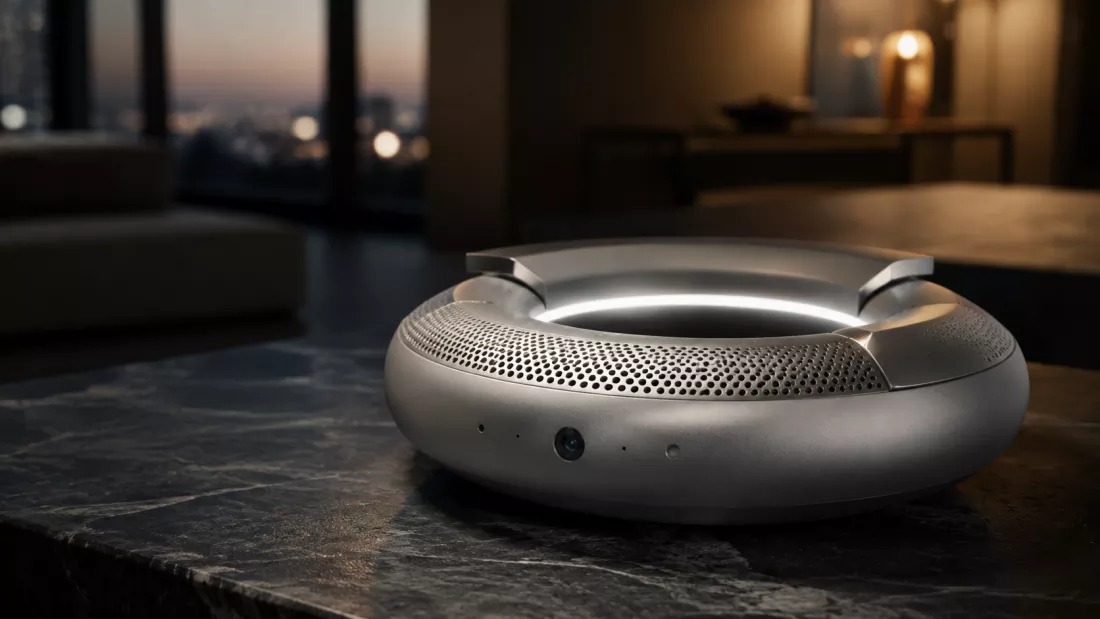
Most smart speakers sit on your counter like expensive paperweights that occasionally mishear you. OpenAI wants something different. Its first consumer hardware product — a screenless, doughnut-shaped speaker designed by Jony Ive’s LoveFrom studio — reportedly costs between $300 and $400 and includes mechanical parts that physically animate when it responds. Think less “Alexa, set a timer” and more “a metal ring that fidgets while explaining quantum physics.” The central question: at that price, does physical charm actually translate to utility?
Jony Ive’s Next Act Comes With a Motor
The same design instincts behind the original iPhone now live inside a hockey-puck-sized ring with a motor.
Here’s what Bloomberg and TechCrunch report about the device so far:
- The ring-shaped body is roughly hockey-puck sized, with a central hole designed for one-handed carrying between rooms.
- It’s built from high-quality metal and runs on a built-in battery — no cord tethering it to your kitchen counter.
- Mechanical moving parts shift and animate during responses, paired with LED lighting to signal listening state.
- A built-in camera and environmental sensors provide visual context, letting the device answer questions about objects in the room.
- It runs advanced full-duplex ChatGPT-style voice models that reportedly learn user preferences over time.
- The targeted launch is 2027, with a possible late-2026 reveal.
The moving parts are the genuine wildcard. Not a pulsing LED ring like your Echo. Actual motor-driven mechanical motion. Gizmodo’s early framing described it as closer to “a squirming AI robot” than a conventional speaker — which is either exciting or unsettling depending on your relationship with anthropomorphized gadgets. The Ive pedigree is unmistakable: the same design sensibility behind the iMac G4 and the original iPhone’s aluminum spine, now applied to something that fits in your palm. Sam Altman described an early prototype as “simple, beautiful, and playful” — though that characterization stems from a social media summary of the event rather than a direct transcript, so treat it as reported color, not confirmed fact.
On the software side, full-duplex voice means the device can listen and speak simultaneously, ditching the rigid turn-taking that makes current assistants feel like walkie-talkies. But battery life, audio quality, latency, privacy controls, and smart gadgets compatibility remain entirely unknown. No one outside OpenAI’s walls has touched this thing.
Apple’s Lawsuit Is Already Complicating Things
Legal friction arrived before a single unit shipped, and the irony is impossible to ignore.
Apple is suing over allegations that OpenAI misled one of Apple’s manufacturing partners into applying a confidential metal-finishing technique to this device. OpenAI fired back in its motion to dismiss, stating it is “building something entirely new and different from anything at Apple,” as reported by Reuters and AppleInsider. The irony is hard to miss: the designer who defined Apple’s visual identity is now building its most direct AI hardware rival, and the litigation landed before any consumer could buy a unit. If that framing sounds familiar, remember the Humane AI Pin — a premium, design-forward AI hardware bet that shipped and immediately underwhelmed. Ambition and aesthetics alone don’t close the gap between concept and value.
At $300-plus — well above a standard Amazon Echo’s roughly $50 entry point — this device needs to out-think your current assistant, not just out-dress it. The 2027 timeline gives OpenAI runway. Whether that’s enough remains genuinely unclear.