You live in a farming town famous for garlic. One morning, cranes appear on a 56-acre lot down the road. Nobody told you about it. Nobody had to. The rise of data centers is reshaping communities across the country with little public input.
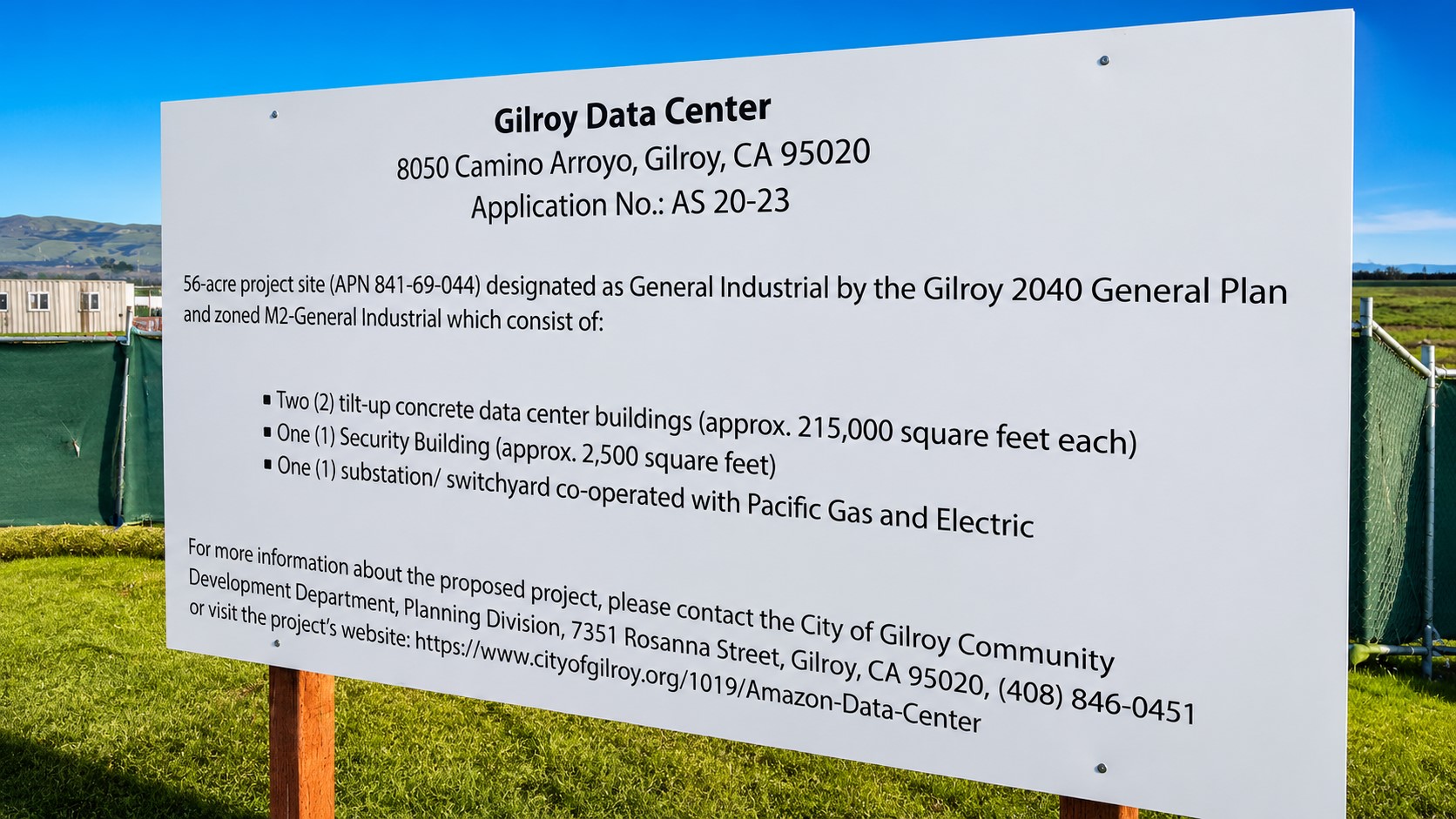
Amazon Web Services bought the parcel at 8050 Camino Arroyo in 2020. The company and city negotiated for years. On July 3, 2023, Gilroy’s community development director signed off on a roughly 438,500-square-foot data center — first phase alone running about 218,000 square feet. No City Council vote. No Planning Commission hearing. According to official city project materials, no public hearing was required. By the time residents started asking questions, the project was already under construction.
The Permit That Nobody Voted On
Decades-old industrial zoning let a staff-level approval greenlight a $2 billion facility without a single public meeting.
Gilroy’s zoning framework dates back decades. The land was tagged industrial long before anyone imagined a hyperscale cloud campus landing there. Mayor Greg Bozzo noted that prior industrial projects moved through the same channel without controversy. Warehouses, food processing plants — same rules, same process. The difference is scale. A $2 billion data center is not a garlic dehydration facility.
The rules were followed perfectly. That’s the uncomfortable part.
Residents have zeroed in on water use — a charged issue in an agricultural region — along with fire risk and the structural impossibility of meaningful input. Their objection isn’t that someone broke the law. It’s that the law never required their participation in the first place. Think of it like a terms-of-service update burying a major policy change in paragraph 47: technically disclosed, practically invisible.
Amazon’s Roger Wehner acknowledged the gap. According to Wall Street Journal reporting, Wehner said the company recognized the community wanted earlier engagement and had since hosted an open house for residents.
A Playbook Playing Out Everywhere
Gilroy’s experience previews what dozens of communities with legacy industrial zones may soon face.
This pattern extends well beyond one California town. Hyperscale data centers are landing across the country through identical staff-level permitting channels, drawing scrutiny over AI infrastructure investment and concerns including:
- secrecy
- water demand
- emergency preparedness
The mechanism Amazon and Google and other tech giants have used is available in most municipalities with legacy industrial zoning. If your town has an old industrial zone — and most do — this story may already be about your town.
Gilroy officials are now weighing code changes that would require planning-commission review, community meetings, and neighbor notifications for future data centers. That response tells you everything. The rules worked exactly as written. And that’s precisely why they’re being rewritten.