Most quantum computers demand conditions hostile to human life. Millikelvin temperatures. Dilution refrigerators the size of industrial freezers. Teams of physicists babysitting hardware around the clock. SAXON Q, a Leipzig-based startup spun out of Universität Leipzig in 2021, just announced two diamond-based quantum processors — the SXQ128 (128 qubits) and SXQ512 (512 qubits) — that skip all of that. Both systems slot into standard server racks, draw normal power, and run continuously at room temperature. Orders are open now. The SXQ128 ships within three months of ordering.
The Yield Problem That Stumped Physics for Three Decades
SAXON Q’s patented sulfur co-implantation process turned a historically dismal 10% success rate into 85%, making diamond qubits manufacturable for the first time.
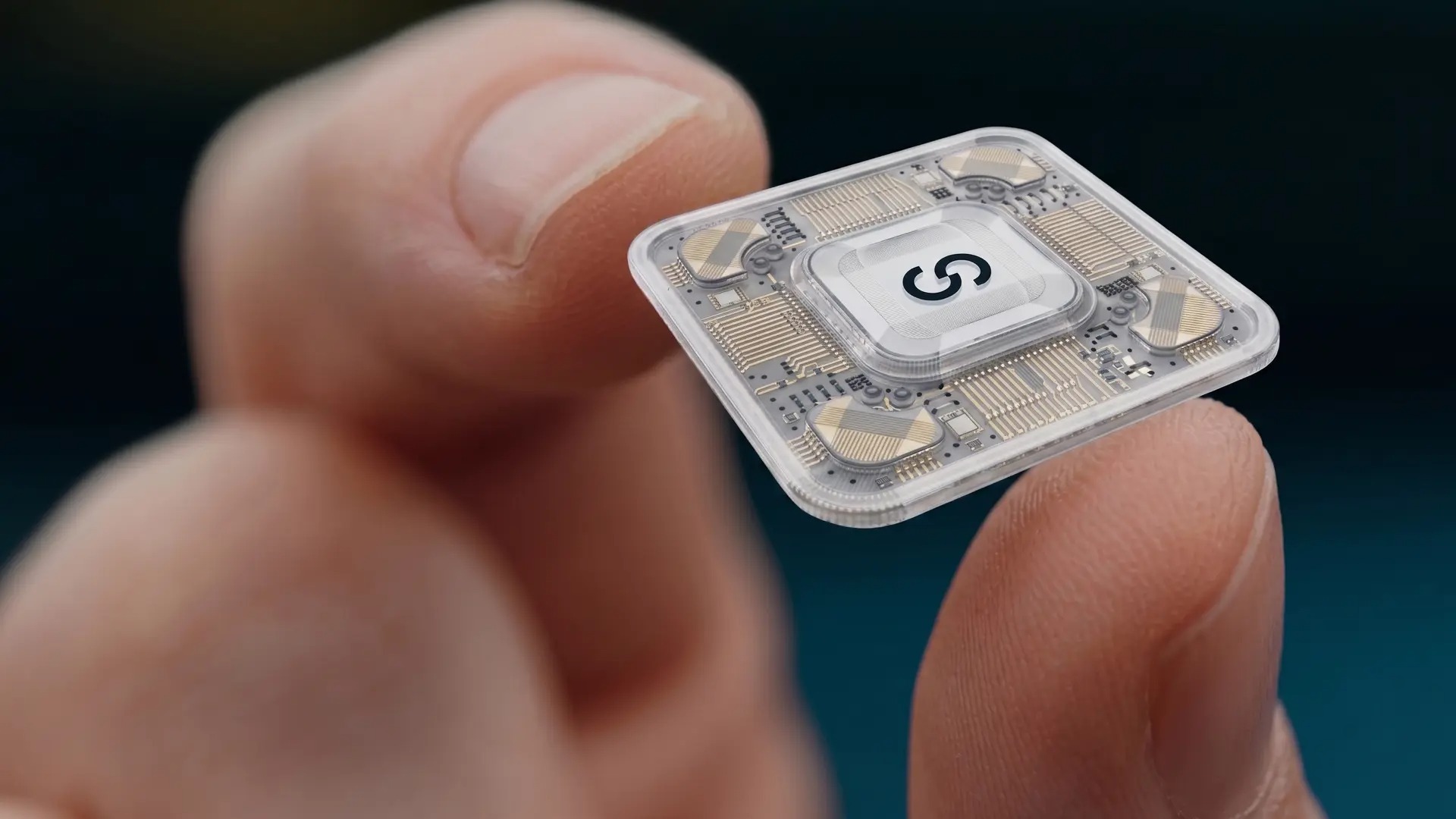
The technology hinges on nitrogen-vacancy centers — point defects in synthetic diamond where a nitrogen atom and an adjacent gap in the crystal lattice form a spin qubit that maintains coherence for milliseconds at room temperature. Well-documented physics, in other words. The manufacturing was the wall.
Historically, only 1 to 10 percent of implanted NV centers actually worked. Think of it like running a chip fab where nine out of ten processors come off the line dead — for thirty years straight. SAXON Q reports its patented sulfur co-implantation process pushes that yield above 85 percent, enabling the dense, predictable qubit arrays needed for scalable production. Gate fidelities reportedly hit 99.92 percent, meaning fewer than one error per thousand operations.
“For thirty years, NV-center quantum computing was a question of manufacturing — whether we could place qubits with enough precision and yield to build something that works outside a laboratory,” SAXON Q CEO Marius Grundmann said, according to The Quantum Insider. “We solved that problem.”
The SXQ128 ships within three months of order and targets:
- Quantum chemistry
- Variational algorithms
- Amplitude estimation
It features eight fully entangled qubits per core across its 128-qubit architecture. The SXQ512 — 16 entangled qubits per core — is built for quantum convolutional neural networks and heavier industrial workloads, with shipments beginning Q2 2027. Both systems are rack-mounted, require no cryogenics or vacuum chambers, and run on standard power. The company claims 6–10× better energy performance versus GPU clusters on equivalent workloads, though that figure is self-reported and awaits independent verification. SAXON Q’s roadmap targets 10,000-qubit architectures and eventual chip-scale quantum coprocessors, backed by more than 220 patents and pending applications.
Real-World Validation, Real-World Caveats
Fraunhofer IWU has run SAXON Q hardware continuously since mid-2025 — but independent benchmarks at the 512-qubit scale don’t yet exist.
Third-party deployment provides some grounding. Fraunhofer IWU put an earlier SAXON Q mobile system to work in June 2025 for industrial optimization in material processing and robotics. Albrecht Hänel, Head of Digital Production Twin at the institute, reported the system “has operated at room temperature continuously since installation — and has exceeded the gate fidelity specifications we outlined in the tender.” The German Aerospace Center (DLR) is also among current users of earlier SAXON Q hardware.
That said, context matters. Superconducting systems from major tech firms still lead in raw qubit counts and software ecosystem maturity. Academic literature flags persistent challenges in uniform large-scale NV fabrication and qubit coupling at higher counts — and real-world performance at 512 qubits remains unproven outside SAXON Q’s own labs. The 85% yield and 99.92% fidelity figures rest on company-reported data alone; independent benchmarks would substantially strengthen the case.
Quantum hardware is beginning to look less like a physics experiment and more like something your IT department could rack and forget. Whether SAXON Q’s manufacturing breakthrough holds at scale will determine if that shift is real — or just a very well-polished diamond.