Palantir charges governments millions per year for the kind of situational-awareness dashboard that makes analysts feel like they’re running a Bond villain’s control room. Elie Habib, co-founder and CTO of Middle Eastern music streaming platform Anghami, apparently decided that was absurd. So he built a functional equivalent over a single weekend, put it on GitHub under an open-source license, and walked away. The project is called World Monitor, and it is not a toy. Much like the surveillance app built by US operatives, it demonstrates how powerful intelligence tooling can emerge outside traditional government channels.
What 500 Live Feeds Look Like on a Single Screen
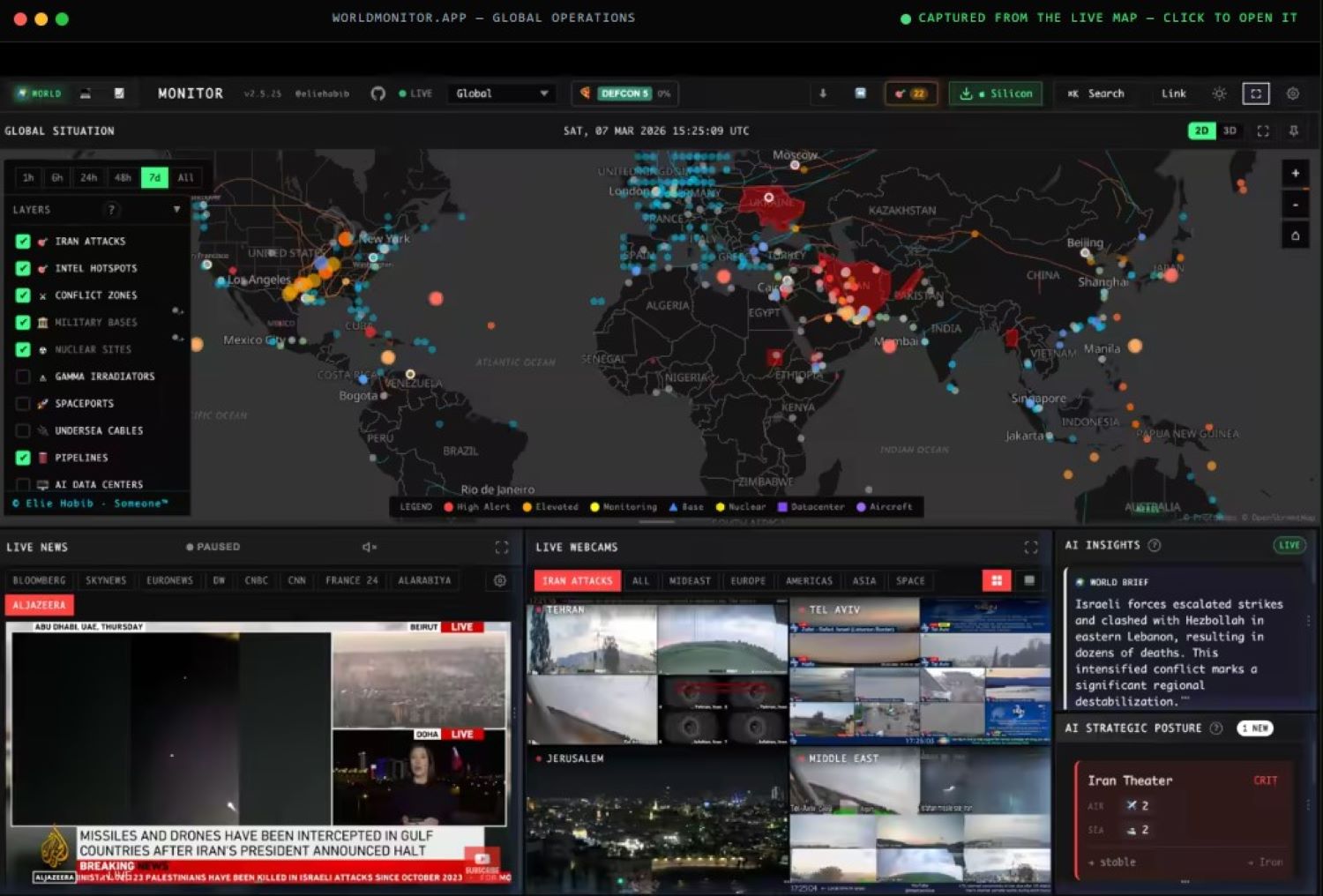
World Monitor aggregates military tracking, financial markets, cyber threats, and natural disasters into one interactive globe.
The dashboard fuses over 500 curated feeds from 65-plus external providers into a dual map engine — a 3D globe powered by globe.gl and a flat map powered by deck.gl — with up to 56 stackable overlay layers. It renders at 60fps without heavy frameworks. Six themed variants ship from a single codebase: world, tech, finance, commodity, energy, and — genuinely — “happy news.”
- 500-plus live feeds spanning military flights, naval vessels, cyber threat indicators, protests, undersea cables, satellite fire detection, and financial markets
- Up to 56 toggleable map layers across geopolitical, infrastructure, and market data
- Three-stage AI threat classification: event ingestion, threat scoring, and focal-point flagging where multiple signals converge
- Native desktop app built with Tauri 2 for Windows, macOS, and Linux, supporting 25 languages
- Fully local AI via Ollama or LM Studio — no API keys, no cloud dependency
A music streaming executive building government-grade intelligence infrastructure as a weekend project and giving it away for free sounds like a parody of Silicon Valley’s “move fast and break things” era. It is not.
Your Data Never Leaves Your Machine
Local AI operation means privacy-sensitive users can run sovereign intelligence infrastructure directly from a laptop.
The local AI pipeline is what separates World Monitor from a flashy visualization demo. Point it at an Ollama instance running a model like llama3.1:8b on localhost, and the entire summarization and threat classification system operates without a single byte hitting a cloud provider. No API keys, no per-token costs, and no third party touching your queries. For journalists covering conflict zones or researchers monitoring sensitive infrastructure, that distinction matters enormously — particularly as government health, financial, and legal data face tightening restrictions on cloud handling across major jurisdictions.
Cloud LLMs via Groq or OpenRouter remain available for users who prefer them — but the on-prem path is fully supported out of the box.
The project sits on GitHub under username koala73 with AGPL-3.0 licensing, and optional commercial terms exist for teams needing closed-source deployments.
This kind of capability used to require a government contract and a budget line item with enough zeros to make your CFO faint. Now it requires a terminal window and about fifteen minutes.