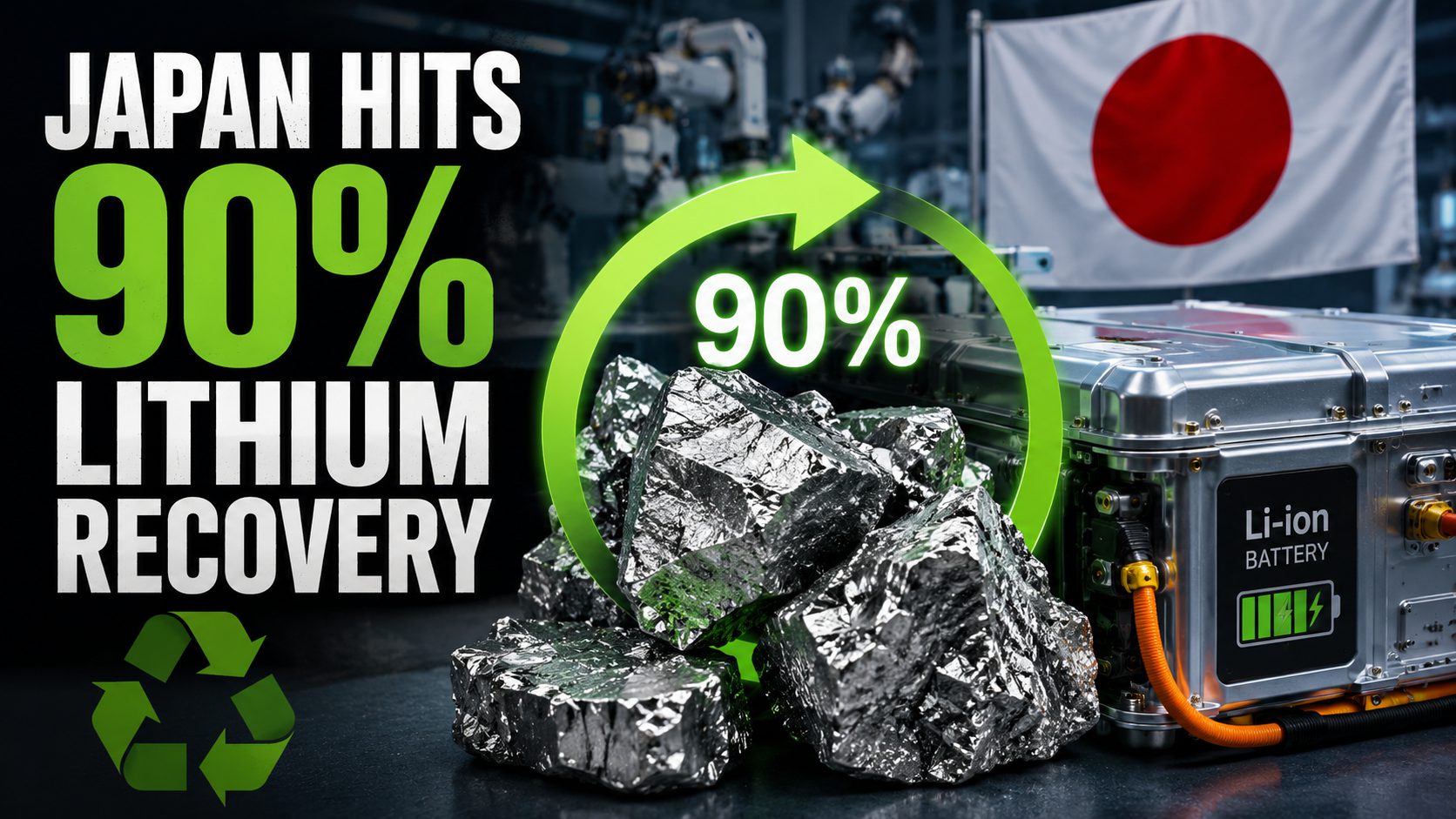
Most battery recyclers worldwide lose more than half the lithium they try to extract. A facility in Tsuruga, Japan, now keeps 90%. That gap matters more than any chemistry textbook might suggest. Japan imports nearly all its battery minerals. Global lithium supply chains remain concentrated in a handful of countries. EV demand keeps climbing. So this isn’t really a recycling story — it’s a resource-security story wearing a lab coat.
How the Process Actually Works
The key innovation is a chemical substitution that closes the loop — and dramatically raises what the plant gets to keep.
Old EV batteries get burned in a specialized furnace, then crushed into “black mass” — a metal-rich powder containing lithium, nickel, and cobalt. From there, JX Metals Circular Solutions applies hydrometallurgy (essentially, dissolving metals in water-based chemical solutions to separate them selectively). The clever twist: instead of adding fresh reagents, the facility feeds its own recovered lithium hydroxide back into the process. The output is high-purity white lithium powder, ready for new batteries, with a carbon footprint reportedly 40% lower than conventional methods.
A JX Metals executive told NHK the facility “boosted recovery rates from under 50% to 90% by using different chemicals and processes,” calling it “among the highest rates in the world.”
Key numbers worth tracking:
- Recovery rate: roughly 90%, up from under 50%
- Carbon footprint reduction: approximately 40% versus older recycling
- Operator: JX Metals Circular Solutions, Tsuruga, Fukui Prefecture
- Scale-up timeline: expansion by 2027, targeting tens of thousands of tons annually by around 2035
- Current collection rate: only 14% of Japan’s used lithium-ion batteries enter official recycling channels
Impressive – But Not the Whole Story
The real constraint isn’t the chemistry — it’s that most dead batteries never reach the facility in the first place.
Before anyone declares this a “massive geopolitical shift” — and online commentators already have, with considerable enthusiasm — context matters. Redwood Materials claims over 95% recovery of key battery materials, according to the company. Japan’s own Toray Industries has demonstrated 95%-plus lithium recovery at lab scale using nanofiltration membranes, per published reports. The Tsuruga achievement represents top-tier industrial practice reaching commercial scale, not a solitary miracle.
The harder problem is almost comically analog. A world-class processing plant fed by only 14% of available batteries is like a high-efficiency kitchen that receives almost none of the groceries. Collection logistics and consumer participation remain the unsexy bottleneck that tends to get underfunded while the chemistry wins the headlines.
Still, the ambition here deserves attention. If collection infrastructure catches up and processing scales on schedule, Japan could shift from critical-minerals importer to regional recycling hub — turning dead battery packs from across Asia-Pacific into domestic lithium supply. That transition won’t happen overnight. But the chemistry, at least, is no longer the obstacle.