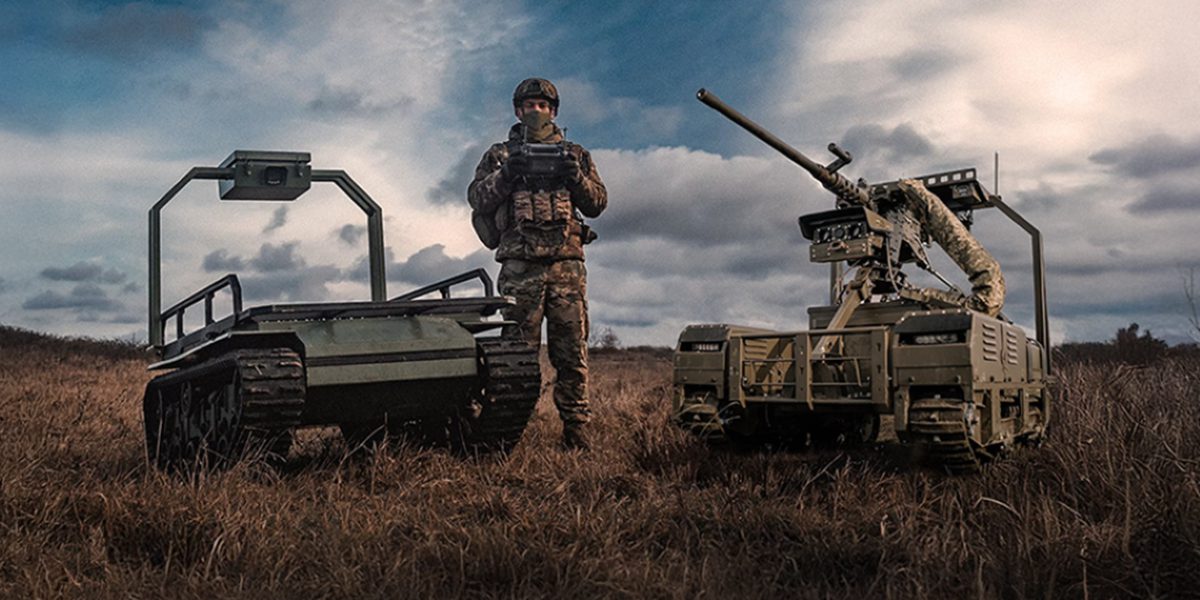
Along the eastern front, a strip of terrain exists where standing upright is a death sentence. Drones and artillery shred anything that moves. Ukrainian forces call it the kill zone. And increasingly, the things moving through it aren’t human. By June 2026, unmanned ground vehicles — tracked and wheeled robots ranging from supply haulers to armed combat platforms — had completed more than 50,000 missions, according to President Zelenskyy. Ukraine went from zero ground robotics companies in early 2022 to roughly 280 firms in four years — a mobilization rivaling even the pace of development seen in hypersonic missiles. This isn’t a gadget story. It’s a doctrine story.
From Garage Workshops to Robot Battalions
Ukraine’s industrial mobilization for ground robotics has outpaced every Western military program combined.
Ukraine contracted 25,000 ground robots for the first half of 2026 alone — more than double 2025 totals. Zelenskyy’s target sits at 50,000 UGVs produced this year. One manufacturer, Tencore, shipped over 2,000 robots in 2025 — more than the US fielded in its entire first Replicator phase, according to TechTimes. Tencore’s director Maksym Vasylchenko projects demand for roughly 40,000 units in 2026.
What These Robots Actually Do
- Logistics: carrying ammunition, food, water, mines, and bunker materials across terrain that would get a soldier killed
- Casualty evacuation: some medical units have evacuated wounded over distances up to 34 kilometers under live drone surveillance
- Engineering: demining, route clearance, and obstacle removal
- Fire support: roughly 10–15% of the fleet carries weapons — machine guns, flamethrowers, and self-detonating attack platforms
In December 2024, the Khartiia Corps reportedly conducted the first all-robot assault — armed ground robots backed by aerial drones overran a Russian position with zero infantry exposed. By April 2026, Zelenskyy announced UGVs and drones had captured a fortified Russian position entirely with unmanned platforms. No Ukrainian casualties. Russian soldiers have surrendered to machines, waving white flags and following robots back to Ukrainian lines — a scene that feels lifted from a Neill Blomkamp film but happened on actual soil.
“Ukraine’s robot army is best seen not as a replacement for infantry but as a mechanism to keep remaining infantry alive long enough to hold the line.” — analyst David Kirichenko, as cited by TechTimes
Still Not a Terminator
A single armed robot reportedly held a frontline position for 45 days — but commanders are clear that infantry isn’t obsolete.
That robot, a Droid TW 12.7 mounting a .50-caliber machine gun, reportedly repelled Russian assaults for six weeks while soldiers remained elsewhere. Russian forces apparently didn’t realize they were fighting a machine. But UGVs can’t climb stairs, clear buildings, or improvise under fire the way humans can. Most require dedicated operators and stable communications links. Each unit costs roughly $24,000 — about twice the price of a heavy-lift aerial drone. The broader implications of autonomous machines displacing human roles are already visible beyond the battlefield, as seen in the rise of the humanoid robot.
CNAS fellow Samuel Bendett, according to Forbes, notes that “Ukraine is leading with its BRAVE1 initiative and expanding production capabilities,” while Russia relies on fragmented volunteer efforts. Western militaries are studying the model closely. They remain far behind in combat hours, mission scale, and doctrinal integration. Ukraine’s battlefield doubles as its R&D lab — designs iterate in weeks, not procurement cycles — paralleling rapid innovation in fields like the robotic knee exoskeleton.
Every military on Earth is watching this footage. The question isn’t whether ground robots will reshape the next conflict. The question is who shows up having done the homework.