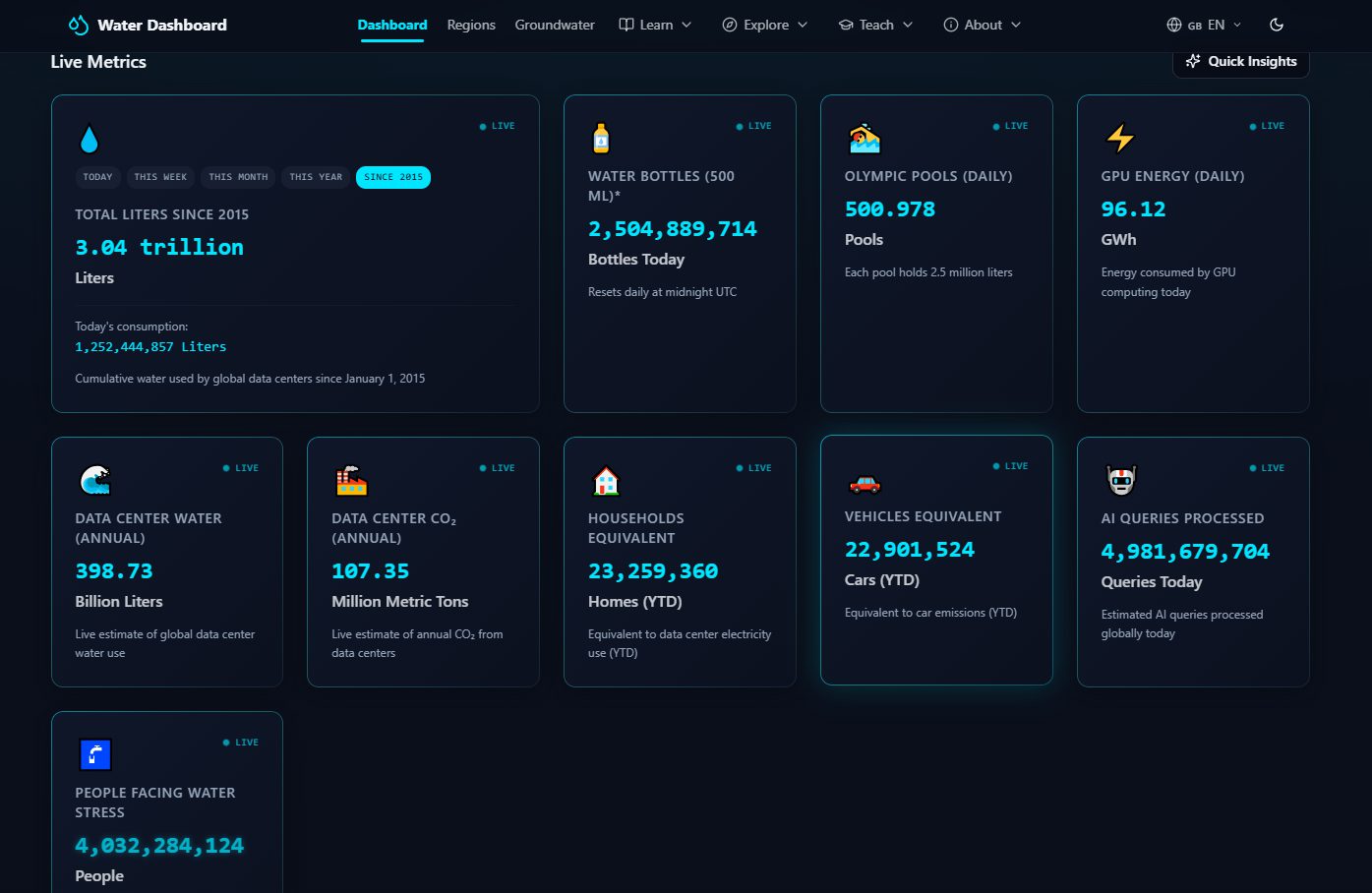
Every time you fire a prompt at ChatGPT — a recipe request, a code fix, a dumb question you’d never Google in public — roughly 5 milliliters of water reportedly evaporates cooling the servers that answer you. That estimate is contested by some researchers, but a new dashboard called watercost.live wants you to watch that number pile up regardless. The scale of AI infrastructure behind these queries is part of what makes the Stargate Project so significant from an environmental standpoint.
What the Dashboard Actually Shows
Running totals, per-query estimates, and analogies designed to make abstract gallons feel personal.
The site displays a live counter of estimated water consumption from AI queries, translating raw milliliters into comparisons you can actually picture — bottles, glasses, households’ daily use. A sibling project, aiwaterusage.com, runs the same concept and tracks water consumed since its own launch. Think of it like Spotify Wrapped for environmental guilt: suddenly a number you never thought about becomes impossible to ignore.
Here’s what the underlying data looks like at scale:
- US data centers consumed roughly 449 million gallons of water per day in 2021, according to the Environmental and Energy Study Institute.
- Hyperscale facilities can consume up to 5 million gallons daily — equivalent to the water use of 10,000 to 50,000 people.
- Phoenix-area data centers currently use about 385 million gallons per year. That figure could hit 3.7 billion as planned centers come online, according to Consumer Reports.
- A peer-reviewed estimate, as summarized by the Lincoln Institute, suggests one 20-query chat session uses approximately a bottle of freshwater.
The honesty matters here. This tracker runs on modeled estimates — a JavaScript counter multiplying a fixed per-query water factor by assumed usage volume. No live sensor readings from Amazon’s cooling towers. A Chrome extension doing similar work for ChatGPT says it plainly: these are estimations, not exact measurements. That transparency is a feature, not a flaw.
Real Number, Incomplete Picture
The 5ml figure is real. It is also incomplete.
Direct cooling accounts for roughly one-fifth of the real footprint; the rest is consumed at the power plants generating the electricity. Technical assessments put onsite use at about 0.48 liters per kilowatt-hour versus 4.52 liters offsite. Some engineers argue AI’s total water share remains modest compared to agriculture or golf courses — a fair point at the national level. Less comforting if you live in Phoenix, where planned data center expansion could push local consumption from 385 million gallons per year to 3.7 billion, according to Consumer Reports.
Public dashboards like this one function as pressure tools, not precision instruments. Carbon footprint labels on airline tickets followed a similar arc — imperfect numbers that shifted corporate behavior anyway, much as AI age laws reflect how policy pressure shapes corporate decisions. Water transparency for AI could travel the same path, one awkward estimate at a time. For those weighing the environmental trade-offs, exploring AI-powered websites worth the resource cost is a natural next step.