While billions watch Messi and Ronaldo battle across screens this summer, a quieter contest is unfolding inside a Shanghai expo hall. Humanoid robots are lining up penalty kicks against robotic goalkeepers—and the timing with the 2026 FIFA World Cup is anything but coincidental. Football has become the most visible stress test for embodied AI. Whether these demos represent genuine technical milestones or expensive marketing piggyback rides depends entirely on who you ask.
Robots at the Spot
The GSMA’s new penalties challenge forces humanoids to read, decide, and kick—without a human hand on the controls.
The GSMA’s Humanoid Robot Football Penalties Challenge runs June 24–26 at MWC Shanghai’s Shanghai New International Expo Centre. The rules are strict. Each robot must autonomously read ball position, track the goalkeeper’s movement, and execute the kick. No remote control. No pre-scripted sequences. Judges score:
- perception accuracy
- balance control
- motion planning
Awards include Top Scorer, Best Goalkeeper, and—this is the telling one—Best Goal Celebration. Expressiveness, apparently, now counts as a benchmark.
Booster Robotics’ T1 humanoid has already gone viral for all the right and wrong reasons. Lab footage shows it striking a ball hard enough to dent the wall behind the goal, according to the New York Post. That raw power sits within a broader Chinese push:
- 3v3 autonomous robot matches ran in mid-June 2026
- Beijing high schoolers competed in a tournament where student-written code controlled every player
- Booster-linked platforms have performed strongly in recent RoboCup adult categories
Unitree and KAIST round out the challenge lineup.
“One robot is demonstrating adaptability, the ability to pick up new physical skills from observation alone. The other is demonstrating reliability, the ability to perform under competitive conditions with no human fallback.” (A widely cited YouTube breakdown comparing the two headline demos)
Atlas Watches Film
Hyundai’s “School of Football” campaign turns imitation learning into something any sports fan can immediately understand.
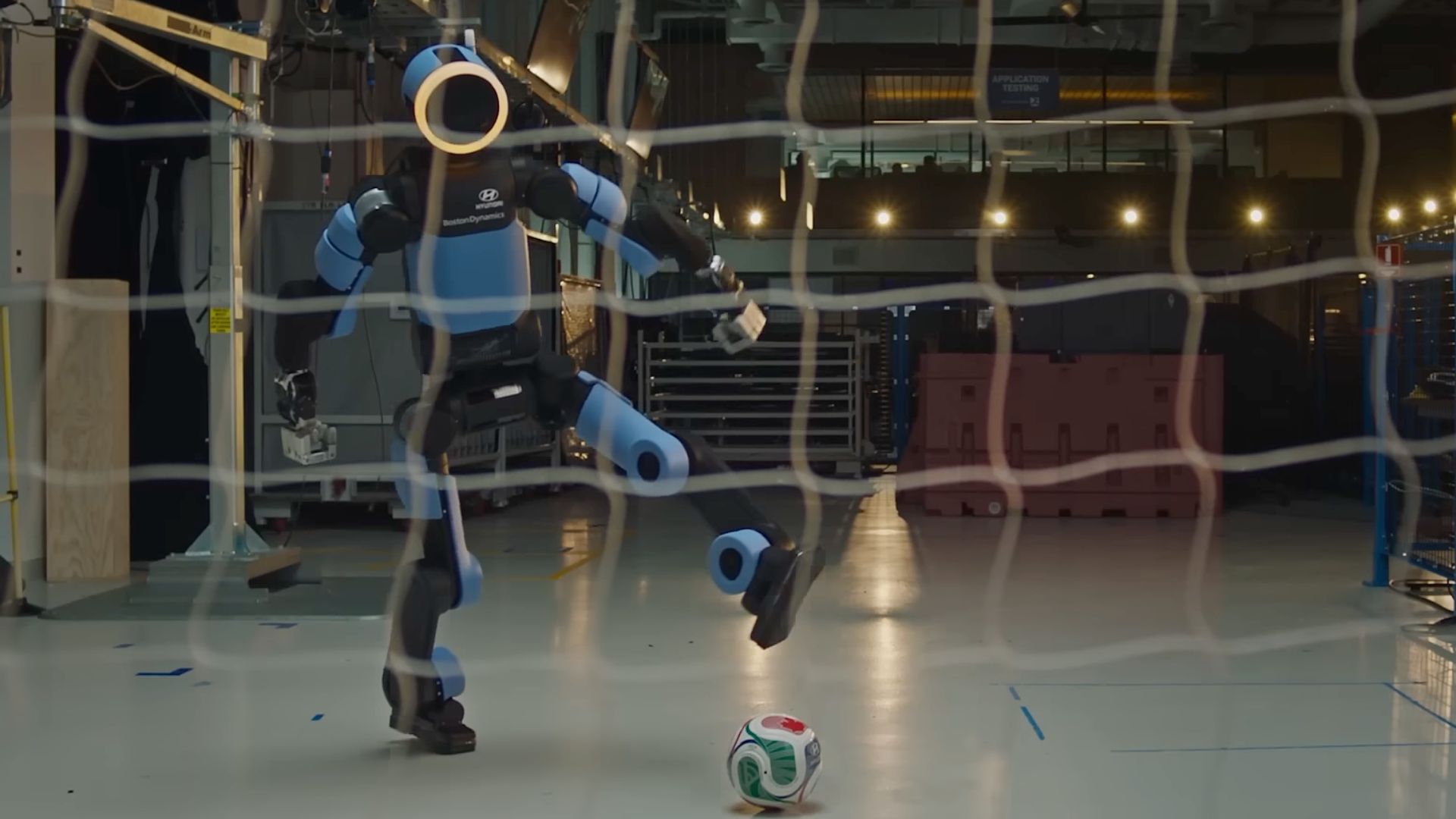
Standing before a screen playing real World Cup footage, Boston Dynamics’ Atlas does something eerily familiar: it studies tape. Hyundai’s campaign shows the humanoid watching how players plant feet and time swings, then replicating the moves—including a “ghost rabona,” that cross-leg kick most humans can’t pull off cleanly either. Atlas also mimics celebrations, raising arms and dropping to one knee. Imitation learning, dressed in a football kit.
The hype-versus-substance debate is legitimate. Penalty challenges are controlled environments. Factory floors and eldercare wards are not. Defenders of these demos argue the combination of high-speed perception, full-body coordination, and safety constraints in robot football transfers directly to industrial and service applications. The GSMA explicitly frames the event as proof that 5G/6G-era infrastructure can support low-latency robot control in dynamic, unscripted conditions. That claim is aimed squarely at telecom investors, not just football fans.
The Long Game
RoboCup’s once-laughable 2050 deadline—robots beating the human World Cup champions—is being taken seriously now.
RoboCup’s stated goal of fielding a robot team capable of beating human World Cup champions by 2050 once sounded like a punchline. Robotics forums now treat it as a serious research horizon. As Messi and Ronaldo dominate screens this summer, something else is watching, learning, and rehearsing its celebration. The real question isn’t whether robots will eventually get there. It’s whether anyone thought to check the workplace safety wall behind the goal first.