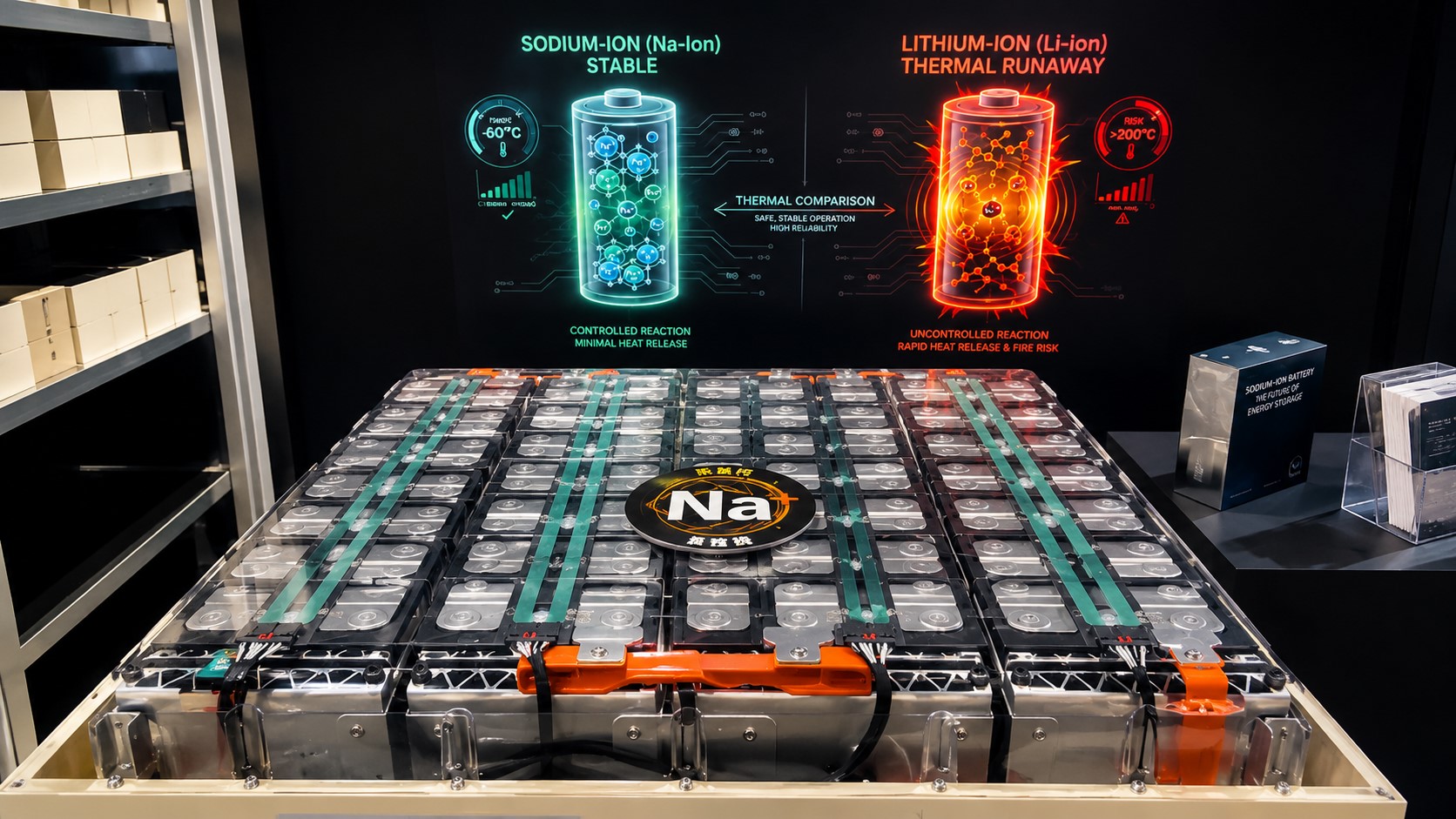
Every lithium-ion grid battery on the market arrives with an entourage: HVAC units, liquid cooling loops, fans whirring like a server room in July. That thermal management hardware adds cost, complexity, and failure points. Syntropic Power and UNIGRID are now betting that sodium chromium oxide (NaCrO₂) cells can skip the whole apparatus. Their partnership targets 1 GWh of North American deployments by 2027 — spanning residential, virtual power plants, and utility-scale applications. The chemistry reportedly absorbs heat during charging instead of generating it. If that holds at commercial scale, the implications for deployment economics are hard to ignore.
What the Test Numbers Actually Say
Independent lab results look strong, but company-announced data deserves healthy skepticism.
The ISO 17025-accredited Rochester Institute of Technology Battery Development Center tested UNIGRID’s 210Ah cells and reportedly found 97.9% round-trip energy efficiency at cell level, with more than 99% capacity retained after 1,000 full discharge cycles. Note the sourcing: Syntropic commissioned this testing, and results come from a company press release — not independently published peer review. The cells also displayed endothermic behavior during charging, meaning they absorb heat from the surrounding environment rather than releasing it. Think of it as your battery running a mild air conditioner instead of a space heater. That thermal property underpins the no-active-cooling claim.
- 210Ah NaCrO₂ cells tested at the RIT Battery Development Center (ISO 17025-accredited)
- 97.9% cell-level round-trip energy efficiency (reportedly)
- 99%+ capacity retention after 1,000 full discharge cycles (reportedly)
- Certified under UN 38.3 transport testing, UL 9540A cell-level testing, and IEC 62619 for commercial deployment
“UNIGRID’s NCO chemistry combines high round trip efficiency, high power capability, strong cycle life performance and distinctive thermal safety behavior, providing the foundation for a GridSpan platform designed to operate without active cooling,” said Matt Huber, CTO of Syntropic Power.
Independent analysts have noted that endothermic cathode behavior, while documented in lab settings, has yet to be validated at sustained commercial throughput — making the 2027 deployment target a meaningful stress test.
What’s Actually Being Built — and What’s Missing
Two products are headed to market, but sodium-ion still occupies a sliver of global battery production.
Syntropic’s first product, Tenet, is a wall-mounted system for residential, light-commercial, and virtual power plant use. GridSpan, its modular DC platform, scales from 20-minute to 20-hour discharge durations. Both use UNIGRID’s chromium-based NCO cathode, which the company distinguishes from competing sodium-ion chemistries — sodium nickel iron manganese oxide (NFM) and sodium iron pyrophosphate (NFPP) — prominently featured by Chinese manufacturers. The broader context is worth keeping in mind: sodium-ion remains a small fraction of global battery production compared with lithium-ion. Energy density still trails the incumbent chemistry. The technology carries genuine thermal advantages, but it is competing against an industry with massive manufacturing scale and years of cost reduction behind it.
The 2027 deployment target is where spec sheets meet reality. Whether NaCrO₂ cells maintain their thermal performance under sustained commercial conditions will determine if this partnership delivers meaningful infrastructure — or remains a promising data set waiting for its full-season order.