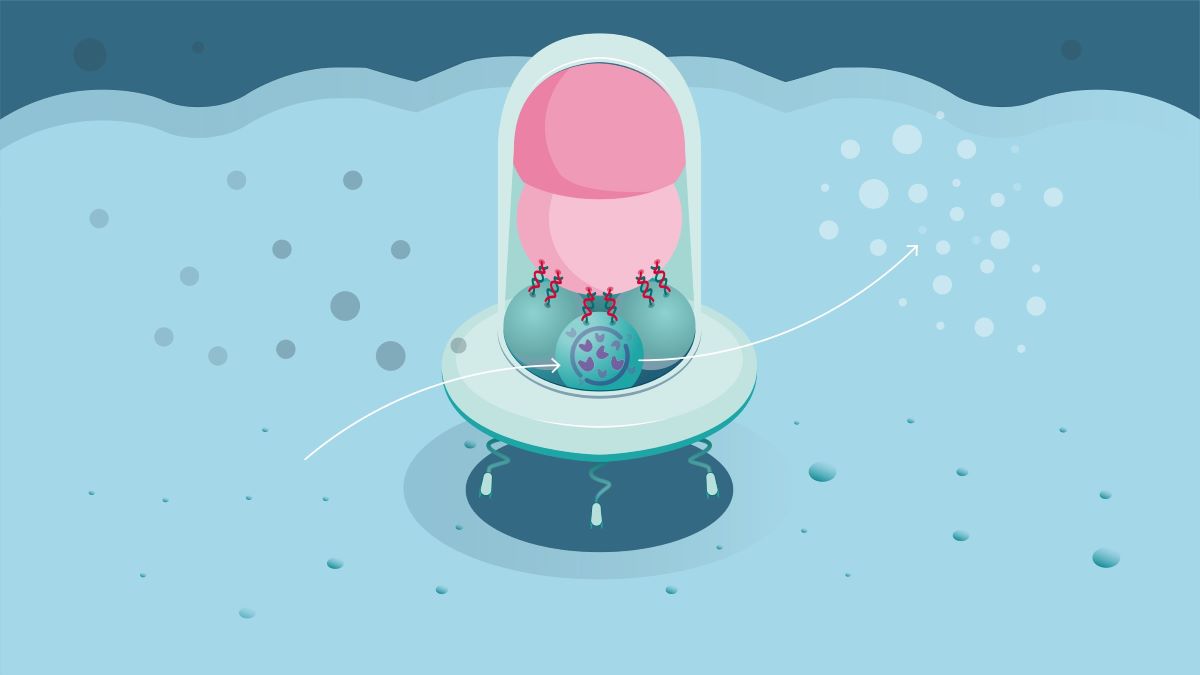
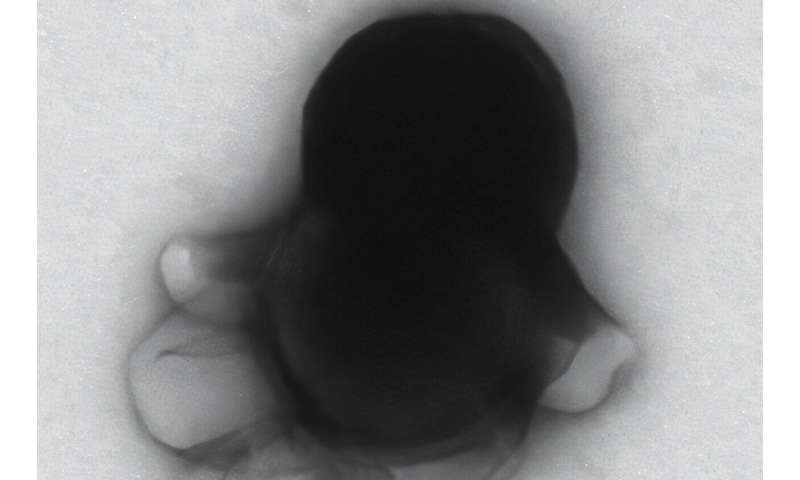
Sixteen percent. That’s what remained of HeLa cancer cell viability after 72 hours with a new nanorobot parked on their surface, synthesizing an anticancer drug on the spot. Not delivering a pre-loaded payload — manufacturing it right there, at the cancer cell surface. Published in Advanced Functional Materials in June 2026, researchers at the University of Basel built this system as two distinct, reusable modules: a magnetic propulsion unit and an enzyme-loaded payload capsule. Think of it as the nano equivalent of a modular PC build — swap the payload without replacing the entire machine.
The connection mechanism uses complementary DNA strands on each module’s surface. The researchers call it “molecular Velcro,” and the term is earned. The strands recognize each other, bind autonomously, and hold the assembly together until deliberately separated. Each payload capsule carries four polymer vesicles with tiny pores. Molecules from the surrounding environment diffuse in, get processed by encapsulated enzymes, and reaction products flow back out. The result is a catalytic reactor small enough to navigate to a specific cell.
When functionalized with docking molecules, the payload capsule latches onto cancer cell surfaces with engineered specificity. The enzymes then synthesize a drug in situ — concentrated exactly where the damage needs to happen. “The drug can have a concentrated local effect if the nanorobot is specifically targeted to cancer cells,” said first author Dr. Voichita Mihali of the University of Basel. That’s a sharp contrast to conventional chemotherapy’s systemic approach.
Reusable, Reconfigurable, and That’s the Real Story
The platform’s modularity separates it from every disposable nanocarrier that came before it.
Most nanomedicine constructs are single-use — deploy, degrade, done. This system breaks that pattern. The magnetic propulsion module lets researchers retrieve robots after a mission, disassemble the two units, refill the payload capsule with new enzymes or a different drug, and reassemble for a new task. “Previous nanorobots are often designed for a specific task only. Our modular system, on the other hand, can be adapted to different applications,” said Prof. Cornelia Palivan, who led the research. Beyond oncology, the team points to the following as near-term targets for the same platform:
- Industrial catalysis
- Environmental remediation, including water purification
One critical limitation demands emphasis: every result so far is in vitro. HeLa cells in culture, not tumors in a living body. The following remain entirely untested:
- Biocompatibility
- Immune response
- Navigating actual bloodflow
- Scalable manufacturing
- Regulatory approval
The researchers explicitly frame human application as a long-term goal requiring substantial safety validation. Compared to competing nanorobot platforms exploring tumor-targeting approaches, Basel leads on modularity and reusability but trails on in vivo evidence. This is a proof-of-concept, not a treatment.
Sci-fi has promised programmable nanobots for decades. This is the closest thing yet to a genuine platform architecture — not a device, but a reconfigurable system. The blueprint works. Now comes everything else.