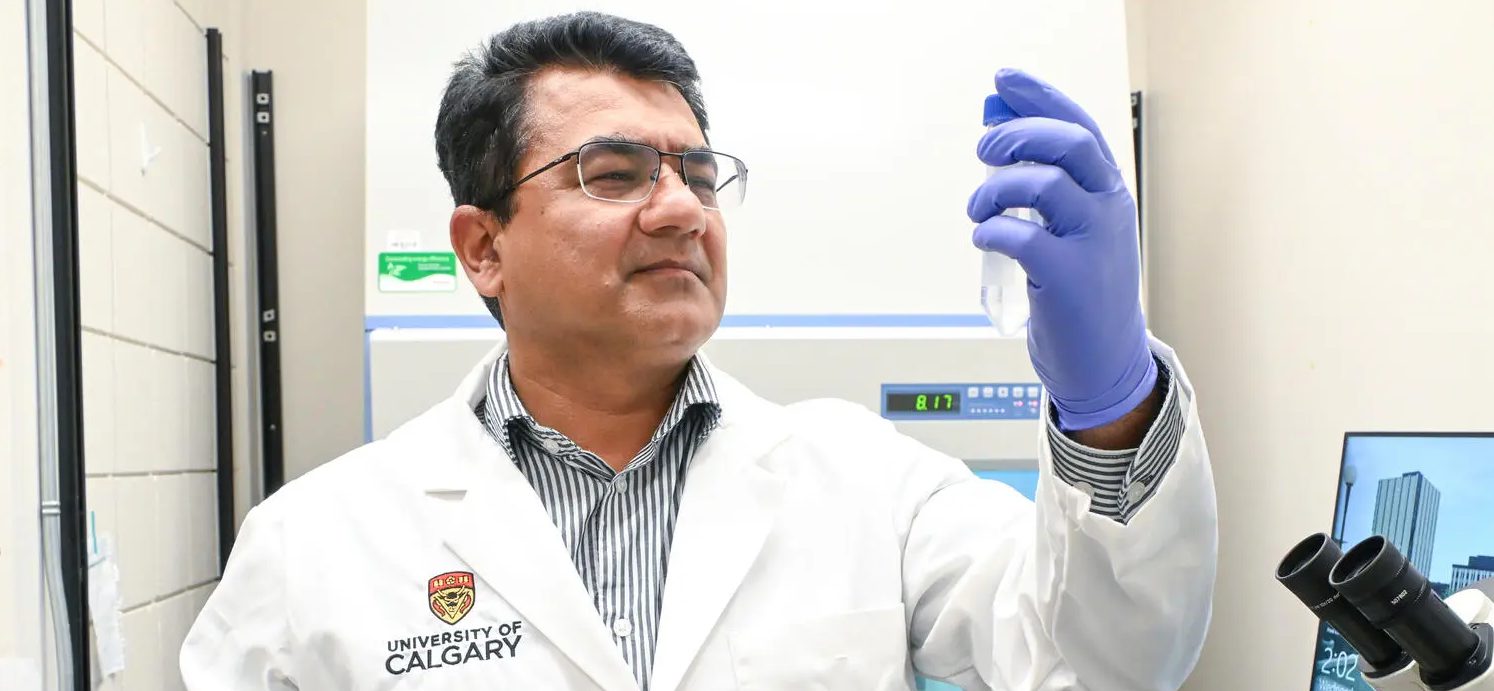
Immunotherapy works for roughly 15% of colon cancer patients. The other 85% get nothing. That’s not a rounding error — it’s a crisis. With an estimated 25,300 Canadians facing a colorectal cancer diagnosis this year, and incidence climbing sharply in people under 50, the urgency is real. A team at the University of Calgary led by Dr. Arshad Ayyaz has published research in Cell Reports Medicine identifying why most of these tumours dodge the immune system entirely. The fix, at least in mice: knock out one gene, and the cancer loses its ability to hide. Tumours didn’t just shrink. They were eradicated.
Why Immunotherapy Keeps Failing Colon Cancer Patients
Most colon tumours don’t overpower the immune system — they simply vanish from its radar.
Checkpoint inhibitors like Keytruda and Opdivo work by removing the brakes on your immune system so it can attack cancer. Straightforward enough. But most colon tumours play a different game. Ayyaz’s team discovered that resistant tumours contain a previously unrecognized cell type that secretes a specific protein — one that essentially tricks the immune system into believing nothing is wrong. The tumour wraps itself in a molecular invisibility cloak, and the immune system walks right past.
What the UCalgary team found:
- A distinct cancer cell type in resistant tumours produces the cloaking protein
- That protein traces back to a single gene
- Gene-editing techniques knocked that gene out completely
- Tumours became visible to the immune system
- Combined with immunotherapy: 100% tumour eradication in mouse models; even without drugs, tumours shrank on their own
The result wasn’t subtle. Think less “finding a new weapon” and more pulling the stealth coating off a fighter jet — the radar was working the whole time.
“I couldn’t believe it at first… By just knocking out one gene, the results are black and white.” — Dr. Arshad Ayyaz, University of Calgary
Promising in Mice. The Hard Part Is Still Ahead.
A striking preclinical result is only the first step on a long road to human treatment.
A 100% eradication rate in mice sounds extraordinary. But mice aren’t humans, and the distance between a preclinical knockout and a bedside treatment remains vast. Safe delivery systems need development. Specificity must be proven — disabling the cloak in cancer cells without triggering immune chaos in healthy tissue. Then comes the full gauntlet of phase I through III trials.
“It is very fundamental research that is still quite some distance away from clinical settings.” — Dr. Arshad Ayyaz, University of Calgary
The broader signal matters, though. Ayyaz suspects a similar cloaking mechanism operates in pancreatic and lung cancers — tumours where immunotherapy also largely fails. Across the CRISPR-era research landscape, the paradigm is shifting: less “build a stronger army,” more “strip away the enemy’s camouflage.”
For younger patients diagnosed at advanced stages — often after the cancer has already spread — current options remain brutally limited. This discovery doesn’t change that today. But it names the problem with uncommon precision, and in cancer research, that’s where every solution starts.