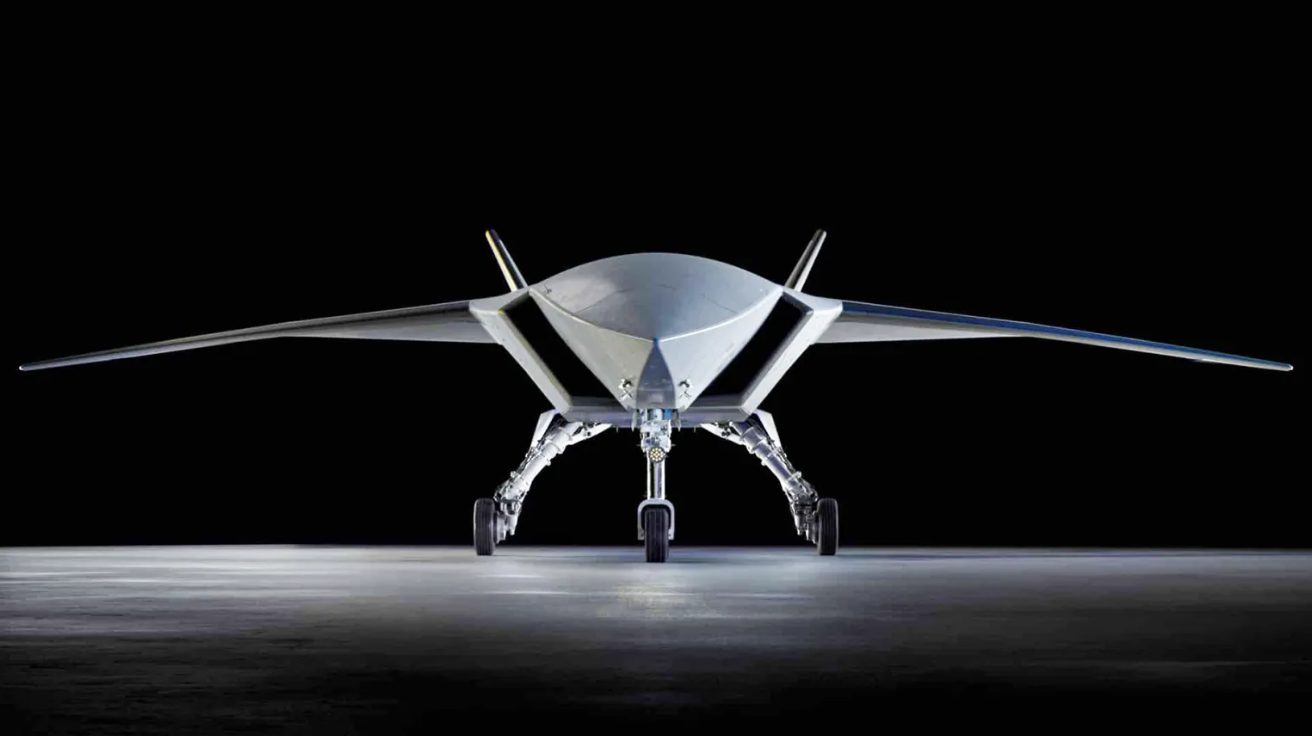
Boeing just solved collaborative combat aircraft’s biggest contradiction. The MQ-28 Ghost Bat Block 3 can now carry AIM-120 AMRAAMs internally while preserving its stealth profile—making it the first CCA designed to blend meaningful air-to-air punch with radar-evading survivability. Unveiled at ILA Berlin through a partnership with Germany’s Rheinmetall, this configuration transforms Ghost Bat from an expensive tech demonstrator into a legitimate force multiplier for allied air forces.
Block 3 Transforms Ghost Bat Into Combat-Ready Platform
Larger wings, more thrust, and internal weapons bays create the first operationally viable stealth CCA.
The Block 3 upgrade represents Ghost Bat’s evolution from prototype to production standard. Boeing increased the wing size by 25% and boosted engine thrust from 10,000 to 12,000 pounds, pushing maximum takeoff weight to 12,000 pounds with a 4,500-pound useful load.
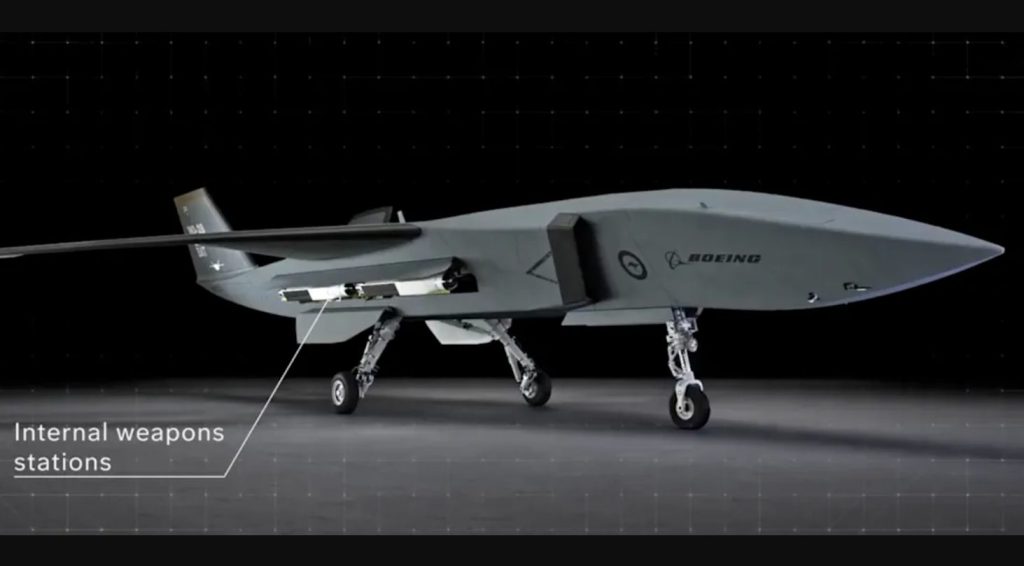
The real breakthrough comes from paired internal weapons bays built into the fuselage sides. Each bay accommodates one AIM-120 AMRAAM or two Small Diameter Bombs, delivering up to two long-range air-to-air missiles or four precision strike weapons without compromising the aircraft’s low-observable characteristics.
Beyond-line-of-sight communications via satellite links enable Ghost Bat to operate independently at its full 2,000+ nautical mile range. Meanwhile, modular 1.5-cubic-meter nose sections allow rapid mission reconfiguration between air-to-air, strike, ISR, and electronic warfare roles.
From Test Shots to Operational Reality
Live AMRAAM firings and accelerated timelines push Ghost Bat toward 2028 service entry.
Ghost Bat isn’t just PowerPoint engineering anymore. December 2025’s “Trial Kareela” saw an MQ-28A successfully engage an aerial target with a live AIM-120—though that missile flew from an external pylon.
The Block 3’s internal carriage capability builds on 150+ test sorties and over 20,000 hours of digital validation, creating the foundation for Royal Australian Air Force operational service by 2028.
Boeing expects Ghost Bat to become the world’s first operational CCA, beating European competitors like Airbus’s U760 Ravenstorm and Helsing’s CA-1 Europa variants to actual deployment. The Rheinmetall partnership positions Boeing for German procurement decisions, with potential Luftwaffe deliveries by 2029 if negotiations advance as planned.
This timeline advantage matters in a crowded field where most competitors remain at the mockup stage while Ghost Bat demonstrates actual weapons employment and autonomous teaming with E-7A Wedgetails and F/A-18F Super Hornets.
Strategic Implications for Allied Air Power
Internal AMRAAM carriage enables new escort and force protection concepts without sacrificing stealth.
Ghost Bat’s internal weapons capability solves a fundamental CCA dilemma: how to provide meaningful combat contribution while maintaining survivability advantages. External missile pylons turn stealth aircraft into conventional targets, but internal carriage preserves the low radar cross-section that Boeing validated through extensive RCS testing.
This capability enables Ghost Bat to escort high-value assets like AWACS and tankers, absorbing risk while extending defensive perimeters around critical enablers. Combined with BLOS control and multi-aircraft coordination, Ghost Bat represents the maturation of loyal wingman concepts from experimental curiosity to operational necessity—assuming Boeing can deliver on its ambitious production timeline.