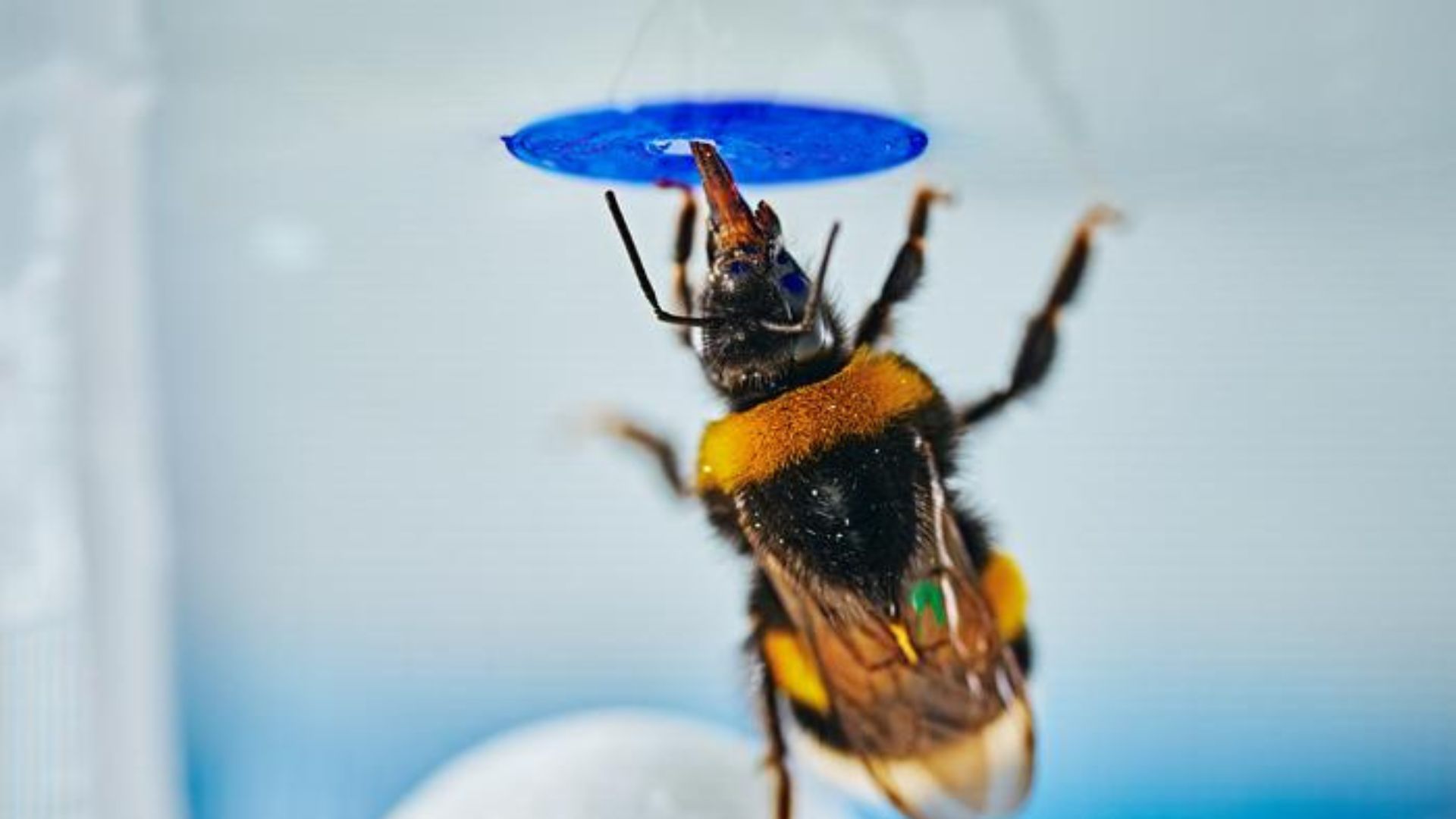
Your assumptions about smart problem-solving just got buzzed. Bumble bees—with brains smaller than a sesame seed—spontaneously figured out how to roll balls under suspended flowers to reach food rewards. No training on the solution. No step-by-step guidance. Just pure, goal-directed innovation that mirrors the famous “box-and-banana” puzzles that made chimpanzees legendary in psychology textbooks.
When Insects Channel Their Inner Köhler
Finnish researchers recreated century-old primate intelligence tests with buzzing subjects.
Picture this: a bee realizes an out-of-reach flower might become reachable if she repositions a nearby ball underneath it. Then she actually does it. Finnish researchers demonstrated this in controlled experiments where bees learned separately that blue flowers contained rewards and that balls were movable objects—but were never taught to combine these facts.
When researchers suspended the flowers from arena ceilings, many bees spontaneously started rolling balls into position and climbing aboard. Lead author Akshaye Bhambore calls the behavior “goal-directed,” emphasizing that successful bees shifted from random wandering to efficient, purposeful movement patterns.
This isn’t your typical “cute animal video” material—it’s the insect equivalent of Wolfgang Köhler’s groundbreaking 1920s chimpanzee studies that first demonstrated insight learning in non-human animals.
The Hidden-Flower Test Separates Real Insight From Lucky Accidents
Rigorous controls proved bees weren’t just attracted to visible targets.
Here’s where the study gets methodologically ruthless. Researchers hid the goal flower during ball-movement phases, eliminating the possibility that bees were simply rolling toward something they could see. Even when the reward was invisible, successful bees navigated balls to the correct target location and climbed on—suggesting they maintained a mental map of where the flower would reappear.
This kind of spatial reasoning challenges assumptions about insect cognition. Previous bee studies often required extensive training or demonstrations. These subjects figured it out from scratch, combining two learned elements into a novel behavioral sequence that had never existed in their experience.
What This Means for Your Robot Future
Small, efficient brains might outperform massive neural networks in unexpected ways.
Before you start anthropomorphizing your garden visitors, senior author Olli Loukola is quick to clarify: we’re “not claiming that bees think like humans.” But the implications for artificial intelligence and robotics are genuinely intriguing.
While tech companies pour billions into ever-larger language models, these tiny insects demonstrate that sophisticated problem-solving can emerge from remarkably compact, specialized neural architectures. The findings add ammunition to debates about neuromorphic computing—brain-inspired systems that prioritize efficiency over raw power.
If a bee can spontaneously solve tool-use puzzles with a brain containing fewer neurons than pixels in this article, maybe our obsession with scaling up isn’t the only path to intelligence. Evolution apparently discovered that flexible thinking doesn’t require massive neural real estate. That’s a lesson worth remembering as we design the next generation of thinking machines.