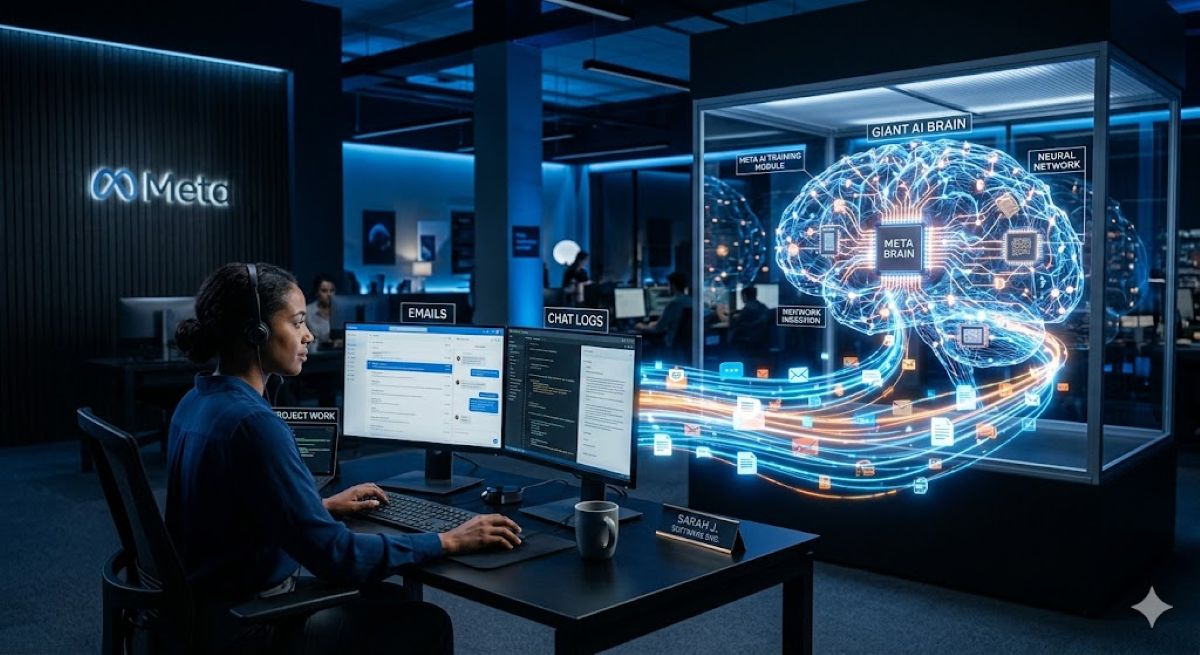
Your company’s monitoring software probably tracks basic productivity metrics. Meta’s goes further—capturing email contents, browsing history, and clipboard data from U.S. employees to train AI agents that can eventually replace human workflows.
The Model Capability Initiative (MCI) represents a new frontier in workplace data collection, according to Reuters reporting on internal company materials. While Meta frames this as capturing “behavioral data” about how people interact with computers, the actual scope extends far beyond mouse clicks and keystrokes.
What Meta’s System Actually Captures
The tool monitors employee communications and digital behavior across more than 200 applications.
MCI pulls data from over 200 apps and websites, including the contents of emails and direct messages sent to U.S. employees—even when the sender lives outside America. Internal analyses show the system also accesses:
- Code changes
- Browser URLs
- Clipboard content
- Device sleep cycles
Some of this information gets stored with weaker security protections than Meta’s public claims suggest. Meta spokesperson Dave Arnold maintains the tool focuses on “how people interact with computers rather than the content on screens.” That distinction becomes murky when email contents and clipboard data enter the mix.
Privacy Lines Get Blurry
The difference between behavioral tracking and surveillance depends on what you’re actually capturing.
Meta told employees their data would be “dissociated” from identifying information. Privacy advocates aren’t buying it. When systems capture message contents and workplace communications—especially international ones involving U.S. employees—the line between anonymous behavioral data and personal surveillance app dissolves.
This matters beyond Meta’s Menlo Park offices. Every major tech company faces pressure to train AI agents using real human workflows. Your employer’s next productivity tool might follow Meta’s playbook.
The Bigger AI Training Game
Meta wants AI agents that can replicate human workflows and perform multi-step office tasks autonomously.
The strategic goal makes sense: train AI systems on actual employee behavior to build agents capable of automating routine computer tasks. It’s like having a digital intern who learned by watching over your shoulder for months—except the intern never forgets and works 24/7.
The workplace monitoring landscape just shifted. What employees consider normal telemetry versus invasive surveillance may need recalibrating as AI training becomes the new justification for data collection.