That E Ink key fob tells you everything about Ferrari’s electric gamble. Slip it into your pocket, and it glows Ferrari yellow—dock it magnetically to start the Luce, and suddenly you’re not just pressing a button, you’re performing a ritual. After five years of collaboration between Jony Ive’s LoveFrom and Ferrari’s design team, the supercar maker’s first EV interior finally answers a question nobody knew they were asking: what happens when Apple’s design DNA gets Italian blood?
Physical Meets Digital in Luxury Electric Design
Ferrari’s tactile approach counters the touchscreen-everything trend plaguing modern EVs.
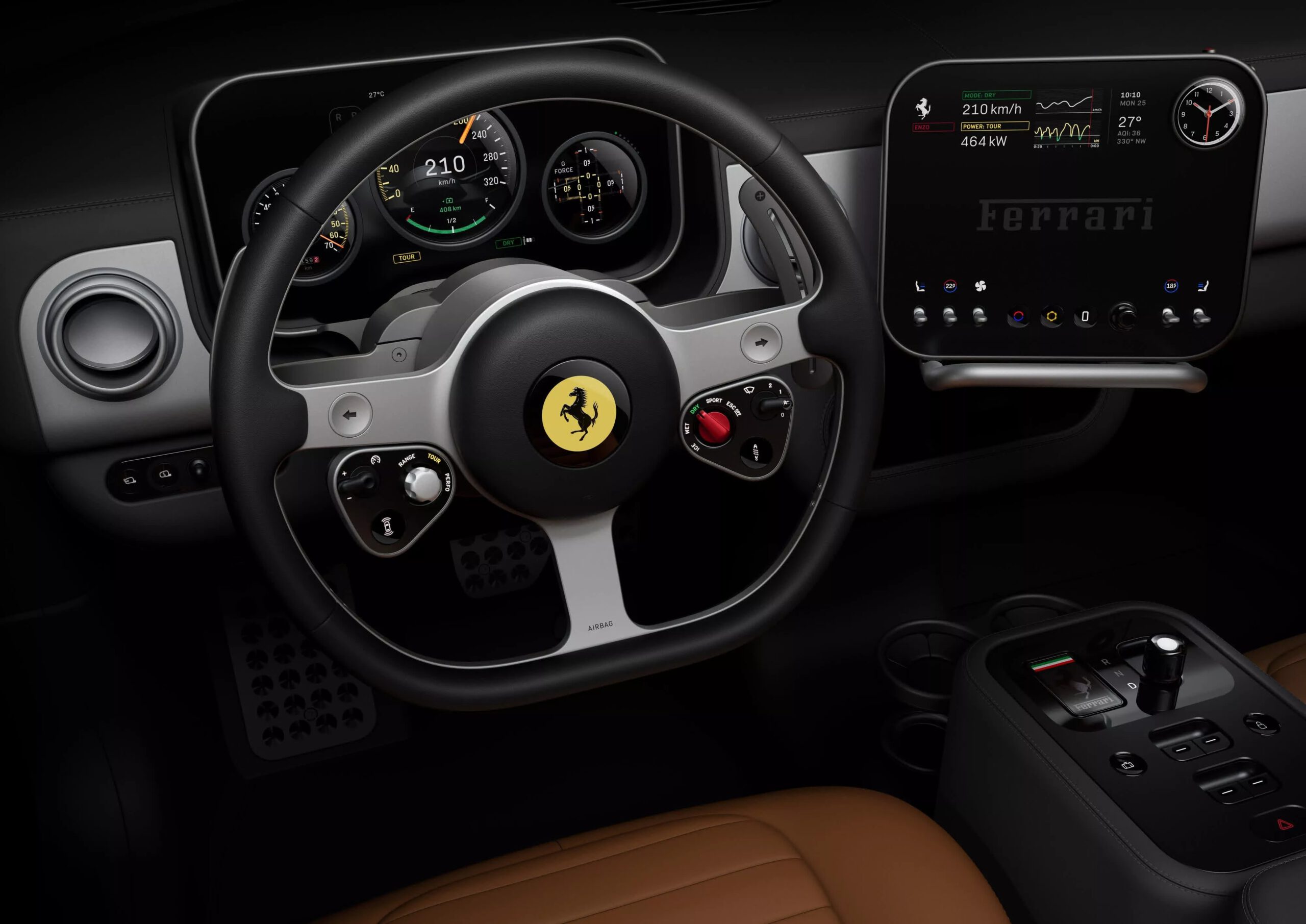
The Luce’s dashboard reads like Ives’s greatest hits album, but with actual substance behind the aesthetics. That central OLED touchscreen pivots between driver and passenger—already clever—but the physical toggle switches below handle climate and media controls. No hunting through submenus while you’re threading mountain curves.
The instrument cluster layers multiple OLED screens behind anodized aluminum rings with parabolic glass lenses, creating a 3D parallax effect that makes Tesla’s flat displays look like budget smartphones. You get the digital precision your iPhone trained you to expect, wrapped in the kind of mechanical craftsmanship that reminds you this thing costs as much as a house.
Mechanical Soul in Electric Packaging
Real speedometer needles and steering wheel dials preserve the analog Ferrari experience.
Here’s where Ive’s automotive vision diverges from his Apple minimalism: the Luce keeps mechanical elements that actually matter to driving. Physical dials on the steering wheel manage:
- Cruise control
- Wipers
- Suspension settings
- Power delivery
Torque gets controlled by paddles—because this is still a Ferrari, not a golf cart.
Even with all the digital wizardry, you’ll find an honest-to-God mechanical speedometer needle. “An electric Ferrari,” Ferrari’s Gianmaria Fulgenzi called it, prioritizing supercar essence over EV purity. The approach feels like what would happen if your iPhone could actually rev to 8,000 RPM.
Apple’s Ghost Car Finally Takes Shape
Ive’s Ferrari collaboration realizes the automotive vision that Apple abandoned.
The timing feels intentional. Apple killed Project Titan in February 2024 after burning through a billion dollars and a decade of development hell. Meanwhile, I’ve spent those same years quietly crafting what might be the most thoughtful EV interior ever conceived.
The Luce arrives in May 2026 as proof that sometimes the best Apple car isn’t an Apple car at all—it’s what happens when Cupertino’s design philosophy gets filtered through Maranello’s racing heritage. Your next supercar might just remember how buttons are supposed to feel.