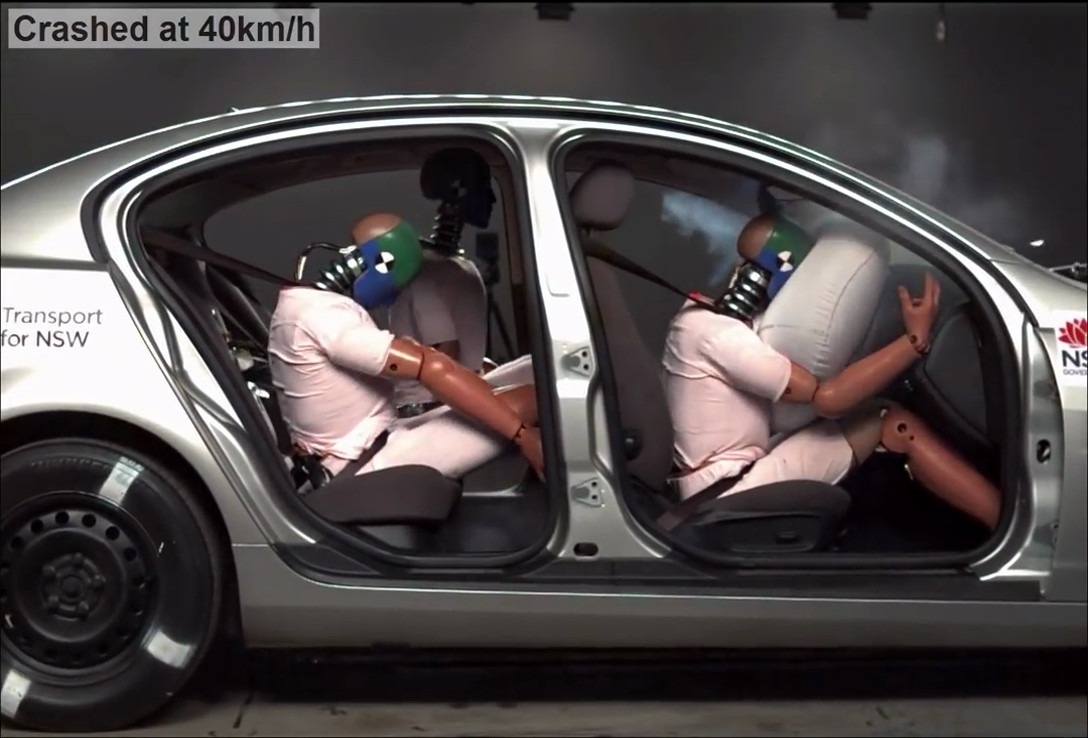
Racing through an intersection when another car runs the red light, you brace for impact—trusting your airbag to deploy instantly. But here’s what you don’t know: your airbag isn’t the reliable mechanical safeguard you think it is. It’s actually a sophisticated computer making life-or-death decisions in 50 milliseconds, and that software can fail catastrophically.
Modern vehicles use Airbag Control Modules (ACUs) that process inputs from multiple crash sensors, occupant detectors, and accelerometers. Like your phone’s GPS getting confused in a complex highway interchange, these sensor fusion systems can misinterpret crash data—especially during offset collisions or multi-point impacts where signals become ambiguous. When these computer problems occur in safety-critical systems, the consequences can be life-threatening.
The Millisecond Decision Engine
Your airbag computer processes crash data faster than you can blink.
Your ACU fuses data from front impact sensors, side sensors, weight detectors, and internal accelerometers to determine which airbags should fire. In edge-case crashes—like the offset geometry that already challenges some sensors—flawed algorithms can classify impact direction incorrectly.
Robson Forensic experts documented cases where ACMs relied exclusively on frontal sensors and “did not detect the impact” during offset crashes, leading to complete non-deployment. Research prototypes demonstrate how different sensor combinations can flip deployment decisions entirely, raising the specter of wrong-side airbag firing when software misreads crash direction.
Hackers Can Turn Off Your Airbags
Security researchers found multiple ways to disable or manipulate airbag systems.
Cybersecurity experts have repeatedly compromised airbag ECUs through diagnostic pathways. Researchers demonstrated disabling airbags via malware that infected workshop diagnostic software, tricking the system into showing airbags as functional while actually switching them off.
CVE-2017-14937 documents vulnerabilities affecting airbag control units in 2014-onward vehicles. Cydrill security analysts found that weak authentication in airbag diagnostic services makes detonation “comparatively easy” once attackers access the vehicle’s diagnostic network. Kaspersky ICS-CERT warns that compromised ECUs can “create dangerous road situations”—including unintended airbag behavior.
The Quiet Update Problem
Critical safety fixes often skip the recall process, leaving vulnerable cars on the road.
Here’s the kicker: many ACU firmware fixes get classified as “service campaigns” rather than formal recalls. This means you might never receive notification about critical safety updates. Unlike the high-profile Takata recalls, software bugs often fly under the radar—distributed only when vehicles visit dealers for routine service.
Your car could be running defective airbag code for years. Some manufacturers treat firmware updates as technical service bulletins, not mandatory safety recalls, creating a two-tier system where aware consumers get fixes while others remain vulnerable. For those comfortable with car fixes, understanding when to tackle repairs yourself versus when professional service is essential becomes crucial.
The solution starts with you: regularly check manufacturer websites for outstanding campaigns using your VIN. As vehicles become increasingly software-defined, we need transparent policies that treat safety-critical firmware bugs as the recalls they should be—not quiet service visits that many drivers never receive. Recent cases like Tesla investigations highlight the growing importance of accountability in automotive software systems.