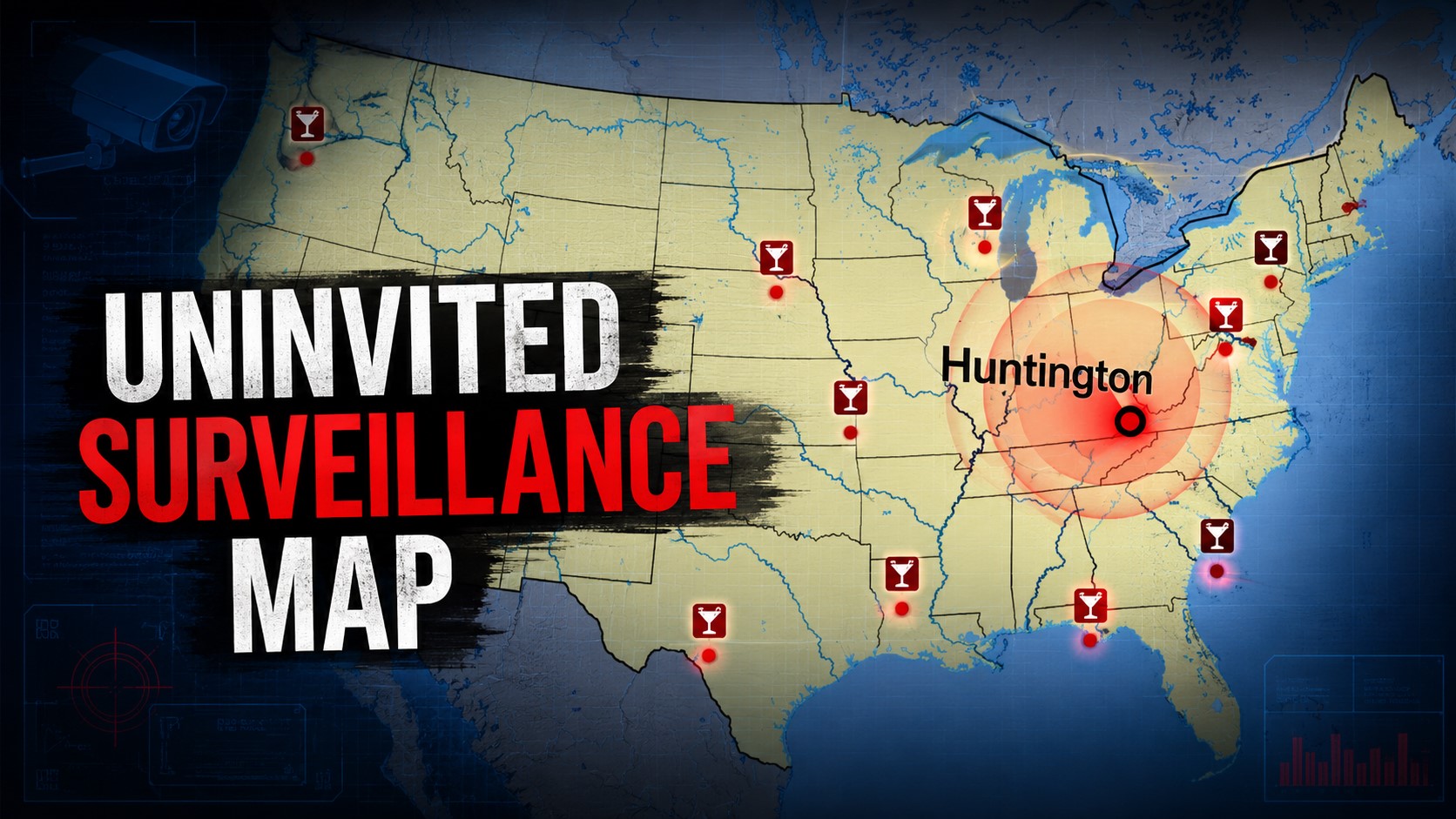
Learning that a government surveillance app is pointed at a bar’s front door is alarming enough. Learning the city used the business name — not a street address — as the targeting reference on an official deployment map is a different kind of gut punch entirely. Alejandro Vence, owner of Boots, and Jason “Harley” Farley, who runs Sharkeys, discovered exactly that after WSAZ obtained city documents showing four downtown bars explicitly named as camera focal points. Neither owner was notified beforehand, according to WSAZ.
What Huntington Just Bought – and Where It’s Pointed
The city’s new Flock Safety contract arms Huntington Police with AI surveillance tools aimed well beyond intersections — straight at specific bar entrances.
Huntington City Council approved a five-year Flock Safety contract in mid-July 2026 despite hours of public opposition, according to WV MetroNews. Here’s what the city is deploying:
- 40-plus automated license plate readers and 17 surveillance cameras
- Two drones and two gunshot detectors
- AI analytics that capture plates, vehicle make, model, and color, then cross-reference local crime databases and the FBI’s NCIC system
- Four businesses named by name on camera-placement maps: Bar None, Sharkeys, LaFontaine’s, and Boots
- Nationally, Flock captures over a billion vehicle images per month, feeding a centralized cloud database that has drawn scrutiny from those tracking secretly tracking users, according to ACLU research
Farley told WSAZ the placement feels like the city is “sabotaging” his business. He said he’d personally skip any bar with a government camera parked outside — and figures his customers will too.
“Really bad business.” — Alejandro Vence, owner of Boots, on being named by business name rather than street address on an official city surveillance map, according to WSAZ
Both owners already operate extensive private security systems and cooperate with Huntington Police on request, meaning the Flock cameras fill no obvious security gap — they simply add a government surveillance layer nobody requested. Vence, who has spent 20 years in Huntington’s bar scene without “a major issue,” sees the name-based targeting as stigmatizing in its own right.
Legal experts told WOWK the cameras are constitutional on public streets — the Fourth Amendment doesn’t shield anyone from observation in public spaces. But constitutional and wise aren’t synonyms. Nearby Putnam County is already reevaluating its own Flock partnership after public concerns, according to WCHS. The ACLU has described Flock’s national network as an “unprecedented surveillance machine,” and that description lands differently when your bar’s name is printed on the deployment map.
The Question Nobody Has Answered
City documents are silent on why these specific doorways were chosen over neutral intersections or parking lots.
That silence is the core problem. Bar None and LaFontaine’s owners declined to comment — but their names remain on that map regardless. Like getting tagged in someone else’s messy post without warning, appearing on a surveillance deployment document becomes part of a venue’s public identity whether the owner consents or not.
The contract is signed. The cameras are legal. What’s missing is any public justification for why these bars, these doors, this level of specificity — and whether downtown Huntington’s nightlife absorbs the cost of a policy question nobody bothered to answer out loud.